


Among the Mesopotamia tablets, there is a whole category dedicated to medicine: lists of plants and their uses, diagnostics, forecasts, healing rituals. And within those, there is a specific group dedicated to female health problems. What is striking is that when mesopotamic medical texts speak of diseases in general, they use the generic term for "man." The specific word for "woman" appears almost exclusively when the text speaks of reproduction: conception, pregnancy, childbirth, postpartum.
It was the particular territory of the female body, as the medical knowledge of that time understood it.
Parir was dangerous. —And they knew it. The mesopotamic texts speak of the risk of childbirth with a frankness that is shocking. Some physiognomic series interpret certain physical features of women as signs of their death during pregnancy or childbirth, the diagnostic and prognostic treaties come to calculate whether the child will live or die.
And then there are the literary and ritual texts, which say what the medical manuals do not explain: they describe delivery with combat images.
An average Assyrian registration —an enchantment to help a woman in a difficult birth— describes the scene like this (translation from M. E. Couto-Ferreira, following W. G. Lambert):
"The mother in labor is surrounded by the dust of death;
like a car, it is surrounded by the dusts of battle;
like a plow, it is surrounded by the dust of the forest;
like a warrior in combat, fighting in his own blood.
Weakened, his eyes do not see; his lips are covered;
does not open them: the fate of death and the fate of silence [around it]. "
There is also a composition called "Elegía in memory of a woman" which laments the death of a woman during childbirth. It is compared with a ship thrown in the middle of the river, with broken notebooks and cut ropes, moving towards the "river of the inner city." That image —the ship loaded with goods that try to reach the pier of life— It was a classic trope of labor enchantments, where the mother (or fetus) appears as a ship carrying a precious cargo to the port. Using it in an election turns death into a journey that never reached its destination. Those words are almost three thousand years old. And yet they communicate.
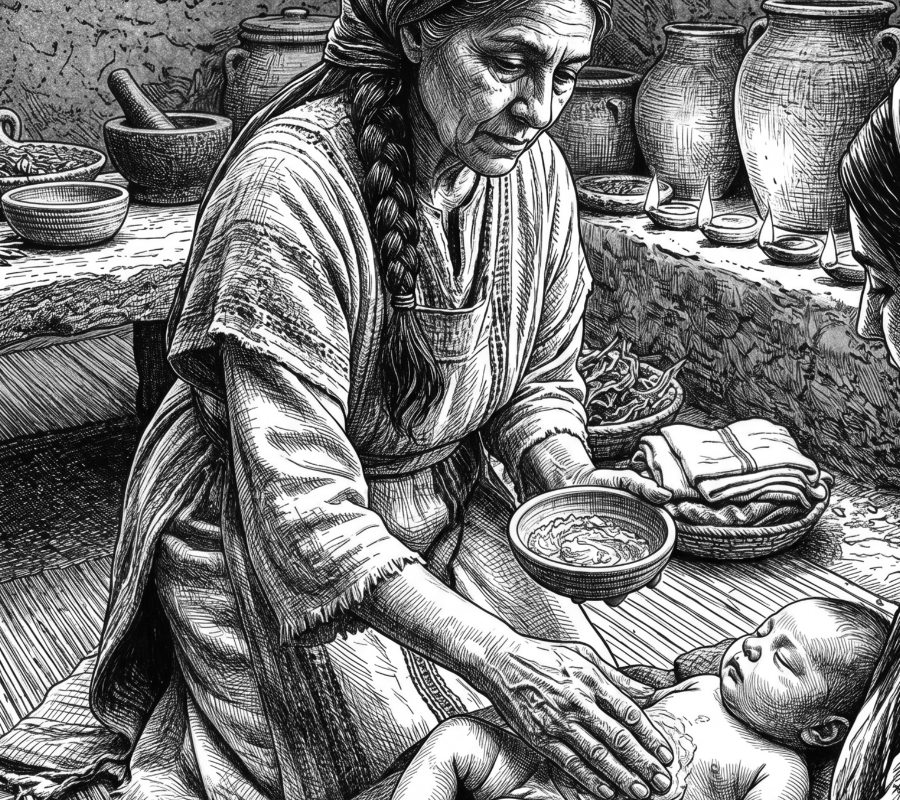
The delivery was a collective matter, attended to by several people with different roles. The central figure was the midwife (šabsūtu), whose name in some texts is translated as "the one who knows the interior." She was the practical specialist of childbirth: she was present, held the woman, received the baby. BAM 248 itself mentions it: "that the midwife is not delayed, that the pregnant woman is going well." It is also mentioned in economic texts. —as a land owner, as a witness to contracts— which confirms that he was a socially recognized figure. His knowledge, however, was oral and body, transmitted from person to person. The clay tablets don't capture him directly.
The āšipu was the specialist of ritual and enchantment, a figure that combined what we would today call exorcist, priest and therapist. He was especially involved when the birth was complicated, reciting formulas and administering remedies loaded with ritual meaning.
The asù was the most pharmacological-oriented healer: he prepared plants, potions, ointment.
In practice, these categories overlap. A single recipe could combine ground plants, oil and a formula to invoke the goddess Gula —without the scribe feeling the need to separate the "medical" from the "ritual." In Mesopotamia, this separation did not exist as a category.
The birth enchantments in BAM 248 —and in the oldest texts before it— They work with a system of images that is repeated, developed and combined. Understanding that system is understanding how mesopotamics conceptualized childbirth.
The fetus as prisoner. The older texts already present the fetus within the mother's body as something trapped, knotted, chained, locked behind a lock that does not give in. The act of birth is therefore expressed as the act of untying, loosening, breaking the stamps. An enchantment of the ancient Babylonian period says: "Let the chains be loose; let the way be broken for him; let the way be opened for him."
The boat trip. A ship loaded with precious goods, with the candles deployed, is moving towards the "pier of life." That image could represent the fetus moving through the delivery channel. —still in its liquid element— towards birth, or to the mother herself as a vessel leading to her cargo to the destination.
Sîn's cow. This is perhaps the most fascinating. The moon god Sîn falls in love with a cow, the ride and she gets pregnant. When the delivery comes, the cow suffers. Sîn then sends two protective spirits carrying "water from labor" and oil from a bowl. The cow stops a calf. The enchantment concludes: just as the cow of Sîn was born, so does the woman in difficulty. This formula —call historiola, a mythical story that works as a precedent for the present— He was in Mesopotamia, Ugarit and Anatolia from the second millennium.
The most revealing thing is how these mythical images materialize in ritual procedures. In one of BAM 248's prescriptions, the enchantment speaks of a "drop of rain," "someone who falls from a wall" and "a dripping pipe." Immediately after that, the procedure orders the exact use of these elements in material form: a "rain stone" (literally, "drop from the sky"), the powder of the lining of a collapsed wall and the dust of a pipe with drips, all mixed with oil and rubbed on the woman's belly, from top to bottom. Symbol and substance form a single system: the images of the spell become ingredients of the treatment.
Potions: plants, animals and unexpected things. The fourth column of BAM 248 is the most similar to what we would now recognize as a medical recipe: ingredients, preparation, mode of use.
The plants are few but appear in multiple combinations. The "dog tongue“ (lišān kalbi) and the "fox vine" (karān šēlebi) —names that already say something about what the mesopotamans called their plants— they are combined alone or with others in potions that the woman should drink in fasting, ground in old beer. These same plants are classified in Babylonian herbalists as specific medicines for difficult delivery.
The plant maštakal is mixed with barley flour toast in oil and beer. It appears in other texts in remedies against witchcraft —a relevant data, because in mesopotamic texts witchcraft was a recognized cause of complications in pregnancy and childbirth.
There are also ingredients of animal origin that are surprising. The dust from the excrements of a wall lizard is prescribed for drinking in beer. In another text from the same Assur file, a stained lizard is prescribed to "expel the fetus," suggesting an association with expelent properties. There is also a substance called rikibti arqabi, usually translated as "bat glove," though the word rikibtu in acadio belongs to the semantic field of mating —which leaves translation open to specialists.
Massages, food and a very unusual procedure
Three BAM 248 recipes involve applying substances to the belly by massage: dust from a crossing place or dog's leg mixed in oil; crushed nest of swallow in oil; root of a plant called pillù male, from the North, sprayed in oil and applied seven times from top to bottom. That address —always from up to down— is consistent with the whole logic of the text: to encourage the baby's descent.
There are also dietary requirements: turtle meat, white pork, bitch meat. And the acorn of Kaniš (allānkaniš), imported from Anatolia, which the woman must chew to give birth quickly —a substance that in other medical texts appears associated with the function of expelling what is "stuck" into the body.
Some of these foods were expensive or difficult to access. Researcher Couto-Ferreira suggests that the dietary section could reflect practices linked to households of a certain status —although the available data on which food was within the reach of who in Mesopotamia are still insufficient to confirm it with certainty.
And then there's the most unique procedure of the whole tablet.
The last major remedy of BAM 248, before a final section dedicated to the newborn, is completely different from all of the above.
Prescribes to go and look for plant outbreaks as You —myrtle— grow up on the top of a mud wall. Once in front of the plant, you have to lie on the floor and talk to him directly: "You have received your gift; now give me the plant of life. Let the belly of the woman, the daughter of the woman, go well." Then the root and the tip are removed, it leaves the place without looking back, without talking to anyone, and a braided band is tied to the woman's left thigh.
What makes this procedure radically different is that there is no god in it. In the rest of BAM 248, the enchantments invoke Asalluhi, Ea, Mami, Marduk, Nisaba. Here, the only interlocutor is the plant itself. This absence of divine intermediation suggests, according to Couto-Ferreira, that this remedy comes from a different tradition. —possibly before or outside the formalized system of the exorcist priest.
The practice has parallels in other cultures. Theophrastus, in his History of plants (4th century a. a. c.), describes the rhizotomoi —Greek cliffs— following similar collection conditions. Pliny the Old man mentions a branch torn on a full moon that should not touch the ground and that, tied to the body, works in gynaecological treatments. The band, in BAM 248, is placed on the left thigh: at the bottom of the body, consistent with the logic of descent that goes through the whole therapy of the delivery on this tablet.
The oil, the smoke and the demons of the threshold
A woman about to give birth in Mesopotamia was also a threshold. A moment of transit between the world of the living and the limit of death, between what is inside and what must come out. That threshold was dangerous.
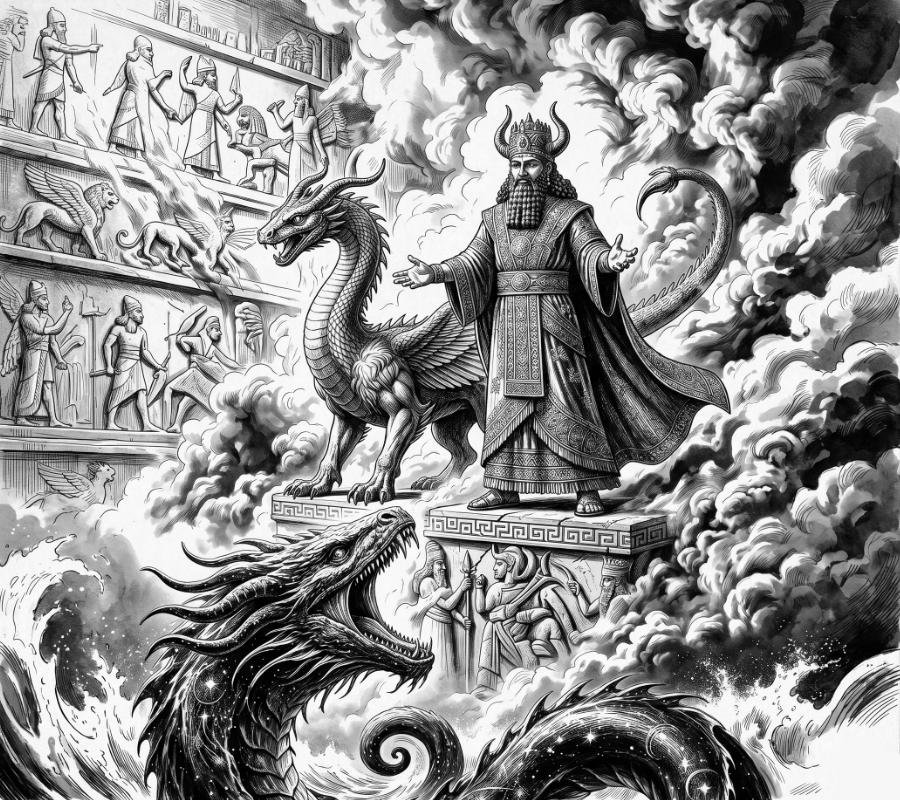
The most feared danger had a name: Lamashtua female entity attributed to abortions, neonatal deaths and newborn diseases. To protect themselves from it, women carried amulets with the image of Pazuzu, the demon of the south-west wind —a powerful and potentially terrible being used precisely to repel Lamashtu. The principle was: to face a danger with another greater danger.
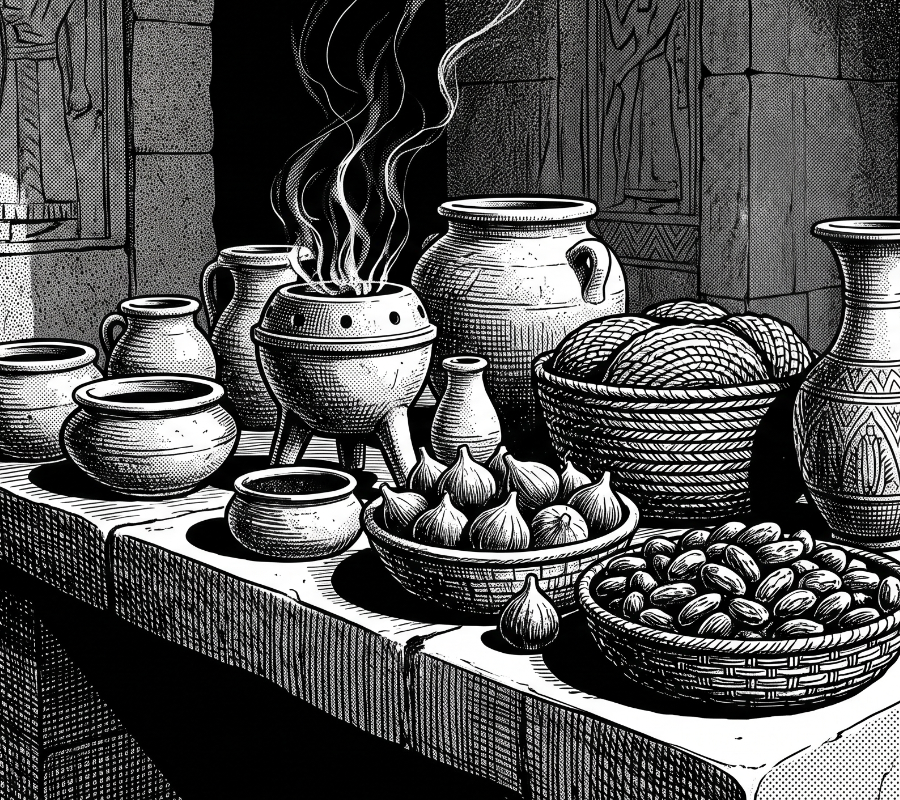
Fumigations with aromatic resins —cedar, juniper, cipress— They were used to purify the space of childbirth and to load it with protection. The sesame oil, applied on the skin of the parturienta and on the newborn, operated simultaneously as an excipient of the plant remedies and as a ritual substance of protection and purification. In mesopotamic texts, that double function of oil did not require explanation: it was simply what oil did.
BAM 248 closes with recipes to protect the baby once born: a mixture of pork and black dog excrements with donkey saliva, wrapped in vellum and placed around the newborn's neck, to remove it from the "hand of the god." Smoke of lion's hair and of burnt goat to drive the devil away lilù. A human bone paste in oil applied to the child's body.
BAM 248 was copied, verified and preserved in the library of the "House of the Exorcist Priest" in Assur. At the end of the tablet, a note says, "Copy and cross-checked according to its original." Whoever wrote it took his job seriously.
This tablet, and all of them like her, were produced by men: scribes, priests, specialists who compiled, copied and transmitted medical knowledge in writing. What the tablet documents is, to a large extent, the knowledge that these specialists considered important to preserve.
The midwife —the šabsūtu"the one who knows the inside"— He was the person who knew the most about childbirth in practical terms. His presence in the texts is lateral: he appears in economic contracts, in witness lists, in a line of enchantment that says "that the midwife is not delayed." His knowledge was in a different way —from hand to hand, from body to body— and the cuneiform texts, by definition, capture little of that.
BAM 248 is, in that sense, a complex object. It brings together under the authority of the exorcist priest a heterogeneous repertoire: elaborate rituals that required a specialist, accessible plant potions that probably circulated in common homes, dietary requirements of a certain luxury, and at least a procedure that seems to come from a completely different tradition. This mixture speaks of a knowledge built over the centuries, absorbing various sources, integrating what worked. —or what was thought to work— in a single clay object.