

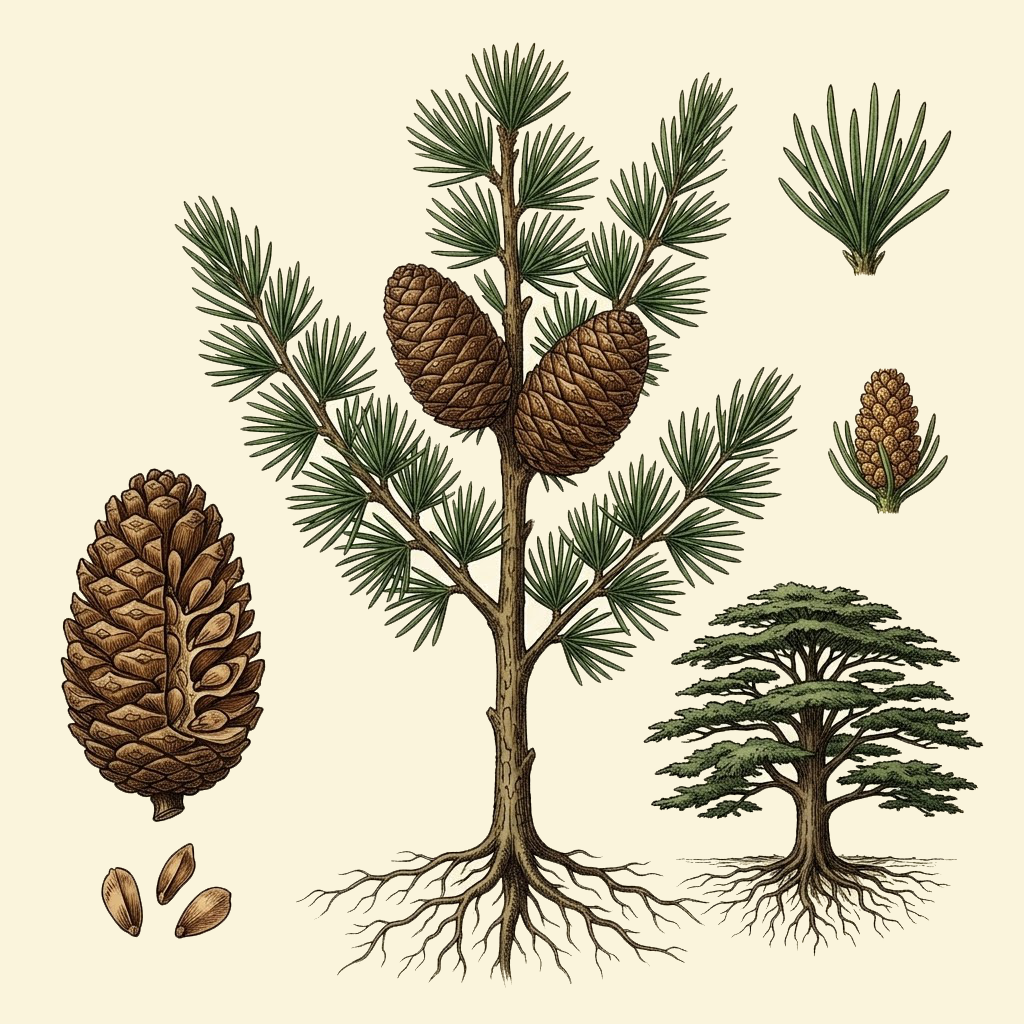
The genus Cedrus groups large coniferous coniferous of the Pinaceae family, characterized by its imposing tree bearing, conical cup in the youth that becomes wide or aparepated in maturity, and very resinous and aromatic wood that has been used historically in construction, carpentry and symbolic uses. Among the most relevant species are Lebanese Cedrus (Lebanese cedar), Atlantica Cedrus (Atlas cedar) and Cedrus deodara (Himalayan cedar), all longevas and capable of reaching more than 30-40 m high, with thick trunks and deep radicular systems adapted to mountain slopes.
Distribution and Biomas: The Cedrus species have a natural disjoint distribution in mountainous massiums of the eastern and western Mediterranean (Lebanon, Antitauro, Turkish mountains, Atlas of Morocco and Algeria) and in the Himalayas (northern India, Pakistan, Nepal), where they form temperate mountain forests. They are mainly between 1000 and 2200 m of altitude in Mediterranean regions, and between 1500 and more than 3000 m in the Himalayas, in climates with cold and humid winters and dry summers, on well drained, often stony or limestone soils, constituting pure masses or mixed with other coniferous and mountain tiles.
Major Producers: The natural masses of Lebanese Cedrus and related species are currently subject to protection and restoration programmes, so that the direct logging of relict forests is very limited; the exploitation is concentrated on plantations and trees cultivated as ornamental and forest in Europe, West Asia and other temperate regions. For the essential oil industry, the Atlas cedar (Cedrus atlantica) from the Moroccan and Algerian massizos has become one of the main origins of Cedrus's "essential cedar oil" from wood and sawmill waste managed under local forest schemes.
Fast source:
University of the Illes Balears. "Cedrus deodara (D. Don) G. Don - Herbari Virtual." Western Mediterranean Virtual Herbari, s. f. Access 24 April 2026. http: / / herbariviral.uib.es /
Species & Culture
Name in old languages
Sumerium: GIŠ.EREN (cedar tree)
Acadio: erēnu
The cedar of Lebanon was the most valued wood in the old Middle East. Since the tree did not grow on the mesopotamic plain, its acquisition required military or commercial expeditions to the Lebanese and Amanus mountains, which made this resource a foreign policy issue.
Construction and monumental architecture: Temples, palaces and monumental doors used beams and cedar panels, whose resistance to rot and insects made it irreplaceable. The Sumerian kings, acadiums, Assyrians and Babylonians proudly recorded in their royal inscriptions the obtaining of cedars from Lebanon for their works. The oldest text that mentions the cedar in detail is the The Poem of Gilgames h (tablets of the 3rd millennium BC in Sumerian and Acadium), where the Cedros Forest (tīrum ša erēni) is a sacred space guarded by the giant Humbaba, and its logging by Gilgamesh and Enkidu is an act of cosmic transgression.
Ritual and perfumery: The resin and cedar wood were burned as incense in the temples. An old acadio cuneiform text mentions the use of "40 cedar resin mines" (GIŠ. ŠIM.EREN) along with other aromatic substances, suggesting their regular use in temple rituals. The cedar resin (šaman erēni, "cedar oil") appears in mesopotamic perfumery recipes as an ingredient of anointing oils for the king and deities. In the medical texts of the Nineveh Library (text ORACC / Nineveh Medical Project), cedar oil was prescribed for therapeutic unitions on the head.
Medicine: The texts of the medical body mesopotamic (āšipu and as You) mention cedar resin in preparations for skin diseases, infections and purification rituals. Babylonians often cited coniferous, especially cedar, for their pleasant smell in fumigation therapies.
Power symbol and permanence: The cedar was a symbol of the gods, royalty and eternity. The records of Assyrian and Babylonian kings such as Salmanasar I, Nebuchadnezzar II and others explicitly mention the import of cedars from Lebanon and their use in large construction projects, as a symbol of the divine power of the monarch.
Quick links:
FAO (2003). "Saving the Cedar of Lebanon." Unasylva 212, Vol. 54.
Finet, A. (1990). "Le Cèdre dans la Littérature Sumérienne et Akkadienne." Liban, l'autre rive, Institut du Monde Arabe, Paris.
The Perfume of Ashur (2025). "Examining Mesopotamian Use of Aromatic Materials Through a Religious Lens."
Atlas's essential cedar oil (Cedrus atlantica Wood Oil) is obtained by steam distillation of wood and other woody parts (splits, sawdust, sawmill residues), using dry material rich in resins. Studies on the oil of Cedrus atlantica in Morocco describe variable yields depending on the provenance and type of woody material, and confirm that the volatile fraction is dominated by hydrocarbon and oxygenated sociterpenes. In the case of Lebanese Cedrus and Cedrus deodara there are also essential wood oils and, in some cases, leaves, but their production is more restricted and subject to local contexts and forest protection.
Main Aromatic Molecules (Atlantic Cedrus, wood)
GC-MS analysis of essential oils from Cedrus atlantica from different regions of Morocco shows profiles dominated by sesquiterpenes characteristic of the hymachalans group. The majority components have identified:
β-himachalene (β-himachalene): very abundant hydrocarbon sesquiterpene, associated with the warm, warm and slightly resinous character of the oil.
α-himachalene (α-himachalene) and γ-himachalene: sesquiterpenic isomers that complete the hymachalane "core" of the oil.
(E) -α-atlantone / (E )-atlantone: relevant oxygenated sesquiterpeno that provides balsamic and sweet facets, considered one of the chemical markers of the Atlas cedar.
Himachalol and allo-himachalol: sesquiterpenic alcohols that contribute to the persistence and fixing of the walled chord.
Other sesquiterpenes (e.g. β-himachalene oxide, α-calacorene, γ-dehydro-ar-himachalene) present in smaller proportions according to geographical origin and distillation conditions.
These profiles correspond to the information from commercial technical sheets where it is highlighted that the main compounds of the oil of Cedrus atlantica are sesquiterpenic hydrocarbons (himalchenes / himachalenes) and oxygenated derivatives (atlanthones, himachalols).
Use in Perfume
Atlas's essential cedar oil is used as a well-walled background note in fine perfumery, soap and personal care products, providing a dry, woody, slightly smoked and balsamic character that structure the base and functions as a fixation of other more volatile ingredients. It is incorporated in friendly chords, oriental, fugère and leather, as well as in male and unisex compositions where it strengthens sensations of clean wood and soft resin, often in combination with notes of incense, balms, vetiver and citrus.
Fast source:
Lupine Publishers. "Chemical Characterization on the Aromatic Composition of Cedrus Atlantica from Morocco in Two Geographical Areas." Modern Approaches on Material Science 1, No. 5 (2018). Access April 24, 2026. https: / / lupinepublishers.com / chemisty-journal /.
Space under construction by collaborators.
The section Technical information and has a general arguative character. It is presented for information purposes to promote responsible knowledge. Because of the risks associated with the incorrect use of botanical extracts, aromatic molecules and the increase in unregulated practices in the production of aromatic products, Myrodia Khartes has chosen not to disclose complete extraction methodologies or specific concentrations that may compromise public safety. Health, ethics and scientific integrity guide our decision to limit the exposure of certain technical data.
- European Commission. (2009). Regulation (EC) No 1223 / 2009 on Cosmetic Products. Official Journal of the European Union, L 342, 59-209.
-
IFRA (International Fragrance Association). (2023). IFRA Standards Library: 52nd Amendment.
- The Good Scens Company. (2025). Fragrance Raw Materials Database

