

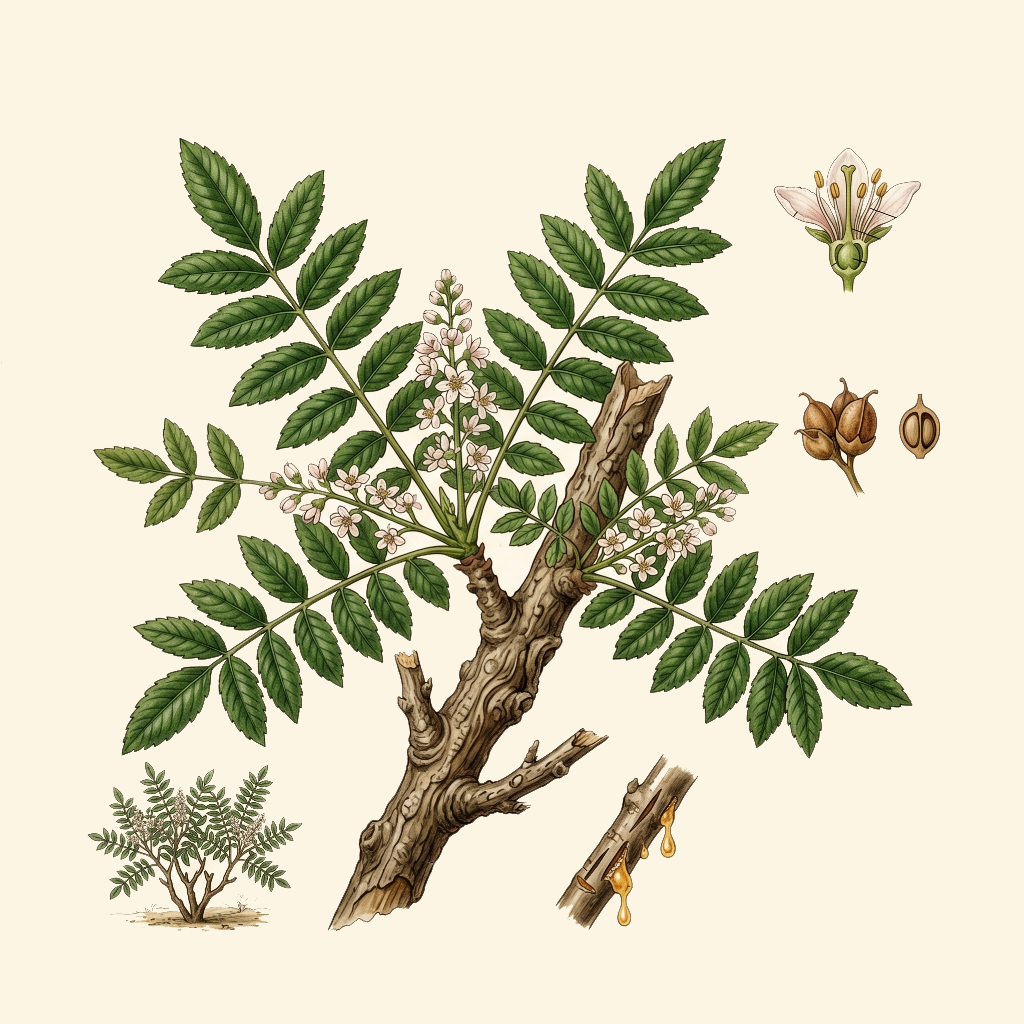
A "classic fossil record" of Boswellia which allows a specific source to be assigned to it at the geological level, but due to its phylogenetic position within Burseraceae and Sapindales, a tertiary origin (Cenozoic, probably Paleogeno-Neogen) is assumed in the framework of the diversification of the woody angiosperms in dry tropical regions. In any case, the documented cultural uses of its resin go back to at least the third millennium, in Arabia and the second millennium, in Egypt and Levante, with references to its trade on the incense routes.
Distribution and biomas: The olive-producing species have a dissipated but consistent distribution with the large warm deserts and semi-arid mountains bordering the Red Sea and the Indian Ocean.
Aphro- Arabian region (classical core of the "sacra" olibano)
Boswellia sacra / carterii: native to the southern Arabian peninsula (mainly Dhofar in Oman, Yemen) and the Horn of Africa (Somalia, Eritrea, Ethiopia). It inhabits rocky slopes, cliffs and stony calcareous soils between approx. 300 and 1500 m. m., with very low rainfall and marked dry season; warm desert biomas and xeric bushes influenced by monzonic fog in the case of Dhofar.
Horn of Africa region (other Boswellia of commercial resin)
Boswellia frereana and B. papyrifera are distributed in Somalia, Ethiopia, Eritrea and, to a lesser extent, South Sudan, in dry deciduous forests and semi-arid spiny shrubs.
They are part of degraded tropical dry forests where they are mixed with Acacia, Commiphora and other resinous trees; many populations already show signs of over-exploitation and low natural regeneration.
Indo-gangetic region (Indian olive)
Boswellia serrata (Indian olive, "salai"): is located in Rajasthan, Madhya Pradesh and other dry and mountainous areas of central and northwest India.
Bioma: tropical and subtropical dry forests (dry monzonic), with marked dry season and poor soils, where it is used more for its medicinal properties (forest acids) than for its aroma, considered somewhat less than that of B. Sachra and B. fereana.
Major producers: Recent literature and trade reports show that world olive production is concentrated in a few countries of the Afro-Arabian belt, with an estimated annual market of 6000-7000 tons and a value of hundreds of millions of dollars.
Somalia: One of the main producers and exporters of Boswellia resin, especially B. fereana and B. Carterii, which feed markets in the Middle East and Western perfumery. The value chains are fragile: conflicts, droughts and excessive exploitation have reduced the quality of the resin and compromised the regeneration of the Boswellia forests.
Ethiopia and Eritrea (Horn of Africa): They produce mainly olive oil B. papyrifera, very important for the ecclesiastical and traditional trade. Reports submitted to CITES warn of population decline and recommend sustainable management and stricter crop regulation.
Yemen and Oman (Dhofar): In Oman, the Dhofar region (around Salalah) produces the olive oil "Royal Hojari" from Boswellia sacra, considered of those most appreciated for the size and color of the tears and their aromatic profile. Yemen also provides significant volumes, although political instability has affected export and traditional chains of the incense route.
India (Boswellia serrata): India is a great producer of resin Boswellia serrata, used mainly in phytotherapy and extraction of boskelic acids for anti-inflammatory uses, rather than in fine perfumery. Its "salai incense" is of regional importance and in the pharmaceutical and supplement industry, while in the global market of perfumery the leading role remains in the B. sacra / carterii and B. fereana.
In short, the geographical core of the perfumistic olive tree (sacra / carterii / frereana / papyrifera) is today in Somalia, Ethiopia, Eritrea, Yemen and Oman, while India is dominated by the production of B. Serrata with more medicinal than aromatic orientation.
Species & Culture
Name in old languages
Acadio: lubbānu (incense / olive); term derived from the semitic root lbn (white).
Acadio also: qutrinnu (incense smoke in general)
Oilybane or franquinzenus is the oleoresin of trees of the genus Boswelliawhich grow in arid areas of South Arabia and the Horn of Africa. Archaeological and textual evidence places its introduction into the Mediterranean-mesopotamic world around the Middle Bronze.
Templar and ritual incense: The olive tree was burned before the statues of the gods to "feed" them with its fragrance. The texts of the Nineveh Library and the archives of the Ebabbar temple in Sippur (dedicated to the sun god Šamaš) record the acquisition and regular use of aromatic substances —of which lubbānu in the first millennium a. C.— for the maintenance of the daily cult. Neo-Assyrian inscriptions and ritual texts document the use of incensaries (qutrinnu) and the role of incense as a vehicle of communication with the divine.
Trade and exchange networks: The expansion of trade in frankincense from South Arabia to Assyria and the Mediterranean intensified during the IX-VIII centuries. C., when the Boswellia sacra of Arabia and the Horn of Africa began to gradually displace local resins. This generated a commercial network that connected southern Arabia, Assyria, the Middle East and the Mediterranean world.
Medicine and purification: In the mesopotamic medicine of the 1st millennium BC, incense was used in therapeutic fumigations for mental diseases (depression, epilepsy), ear and eye conditions, and demonic infestations. Its simultaneous medical and ritual function was consistent with the mesopotamic conception of the disease as spiritual disturbance.
Important note: The direct evidence of olive oil Boswellia in mesopotamic contexts are predominantly of the I millennium a. C. (neoasirium and neobabilonic period). In previous periods, local coniferous resins (cedar, juniper, ciprés) performed similar functions. This does not exclude the previous use of Boswelliabut reflects the limitations of the archaeological record and the difficulty of identifying botanical resins without chemical analysis.
Quick links:
Böck, B. (2014). The Healing Goddess Gula: Towards an Understanding of Ancient Babylonian Medicine. Leiden / Boston: Brill.
Evershed, R. P. et al. (1997). "Archaeological Frankincense." Nature 390 (6661).
Hamblin, W. J. (2006). Warfare in the Ancient Near East to 1600 BC. New York: Routledge.
Kohzen (2025). "Olibanum Incense: 7 Fascinating Insights About This Ancient Resin."
May, N. N. (2022). "I Burn as Incense for You: Cenders in Assyria and Beyond."
Middeke-Conlin, R. (2014). "The Scents of Larsa: A Study of the Aromatics Industry in an Old Babylonian Kingdom." Cuneiform Digital Library Journal 2014:1.
Obtaining the raw material: the resin is obtained by practicing incisions in the bark of several species of Boswellia (sacra, carterii, papyrifera, serrata, frereana), allowing to exudate the latex that dries in the form of "tears" that are then collected.
Steam distillation: is the standard method for fine perfumery; from the oleogoma- resin you get an essential oil (yields around 4-6% in Boswellia sacra) rich in monoterpenes and some oxygenated esters.
Extraction with volatile solvents: hexane, oil ether or other solvents produce an olive concrete that, after removing waxes and residues, gives an absolute of olive oil, more rich in diterpenes (incensol, incensol acetate) and triterpenes (boswélic acids), with a denser, balsamic and slightly ambarate profile.
Hydroalcoholic extraction (tinctures): traditionally, tinctures are prepared in ethanol at high grade; they concentrate part of the aromatic fraction, but are used more in aromatherapy and galenic formulation than in high-level perfumery.
In modern industrial formulation, both distilled and absolute essential oil is used as a result of the search for more citric and volatile incense (oil) or more resinous, creamy and ambarbed (absolute).
Main aromatic molecules of olive oil
The chemical profile varies by species of Boswellia and terroir, but there are common patterns well documented by GC-MS in Boswellia sacra, papyrifera, neglecta and rivae.
Monoterpenes (very volatile fraction)
The essential oil of Boswellia sacra predominate:
α-pinene (monoterpeno hydrocarbon): fresh, resinous note, pine needle type; in many species it is the majority component of the volatile fraction.
limonene: it provides citrus facet (lemon / bitter orange), very evident in certain olive chemotypes.
p-cimeno: slightly medicinal aromatic-citric mice; present in Boswellia rivae and other species.
Other common monoterpenes: α-thujene, terpinen-4-ol, myrcene, sabinene, which modulate the fresh, spicy and terrous character of the note.
Diterpenes and diterpenic esters ("incense" core)
In the less volatile fraction (heavy oil, absolute, methanolic extracts):
Incensol (a diterpeno alcohol) and insenyl acetate / incensol acetate: considered key in the warm, slightly spicy, balsamic "incense" character.
Other diterpenes: verticular-4 (20), 7,11-triene and related structures, which reinforce the resinous and related background.
Triterpenes and Boswéllic acids (little direct contribution to the smell, but typical of Boswelia)
Boswelic acid (α-boswellic acid) and derivatives: are Boswellia markers, essential from a pharmacological (anti-inflammatory) point of view, but with an olfactory contribution limited by its very low volatility.
Triterpenes such as β-amyrine, α-amyrine and its ketones (β-amyrenone, α-amyrenone) appear in methanolic and absolute extracts.
Olive acids
Recent studies identify two apolar molecules with a cyclopropane ring, (+) -trans- and (+) -cis-2-octylcyclopropane-1-carboxylic acid, known as "olive acids," which are considered responsible for a characteristic nuance of the smell of olive incense, and were first described in Boswellia resin.
Reference molecules used in perfumery to recreate the smell of olive oil
In modern perfumistic practice, natural fractions of olibanum are combined with isolated molecules and synthetic analogues to modulate stability, projection and cost.
Natural isolated (or enriched) from Boswellia
Rectified or fractional olive essential oil: selective enrichment in α-pinene, lemonene and other light monoterpenes for more citrus and "incensated" output notes.
Diterpenic fractions concentrated in incensol / incensol acetate, which reinforce the warm, balsamic and slightly amputated "heart" of the chord.
Although not always marketed under an isolated name in industry catalogues, these diterpenes are analytical references and, in some cases, specialized niche ingredients.
Perfume palette molecules associated with incense / olive chord
Not everything that smells of "church incense" comes directly from Boswellia; the chord is built with a combination of materials where the natural olive tree is based on molecules that remember its chemical profile:
Monoterpenes and derivatives:
α-pinene, β-pinene, lemonene, myrcene of citric or coniferous origin, used as fresh and resinous components in the head of the incense chord.
Terpinen-4-ol, p-cimeno and other terpenic aromatic compounds to shape the spicy and herbal appearance.
Ambarado- resinous "incense" molecules (not always derived from Boswellia, but used to reinforce the feeling of olive oil):
Various ambrinol / ambercore, labdanum- type diterpenes, cystus and elemi resinoids, which bring balsamic, ambarated and slightly smoked weight, imitating the heavy part of the burnt olive tree.
Resinoids delemi (Canarium), rich in monoterpenes and related sesquiterpenes, are combined with olibano for a brighter resin-citrus facet.
Synthetic support molecules:: Although the exact formulas are owned, the technical literature describes the use of aromatic aldehydes, certain persistent citrus esters and friendly-amber notes (for example, Iso E Super, Ambroxan, etc.) to set and expand the incensate chord built from olive.
IFRA
There is no specific standard that limits olive / Boswellia by name; the general IFRA standards apply for allergens, total exposure and product categories.
In the EU, olive oil is treated as essential oil NCS: it is covered by REACH and CLP, but a temporary five-year exemption has been introduced for natural essential oils not chemically modified in the new CLP, and can continue to be used in fragrances and cosmetics in compliance with the cosmetic Regulation (safety assessment, allergen labelling, etc.).
Space under construction by collaborators.
The section Technical information and has a general arguative character. It is presented for information purposes to promote responsible knowledge. Because of the risks associated with the incorrect use of botanical extracts, aromatic molecules and the increase in unregulated practices in the production of aromatic products, Myrodia Khartes has chosen not to disclose complete extraction methodologies or specific concentrations that may compromise public safety. Health, ethics and scientific integrity guide our decision to limit the exposure of certain technical data.
- European Commission. (2009). Regulation (EC) No 1223 / 2009 on Cosmetic Products. Official Journal of the European Union, L 342, 59-209.
-
IFRA (International Fragrance Association). (2023). IFRA Standards Library: 52nd Amendment.
- The Good Scens Company. (2025). Fragrance Raw Materials Database

