

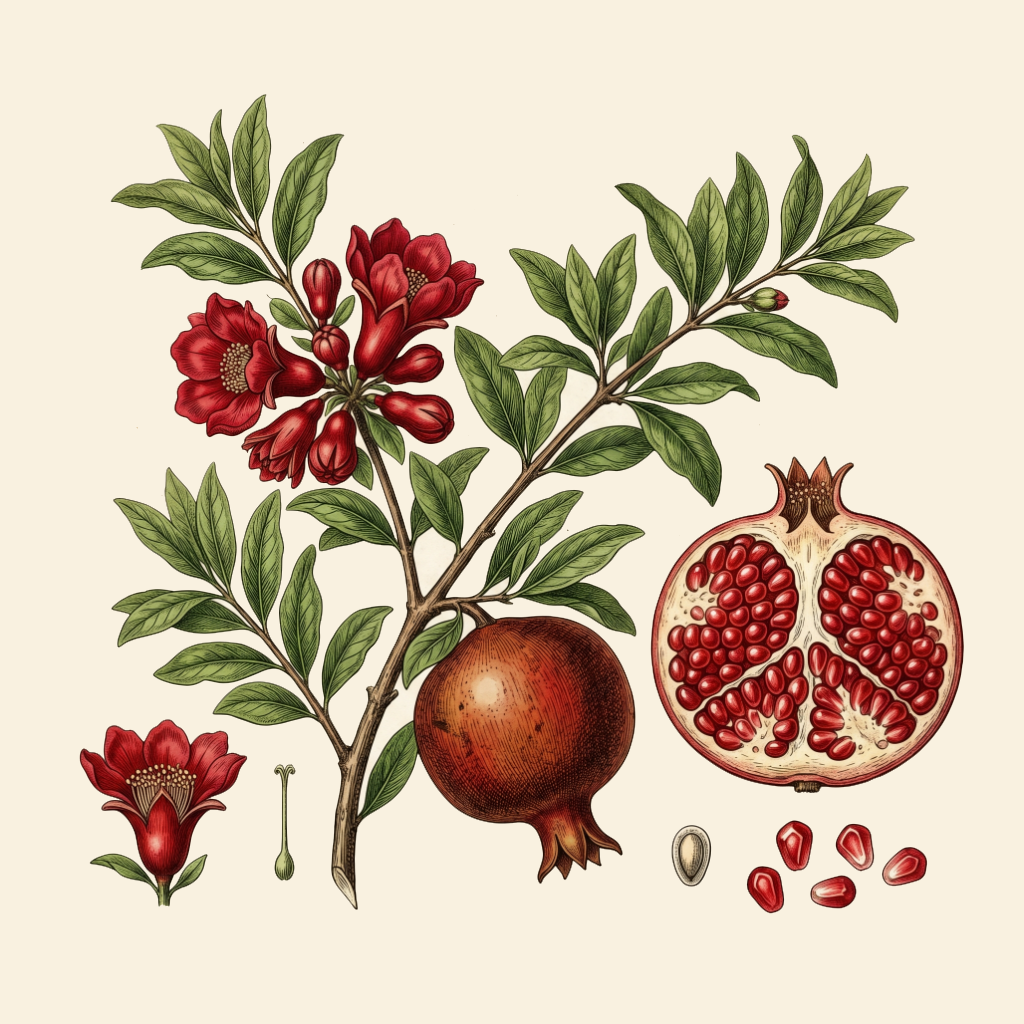
Distribution and Biomas: Punica granatum has an oriental Mediterranean phytogeographical distribution, although it is currently grown in tropical, subtropical and temperate regions around the world. The species is distributed from sea level to 1,600 meters of altitude. In its secondary distribution area, as in the state of Campeche, Mexico, it adapts to climates with hot summers, being very drought-resistant once established.
Habitats and Biomas: Riparian communities and hedges: At altitudes between 0-1,600 m. Mediterranean bushes: Pines with rosemary and topolars. Cultured areas: Solares, family gardens and gardens. Bordes of roads and altered places: As a subspontaneous plant. The grenade requires normal and fresh soils, although it tolerates lack of moisture, and needs full sun exposure. It is sensitive to frost but adapts to various edaphic conditions.
Major Producers: The global area of grenade cultivation is more than 300,000 hectares, with production concentrated mainly in Asia. World's leading producers: India: World leader in production. China: Second largest producer. Iran: Third global producer. Turkey: Fourth place. Afghanistan: Fifth producer. Other major producers include the United States, Iraq, Pakistan, Syria and Spain. The Asia-Pacific region represents the most growing market due to the presence of India and China as the world's leading producers.
Species & Culture
Name in old languages
Sumerium: urma
Acadio: nurmù
The grenade is considered to be native to the region that covers the present Central Iraq and the Caucasus, an area from which it extended to the west. The word Sumerian urma is the origin of the Persian anār and Arabic rumān.
Food: The fruit was consumed fresh and like juice. Fermented drinks from grenade were also produced. Cuneiform texts of the paleobabilonic period mention the pomegranate among the fruits cultivated in the mesopotamic gardens.
Fertility symbolism and ritual offerings: Pomegranate was a primordial symbol of fertility and abundance for its numerous seeds. The acadiums offered it to statues of Ishtar (goddess of love, reproduction and war), believing that the fruit embodied the living powers of divinity. Representations in Assyrian art of the Neosirium period (IX-VII centuries BC) show embroidered grenades in the garments of kings and women of royalty, as well as in the reliefs of the Northwest Palace of Asurnasirpal II in Kalhu (Nimrud). A pomegranate-shaped object —with drilling to be sewn to a garment or suspended in a diadem— was recovered in the Nimrud excavations by Max Mallowan in 1952 and is preserved today at the Metropolitan Museum of Art.
Art and architecture: The grenades adorned jewels, ivory plates and luxury objects in the Assyrian palaces. A ivory plate of Fort Shalmaneser in Nimrud (9th century BC) combines papyrus and pomegranate motifs as a symbol of abundance and agricultural cycle.
Possible mythological reference: Some scholars suggest that the "tree of knowledge" of mesopotamic mythology could be identified with the grenade, although this is still being discussed.
Quick links:
"From Fruit to Fertility Symbol: The Pomegranate in Ancient Mesopotamia."
Metropolitan Museum of Art (2022). "Pomegranate carved in the round | Assyrian | Neo- Assyrian. "
Metropolitan Museum of Art (2022). "Openwork plaque with papyrus and pomegranates."
Stager, L. E. & Wolff, S. R. (1984). "Production and Commerce in Temple Courtyard: An Olive Press in the Sacred Precinct at Tel Dan." Bulletin of the American Schools of Oriental Research
Ward, C. (2003). "Pomegranate in World Archaeology." World Archaeology (referred in BYU Scholars Archive).
The extraction of essential oil from the pomegranate is mainly from the shell (pericarpian), although it can also be removed from the flowers. The most commonly used methods are:
Extraction methods
Steam drag (hydrodistillation): This is the most effective method to extract essential pomegranate shell oil, reaching a yield of 8.7%. The process uses overheated steam that drags the organic volatile compounds without thermal modification.
Solvent extraction: solvents such as hexane, ethanol or 50% hydroalcoholic mixtures are used with 1: 20 mass / volume proportions, followed by maceration for 72 hours. This method also includes variants such as Soxhlet and solid-liquid extraction.
Cold pressed: Specifically for pomegranate seed oil, which contains mainly triacylglycerides (99%) with high puncture acid content (80%).
Main Aromatic Molecules
The aromatic profile of the grenade varies according to the part of the plant used
Essential shell oil: The fatty acids identified include butyric acid (C4: 0), linolelaidic acid (C18: 2n6-t), linoleic acid (C18: 2n6-c) omega-6, arachidic acid (C20: 0) and dososahexaenoic acid DHA (C22: 6n-3) omega-6, some present up to 0.9% by weight.
Essential flower oil: The majority compounds are hexadecanoic acid (52.4%), linoleic acid (15.2%), heptacosane (10.1%) and pentacosane (10.1%).
Volatile compounds of juice: Studies by GC-MS identified beta-myrcenum, 1-hexanol and (Z) -3-hexen-1-ol as the key compounds active in the aroma of grenade juice. In addition, 46 volatile compounds have been identified by HS-GC-IMS and 58 by HS-SPME-GC-MS.
Other aromatic components: The shell is rich in polyphenols, anthocyanins, elagic acid and elagitanines (mainly punicalagine and punicalin), which, although not strictly aromatic, contribute to the general sensory profile. The main volatile compounds include isobutanol, isopentanols, vitispirans and volatile esters.
Aromatic molecules in Spain
In perfumery, the pomegranate note is a synthetic reconstruction, as there is no absolute or essential oil naturally available in commercial quantities. The pomegranate chord is created by:
Main components of synthetic chord
Fruit esters: They provide the sweet and fruity character
Green aldehydes: They bring freshness and vivacity
Calibrated terpenes: add aromatic complexity
Natural molecules identified in grenade
Natural volatile compounds that are synthetically recreated include:
Beta-myrceno: Terpeno with fruit notes
1-hexanol: Aldehyde with green and herbaceous notes
(Z) -3-hexen-1-ol: Alcohol with fresh and green aroma
Isobutanol and isopentanols: Alcohols with fruit notes
Vitispirans: Cyclic compounds with fruit character
Volatile esters: Responsible for sweet and fruity notes
This aromatic reconstruction allows a consistent olfactory profile of pomegranate for perfumery applications, as direct extraction is not economically viable and does not produce sufficient returns for commercial use.
IFRA
No specific restrictions documented for natural ingredients of Punica granatum
IFRA certificates for fragrances containing pomegranate chord (synthetic) are available and comply with the 51st IFRA Amendment. Commercial grenade fragrances are evaluated by IFRA conformity certificates on a case-by-case basis according to the specific formulation.
Security Assessment (CIR)
The Cosmetic Ingredients Review Panel (CIR) published a safety assessment in 2017 that concluded that Punica Granatum Seed Oil and Hydrogenated Punica Granatum Seed Oil are safe for cosmetic use. The study confirmed that the 26 fragrances allergens defined by the EU's cosmetic regulation were below the threshold levels in concentrates of grenade extracts.
Space under construction by collaborators.
The section Technical information and has a general arguative character. It is presented for information purposes to promote responsible knowledge. Because of the risks associated with the incorrect use of botanical extracts, aromatic molecules and the increase in unregulated practices in the production of aromatic products, Myrodia Khartes has chosen not to disclose complete extraction methodologies or specific concentrations that may compromise public safety. Health, ethics and scientific integrity guide our decision to limit the exposure of certain technical data.
- European Commission. (2009). Regulation (EC) No 1223 / 2009 on Cosmetic Products. Official Journal of the European Union, L 342, 59-209.
-
IFRA (International Fragrance Association). (2023). IFRA Standards Library: 52nd Amendment.
- The Good Scens Company. (2025). Fragrance Raw Materials Database

