

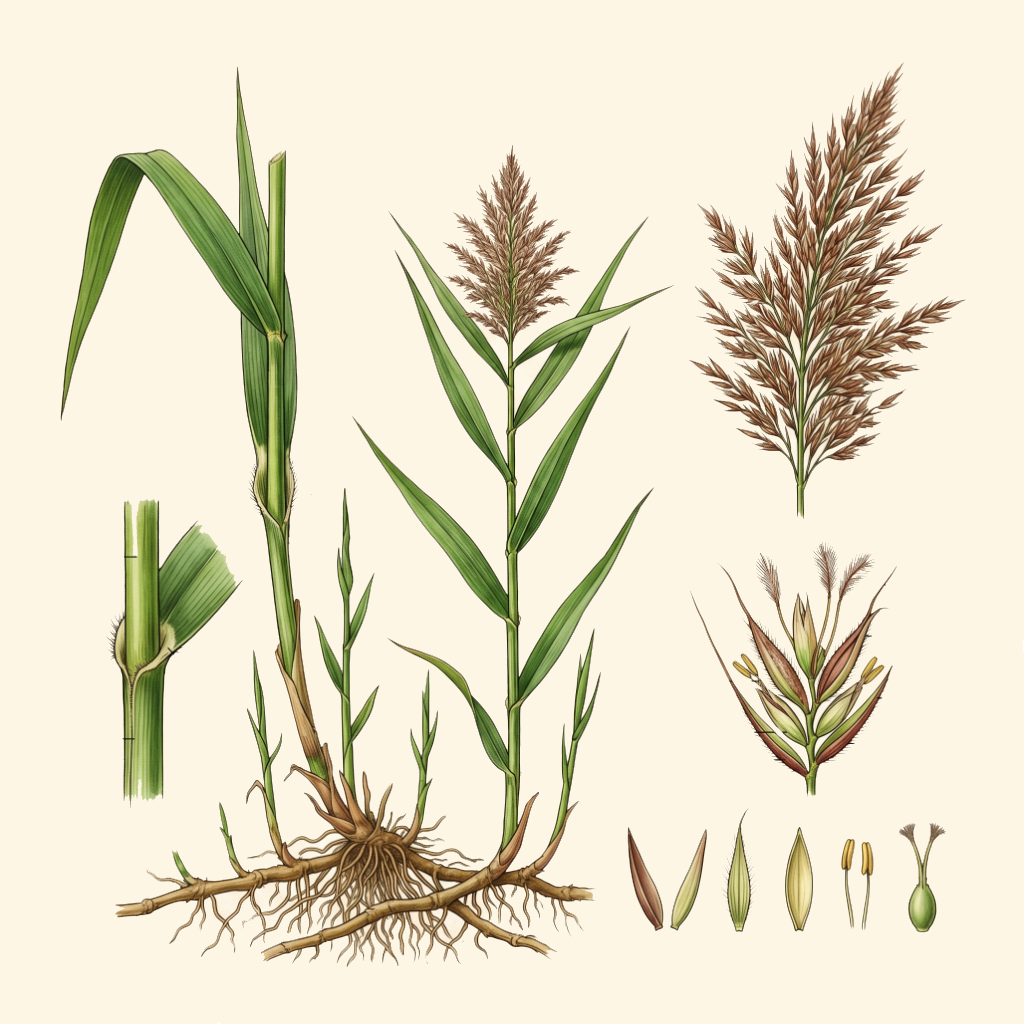
In evolutionary terms it is considered a holocena-present species with recent history of expansion and differentiation of lineage. The generic epitet Phragmites derives from the Greek phragma ("cane, stake, fence"), in reference to its traditional use for packing and closing; australis means "from the south." In the floristic literature, it is considered a species of predominantly European-Eurasian origin that has subsequently spread throughout almost all temperate regions of the world.
Distribution and biomas: Phragmites australis has a cosmopolitan or subcosmopolitan distribution: it is present in almost all temperate regions and many subtropical regions on the five continents. In Europe and the Mediterranean basin it forms extensive carrizals in riverbanks and watersheds; in North America, the expansion of non-native invasive genotypes has been documented since the 19th century. As for biomas and habitats, it is a typical species of: Continental Wetlands: river margins, streams, ramps, channels, lagoons, ponds, reservoir tails. Marsh and slobber areas: it tolerates moderate levels of salinity in water and soil, so it appears in marshes, estuaries and edges of coastal areas provided it receives fresh water.
Major producers: There is no "production" of Phragmites australis comparable to agricultural crops (there are no global tonnage statistics such as wheat or sugar cane), but regions where the species is particularly abundant or intensively managed are identified.
Species & Culture
Name in old languages
Sumerium: gi (reed, reed)
Acadio: qanû (cane)
The common reed was, along with the barley and the date palm, one of the most fundamental plant resources of mesopotamic civilization. The Sumerian proverb "Where there are no joints, that is the worst of all poverty" (ki gi nu-ú-ub-tuku u-hul@-@ gal-la-àm) expresses its absolute civilisation value.
Construction: When the Sumerian first arrived in the south of Mesopotamia in the 5th millennium BC, they found a region of marshes dominated by the cane. Before draining these areas and building cities, they lived in cabins (gikum) built with joints on islets in the swamp areas. This constructive tradition lasted and the cane structures —including walls, screens and roofs— remained common throughout Mesopotamic history, especially among marginal populations and "Marisma Arabs" (Madan).
Writing and administration: The clay board and the cane style (giqannum) were the essential instruments of the mesopotamic bureaucracy. The cuneiform writing was made by printing the obliquely cut end of a cane on wet clay. The Greek word "canon" and its derivatives come from the Sumio- acadio qanû (cane), with the meaning of "measure" or "standard." Thus, the cane literally generated the writing and the concept of rule or canon.
Music: The reels were the basic material for the manufacture of flutes, double oboes and other wind instruments. The cane flute (gi-di) appears in Sumerian texts since the Early Dynamic period. The god Enki / Ea is associated with the cane flute, and the canyaveral appears as a metaphor for the origin of language in the Sumerian-Babylonic myth.
Canasteries and mats: The rods were widely used for the production of mats (gipi), baskets, ropes, garden fences and irrigation systems. Archaeological studies of the Abu Tbeirah field (3rd millennium BC, southern Iraq) have identified cane-based braided materials with a wide variety of techniques.
Fuel and fodder: The cane served as fuel (common household fuel in the swamp areas) and as feed for domestic animals.
Magic and religion: The cucaveral was a central motif of mesopotamic mythology. In the myth of Enki and Ninhursag, in the Enuma Elish and in numerous enchantments, the rods are magical instruments and bridge between the human and the divine world. The cane was used in magic rituals - doctors of exorcism and in divination (extispicy and lecanomancy).
Fast sources:
"Vegetable Plaiting Materials from the Site of Abu Tbeirah (Southern Iraq), Third Millennium BC." EXARC Journal.
Kaçar, A. (2022). "Eski Mezopotamya Mitolojisinde Kamış / Sazlık ve Kamışın Dinsel-Büyüsel Ritüellerde Kulanımı." OANNES - International Journal of Ancient History 4(2): 539–555.
Kleczkowska, K. (2012). "Where there are no remedies, it is the worst of all poverty: on some proverbs and methodologies in Sumerian literature." Ex Nihilo 2(8).
Stol, M. (2000). Birth in Babylonia and the Bible: Its Mediterranean Setting. Cuneiform Monographs 14. Groningen.
Wiggermann, F. A. M. (1992). Mesopotamian Protective Spirits: The Ritual Texts. Cuneiform Monographs 1. Groningen: STYX & PP.
The Junco - Phragmites australis (carrizo) is not a classic aromatic plant and is not used in a recognized way to obtain essential oils or perfumistic raw materials.
Aromatic extraction and types of extracts
In industrial practice, when using Phragmites in cosmetics, hydroalcoholic or aqueous extracts of rhizoma or "cane" (stems) are used, with biological objectives (anti-inflammatory, soothing), not to capture a characteristic smell. The term INCI "Phragmites Australis Rhizome Extract" indicates precisely an extract by solvent (water, alcohol or CO), without reference to essential oil or to perfumistic volatile fraction.
Potable aromatic molecules
Since Phragmites australis is not used as a characteristic olfactory raw material, neither are "perfume molecules" designed to reproduce its smell. When you want to evoke "aquatic cucaveral" or "wetland with joints," the perfumists generally resort to:
Green / herbaceous molecules (not specific to Phragmites):
Cis-3-hexenol and cis-3-hexenyl acetate (green leaf, cut grass).
Octenols and nonadienals in some cases, for wet vegetation purposes.
Water / fresh molecules:
Calone (methylbenzodioxepinone), for marine-ozonic facet.
Other "watermelon" or "marine notes" of patent, which give a sense of moisture and water.
Terrestrial / wet molecules:
Geosmina, for the printing of wet soil (although used with extreme moderation).
These molecules are not obtained from Phragmites, but are incorporated by synthesis or from other natural materials to build an olfactory landscape compatible with "jars, carrizo, wetland"
Quick link:
PHRAGMIES AUSTRALIS RHIZOME EXTRACT
IFRA
There is, to date, no specific IFRA standard for "Juncos / Phragmites australis" as a perfumistic raw material, nor a particular restriction on European cosmetic regulations beyond the general rules applicable to any vegetable extract used in fragrances and cosmetics.
In the EU, Phragmites appears as a generic cosmetic ingredient ("rhizome extract") without specific restrictions in the annexes to cosmetic legislation.
On the basis of ingredients such as CosIng / CosIng Checker, "PHRAGMITS AUSTRALIS RHIZOME EXTRACT" appears as a cosmetic ingredient with "skin conditioning" function, and it is explicitly indicated that it has no associated restriction entries in the annexes (i.e. it is not specifically prohibited or restricted).
Space under construction by collaborators.
The section Technical information and has a general arguative character. It is presented for information purposes to promote responsible knowledge. Because of the risks associated with the incorrect use of botanical extracts, aromatic molecules and the increase in unregulated practices in the production of aromatic products, Myrodia Khartes has chosen not to disclose complete extraction methodologies or specific concentrations that may compromise public safety. Health, ethics and scientific integrity guide our decision to limit the exposure of certain technical data.
- European Commission. (2009). Regulation (EC) No 1223 / 2009 on Cosmetic Products. Official Journal of the European Union, L 342, 59-209.
-
IFRA (International Fragrance Association). (2023). IFRA Standards Library: 52nd Amendment.
- The Good Scens Company. (2025). Fragrance Raw Materials Database

