

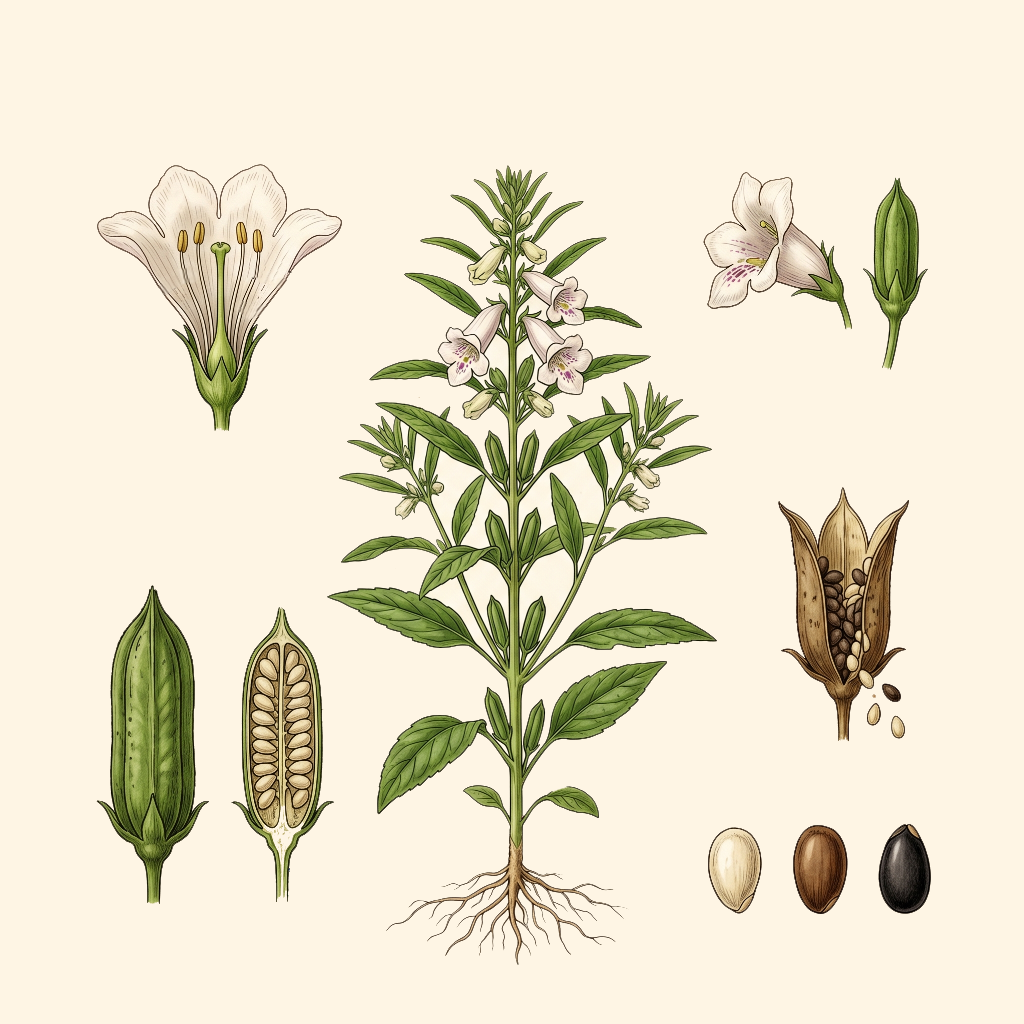
It is considered one of the oldest oilcrops; various sources place their domestication more than 3,000-4,000 years ago in Asia and Africa, with S. Indicum as the cultivated species derived from African wild relatives. As a culture, its documented history is fully holocene (Neolítico-Bronze Age and later), without evidence that as a cultivated species it is earlier; it is therefore integrated into the oleiculture of the medium-late Holocene, contemporary to other early oilseeds crops. This chronology (≥ 3,000 years AP) places it very within the Holocene, not in previous geological periods.
Distribution and biomas: It is now widely grown in Asia and Africa, and to a lesser extent in the Americas and the Mediterranean; it is described as well adapted to tropical and subtropical climates, with a special presence in India, China, Myanmar, Sudan, Ethiopia, Tanzania, Nigeria and other countries with a warm climate. Biomas and habitat: a plant of warm, drought-tolerant areas, cultivated in tropical savannah, tropical and subtropical dry forests and warm dry agroecosystems; it requires moisture for germination and ~1.200-1.600 mm rain per season for optimal performance, although it supports relatively arid conditions once established. Ecological conditions: it is grown in well-drained soils, usually in low lands and river plains; its tolerance to difficult environments makes it alternative to small producers in semi-arid regions of Africa and Asia.
Major producers: Traditional producers: India and China are repeatedly cited as two of the world's largest sesame producers, adding about half of global production in some estimates.
Major recent producers (FAOSTAT vision / analysis 2014-2019): an analysis of international data indicates that Myanmar, India, Tanzania, Nigeria and China, followed by Burkina Faso, Ethiopia, South Sudan, Chad and Uganda, are major countries by volume (2019).
Other relevant producers: in addition to the above, Sudan and Ethiopia are mentioned as major African exporters, and a significant presence of cultivation in Pakistan, Turkey, Thailand, Egypt, Uganda, as well as several Latin American countries (Mexico, Colombia, Nicaragua, Paraguay, Venezuela).
Species & Culture
Name in old languages
Sumerium: še-giš-ì ("grain oil plant," literally "grain oil plant")
Acadio: šamašammū (sesame)
The sesame was introduced into Mesopotamia from the Indian subcontinent, probably through the networks of exchange with the civilization of the Indo, around the 21st century a. C. according to the earliest textual data. However, the oldest written record of the term še-giš-ì dates from the mid-30th century a. C.. Its arrival radically transformed the economy of mesopotamic oils.
Cooking and food oil: Sesame oil (šamnum) was the predominant cooking oil in Babylon of the first millennium a. C. The historian Herodotus wrote in the 5th century a. C. that the sesame was the only oil the Babylonians used. It was a basic ingredient in the kitchen of all social strata, used for cooking, frying and dressing.
Economy and administration: Thousands of cuneiform tablets of the period Ur III, paleobabilonic and later document the production, distribution and trade of sesame oil. This oil was one of the most carefully recorded goods in the institutional inventories of palaces and temples, along with barley and wool.
Lamp and lighting: The sesame oil was used as a lamp fuel. The first references to lamp oils in Mesopotamia appear in the archives of the Mari palace, and the sesame was the main source of this fuel.
Ritual and offering: The sesame was considered a sacred plant in Mesopotamic societies and was used in religious rituals as an offering. The files of the Ebabbar temple in Sippur mention two types of oil (kia and siltu) of sesame base, perfumed with aromatic substances for use in rites of the god Šamaš.
Medicine: Sesame oil was used in medicine as an excipient for ointment and medicinal preparations applied to the skin.
Quick links:
"Open Sesame (Sesamum indicator L.): Exploring its modern and old cultivation in Kurdistan, Iraq. "
Bedigian, D. & Harlan, J. R. (1986). "Evidence for Cultivation of Sesame in the Ancient World." Economic Botany 40 (2): 137-154. (AGRIS FAO reference).
Bedigian, D. (2004). "History and Lore of Sesame in Southwest Asia." Economic Botany 58(3): 330–353.
i ▼ .MesopOil Project - LMU München (2023). "Topics: Sesame Oil in Early Urban Mesopotamia."
Sesame (Sesamum indicum) is not used in perfumery as essential oil, but above all as fatty oil and CO extract, which concentrate its toasted-gourmand facets (hazelnut, hot bread).
Raw material used: seeds, generally toast when looking for the gourmet chord of hazelnut, peanut, bread and coffee; raw if you want a more neutral and fat profile.
Cold pressed vegetable oil: standard method for obtaining sesame seed oil; mechanically press, ideally cold, and filter to preserve its lipid profile and characteristic aroma.
Extraction with CO - supercritical (perfumistic selection): is the procedure indicated for fine perfumery; it allows to extract an aromatic fraction rich in volatile compounds without thermal degradation and faithfully reproducing the smell of the roasted seed (caramelized hazel, hot bread, maple syrup, coffee, peanut).
Other cosmetic forms: is also formulated as "sesamum indicator seed oil / seed extract" in cosmetics, where the emphasis is functional (fatty acids, antioxidants) rather than strictly olfactory.
In niche perfumery, the "sesame CO-extract" is used as a heart / base note, rare but recognizable, associated with oriental chords, gourmet and dry gourmet.
Aromatic molecules characteristic in sesame
Sesamol (a phenol derived from lignans): key antioxidant of sesame oil; contributes to oxidative stability and provides a soft-toasted phenolic background.
Sesamine and sesamolin (lignans): they are not very volatile, but their thermal degradation during the toast is involved in the generation of toasted notes and in the stability of the aroma.
2-acetyl-1-pyrrolin (2-AP): nitrogenated heterocyclo responsible for the smell of basmati rice, freshly baked bread and popcorn; it is cited as one of the key aromatic molecules of sesame, responsible for its nuances of bread and roasted cereal.
A mixture of Maillard reaction products and pyrazins generated during toasting (not always listed one by one in general sources), which explain the facets of caramelized hazelnut, coffee, peanuts, maple syrup and hot bread described for the sesame extract.
Molecules used in perfumery to recreate the smell of sesame
2-acetyl-1-pyrroline (2-AP) or pyrroline analogues for the effect of hot bread / basmati rice, which is key in the cereal-roasted character of sesame.
A number of roasted pyrazins (e.g. 2-ethyl-3,5-dimethylpyrazine, 2,3-di-ethyl-5-methylpyrazine, etc.) recreating notes of roasted nuts, peanuts, coffee and cereal. These molecules are widely used in "nutty" chords and are probably combined with the Sesame CO) to strengthen their gourmand profile.
Sesamol can also be used as an isolated molecule (in addition to its natural presence in oil) both for its antioxidant properties and for its slightly phenolic-toasted nuance in fat formulations.
To complete the chord, perfumists usually add materials that harmonize with the sesame profile: vanillin / ethyl vanillin (maple syrup facet), soft coumarins, certain "nutty" type lactones, and creamy wood (sandalus, cashmeran) as described in the combined use of sesame with oriental and related facets.
"Toasted sesame" chord pattern in perfumery (indicative example)
Natural base: Sesame extract by CO) supercritical.
Bread / rice facet: 2-acetyl-1-pyrrolin or other pyrrolin analogue.
Foot nuts / peanuts: a mixture of roasted pyrazins in traces.
Sweet-syrup facet: vanillin / ethyl vanillin, small amounts of coumarins.
Support: oriental chords and weeds (vanilla, wood, resins) that are known to combine particularly well with sesame.
IFRA
Without specific prohibition / restriction rule for "Sesamum indicator seed oil / sesame CO-," it is used in accordance with the general IFRA framework and the CPSR evaluation, and suppliers explicitly indicate "no known restrictions" or "no restriction for category 4" in the 51st amendment.
Cosmetic regulations EU: allowed as a cosmetic ingredient (COSING), without limits of% set in annexes, subject only to general safety requirements and extended allergens regulations (which today does not include sesame as such).
Space under construction by collaborators.
The section Technical information and has a general arguative character. It is presented for information purposes to promote responsible knowledge. Because of the risks associated with the incorrect use of botanical extracts, aromatic molecules and the increase in unregulated practices in the production of aromatic products, Myrodia Khartes has chosen not to disclose complete extraction methodologies or specific concentrations that may compromise public safety. Health, ethics and scientific integrity guide our decision to limit the exposure of certain technical data.
- European Commission. (2009). Regulation (EC) No 1223 / 2009 on Cosmetic Products. Official Journal of the European Union, L 342, 59-209.
-
IFRA (International Fragrance Association). (2023). IFRA Standards Library: 52nd Amendment.
- The Good Scens Company. (2025). Fragrance Raw Materials Database

