

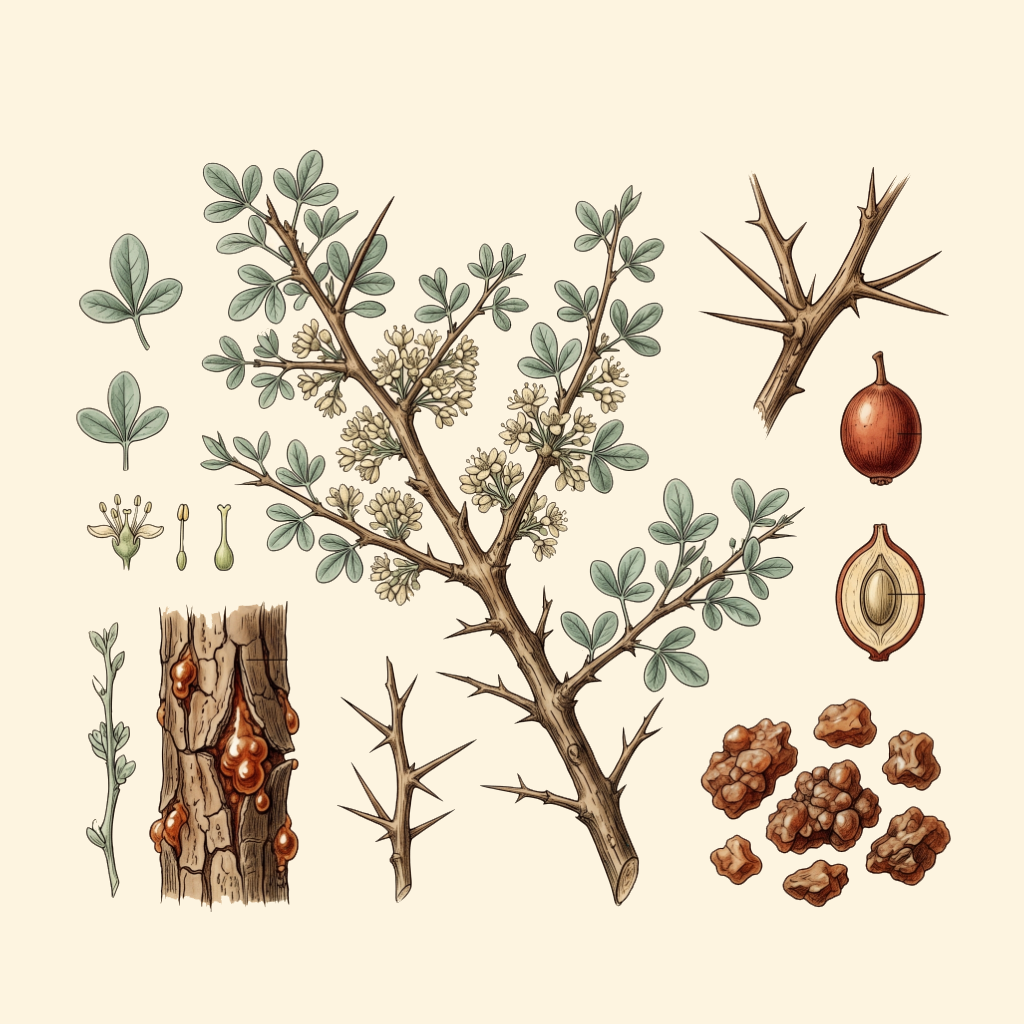
Botanically it is a relatively modern angiosperma dicotyledonea; as a species and as a genus Commiphora it is considered to have diversified within the framework of the neogenous tropical flowers, in late Cenozoic (Mioeno- Pliocene), along with other African and Arabian xerophite linages, although systematic literature does not assign a precise "geological age" to the individual species. In geological and paleophloristic terms, it is therefore a current species (Holocene) of a lineage that has been adapted to arid and semi-arid climates from the Neogen.
Distribution and biomas: It is native to northeastern tropical Africa (Djibouti, Ethiopia, Somalia, northeastern Kenya) and the Arabian Peninsula (Yemen and Oman). It is developed in slopes and valleys of desert and semi-arid regions, at approximately altitudes of 250-1300 m, with low annual rainfall (approx. 230-300 mm or 23-30 cm). In terms of biomas, the species is inserted in: Xerophile Matorral and dry open forests: Acacia / Vachellia-Commiphora in arid and semi-arid areas. Hot deserts and subdeserts with somerous soils, often stony or on limestone, sandstone or granite, with scattered vegetation.
Major producers: Botanical and economic literature agrees to point to Somalia as the world's largest producer of myrrh resin (and also incense / boswellia), both in volume and in historical importance. Contemporary sources of supply from the essential oil industry place the main source of the quality myrrh in Somaliland and other regions in northern Somalia, where collection is part of traditional supply chains. Other relevant countries as producers and exporters of myrrha resin (mainly C. myrtha and related species) are:
Ethiopia (especially Somali and Eastern regions).
North-East Kenya.
Yemen and Oman, on the Arabian Peninsula, with minor but traditionally important production on historical routes of aromatic resins.
Species & Culture
Name in old languages
Acadio: murru (grunts)
The term Sumerian is not well established; the myrrh was imported from Arabia and the Horn of Africa
Mirra is an oleoresin obtained from the trees of the genus Commiphoranative to southern Arabia and the Horn of Africa. Its name reflects a common semitic root: acadium murru, Hebrew mōrArabic murr (all mean "bitter"). It was an imported asset of great value in Mesopotamia.
Perfume and anointing: In Menology of the Lying (Lying Down Menology) of the neoasirium period, myrrh oil (šaman murri) was prescribed for the king's ritual anointing in the third month of the calendar. The myrrh was a central ingredient of the most elaborate and expensive anointing oils of Mesopotamia. The texts of Mari (ca. 2000-1700 BC) document shipments of murru from Arabia to Mesopotamia.
Medicine: The medical texts of the Nineveh Library (I millennium a. C.) mention murru in medical preparations. The text of the ORACC / Nineveh Medical Project prescribes: "Dry and crush a plant called murru (myrrh), mix it with water and continually anoint the patient's head with it. "The myrrh was used in treatments against skin diseases, wounds and as antiseptic.
Incense and ritual: The myrrh was part of the "aromatic pharmacy" of the mesopotamic temples, burned as incense in ceremonies of purification, exorcism and divine offerings. The texts of the corpus of enchantments (Maqlu, Šurpu) include it among the purifying substances.
Trade: The myrrh was one of the most marketed luxury products in the exchange networks of the old Middle East, along with incense and spices. Its import from South Arabia and the Horn of Africa made Mesopotamia a key node of incense routes.
Quick links:
Hätinen, A. (2024). "Purification, Defilement, and Privilege? An Example from the Hemerological and Menological Corpus." KASKAL 1: 159–168.
Levey, M. (1959). Chemistry and Chemical Technology in Ancient Mesopotamia. Amsterdam: Elsevier.
Nineveh Medical Project - ORACC (2021). "Application of Medicines." University of Pennsylvania.
Thompson, R. C. (1949). A Dictionary of Assyrian Botany. London: The British Academy.
Essential oil (main method)
Part used: Exudated gomorresin from the trunk, which is let dry and then distilled.
Method: steam distillation or resin hydrodistillation.
Typical performance: Gomorresin contains approximately 3-8% essential oil.
olfactory result: balsamic, warm, terrous, dry, slightly smoked and herbaceous smell, used as a background note and fixation.
Super critical CO extract
Raw material: same dry myrrh resin.
Method: A supercritical CO extraction, which drags volatile fractions and part of non-volatile resinoids.
Result: a more complete and dense profile than the distilled essential oil, with more marked balsamic and slightly spicy facets, highly appreciated in fine perfumery and anhydrous cosmetics.
Hydroalcoholic / aqueous extracts
They are mainly used in cosmetics and phytotherapy (aqueous or hydroalcoholic extracts of the plant or gomorresin), not so much in fine perfumery.
They contain fluorides, resins, terpenoids and triterpenes, but a less refined aromatic profile than essential oil or selective CO.
Main aromatic molecules
The volatile fraction of the myrrh is rich in sesquiterpenes and furanosskoterpenic compounds, with a relatively well defined chemotype.
Main molecules reported in essential oils of Commiphora myrtha:
(very characteristic)
Furanoeudesma-1,3-diene (also named furanoedudesma-1,3-diene).
Furanodiene / curzerene (this is often formed by thermal isomerisation of furanodiene during distillation).
Furanodienone (furanodienone).
Non-furanosic shesoterpenes
Lindestrene (lindestrene).
β -elemeno.
Germacrene B and germacrene D.
δ-elemeno.
β-cariophylline.
γ-elemen and γ-cadinene.
Herabolens (under the general name herabolene in some texts).
Monoterpenes and other terpenes
Limonene, α-pinene and other monoterpenes.
M- cimeno.
Linalool.
p-mentia -1-en-8-ol (p-mentia -1-en-8-ol).
Phenylpropanoids and aromatic aldehydes (in minor proportions)
Eugenol.
Cinnamaldehyde and cuminaldehyde, contributing to spicy nuances.
These molecules, especially furanoshesterpenes (furaneudesma-1,3-diene, curzerene / furanodiene, furanodienone), are considered key chemical markers of the myrrh and are the main responsible for its balsomic, resinous, warm and slightly medicinal odour.
Molecules used in perfumery to recreate / accentuate the myrrh chord
In perfumer practice, three approaches are used: essential oil / natural CO, synthetic "reconstructed" and ambarados- resinous background chords that evoke myrrh. From the chemical and perfumist literature, we can highlight:
Natural components of myrrh used as
These compounds are present in essential oil or CO-extract, and some are also marketed as relatively isolated materials to strengthen the character of myrrh or resin:
Furanoeudesma-1,3-diene.
Curzerene / furanodiene.
Furanodienone.
Lindestrene.
β -elemeno.
Germacrene B.
β-cariophylline.
In formulation, the "myrrh profile" is usually achieved directly with standardized essential oil or CO-extract, where these compounds already come in their natural matrix of sesquiterpenes.
Synthetic or other raw materials for the construction of chord
Although they are not "myrrh molecules" in a strict sense, they are used to reinforce key facets of the myrrh smell (balm, resin, spice, dry amber, soft smoke):
For the balsamic / amphied facet:
Vanilin, ethyl vanillin (provides balsamic sweetness).
Benzoin and its components (e.g. benzyl benzoate) in complex chords.
For the special-resinous facet (in dialogue with eugenol, cinnamaldehyde, cuminaldehyde present in the resin).
Eugenol and derivatives (eugenyl acetate).
Spicy aromatic aldehydes (cinnamaldehyde, cuminic aldehyde).
For the yellow-dry facet (strengthening the sesquiterpene base):
Super E-Iso and other synthetic toned to give dry toned volume.
Cedramber, vetiveryl acetate, which can accompany the terroso--related character.
In author's perfumery, essential oil or myrrh CO is usually combined with other resinoids (incense / olibano, benjui, opopponac) and ambarated chords to obtain a more complete and stable myrrh chord in formula.
IFRA
The myrrha myrrha is marketed as essential oil of Commiphora (CAS 84929-26-0 / 8016-37-3) and is evaluated as a perfumistic ingredient within the IFRA Code of Practice.
Several IFRA conformity certificates for "Myrrrh Essential Oil" (IFRA 49th and 50th amendment) show myrrh as an ingredient without specific concentration limits (maximum 100% in all product classes), i.e. "generally not restricted."
In the EU myrrh is regulated as a fragrance ingredient in mainly low cosmetics:
Regulation (EC) 1223 / 2009 on cosmetic products (safety, labelling, PIF files, etc.).
Revised CLP Regulation on classification, labelling and packaging of substances (for hazard classification, safety sheets, etc.).
The myrrh, as essential oil, is considered a Complex Natural Substance (NCS); recent decisions of the EU Council have maintained this category for essential oils, which favours their continued use provided that the risk of its components (allergens, sensitising substances, etc.) is properly managed.
Reference: AEFAA article on the EU Council decision on essential oils such as NCS.
Quick link: European Union turn on essential oils - AEFAA
Space under construction by collaborators.
The section Technical information and has a general arguative character. It is presented for information purposes to promote responsible knowledge. Because of the risks associated with the incorrect use of botanical extracts, aromatic molecules and the increase in unregulated practices in the production of aromatic products, Myrodia Khartes has chosen not to disclose complete extraction methodologies or specific concentrations that may compromise public safety. Health, ethics and scientific integrity guide our decision to limit the exposure of certain technical data.
- European Commission. (2009). Regulation (EC) No 1223 / 2009 on Cosmetic Products. Official Journal of the European Union, L 342, 59-209.
-
IFRA (International Fragrance Association). (2023). IFRA Standards Library: 52nd Amendment.
- The Good Scens Company. (2025). Fragrance Raw Materials Database

