

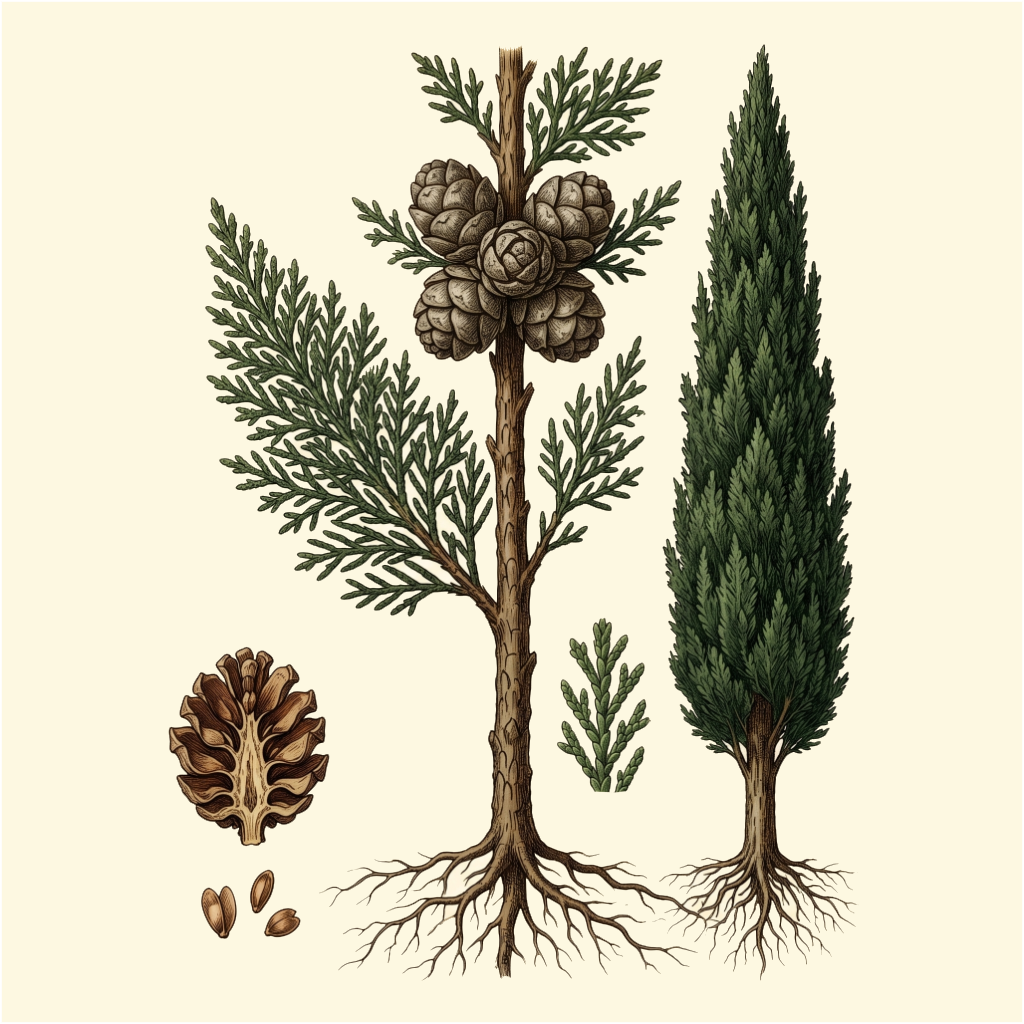
It is a always green tree, with a columnar or extended bearing, which can reach about 20-30 m high; it has small spamamiform leaves and globous woody cones.
Taxonomically it belongs to the family Cupressaceae (order Pinales, class PinopAIDS), a group of coniferous whose fossil record dates back to the Mesozoic (Jurassic-Cretaceous), although C. sempervirens as a current species is typical of the Quaternary (Holocene) and the modern flora of the Mediterranean region.
Current distribution and biomas: In its area of origin, the common cypress is located on dry slopes, open forests and Mediterranean climate bushes, in regions with warm and dry summers and soft and rainy winters.
It is adapted to very varied soils, including stony and limestone substrates, provided they have good drainage, and supports both summer and moderate cold drought.
By human cultivation it has spread throughout the Mediterranean basin (Spain, Italy, France, Maghreb), the Canary Islands, and other regions with Mediterranean or similar temperate climates (California, Central Chile, Australia, Eastern Africa at altitude).
In many places outside its native area it behaves mainly as a species planted in gardens, cemeteries, short-lived and repopulated, rather than as a dominant component of natural forests.
Major producers: As a forest and ornamental species, Cupressus sempervirens is grown extensively in countries of the Mediterranean basin, being particularly abundant in Italy, Spain, Greece, Turkey and other countries of the Eastern Mediterranean.
In Spain, for example, it is considered a very common tree in gardens, cemeteries and repopulations in various communities (Aragon, Murcia, Balearic Islands, Valencia, etc.), where it is planted for thousands of specimens.
As for the production of essential oil from cypress (used in perfumery and cosmetics), commercial sources point to a number of important areas of production in the Mediterranean (especially Spain) and also projects in East Africa (Kenya), where essential oil companies have developed supply chains for Cupressus sempervirens and other cupresaceae.
Species & Culture
Name in old languages
Acadio: šurmēnu (also possibly Ο ašûru)
The exact term in Sumerian is discussed; some specialists propose GIŠ.ŠUU.R.MIN
Mediterranean cypress does not grow naturally in Mesopotamia and should be imported from Amanus, Lebanon and other mountain regions. This condition of exotic good partly determined its privileged use in high-status contexts.
Construction wood and carpentry: Like cedar, cypress wood was used in the construction of temples and palaces for its extraordinary durability, resistance to insects and aroma. Assyrian texts record the import of cypress from the Amanus and Lebanon. Its wood was also used to make doors, luxury furniture and coffins.
Ritual and incense: The cypress appears next to the cedar and the juniper in the category of "conniving aromatics" (rīqūtu) burned in mesopotamic temperar rituals. Neo-Assyrian ritual corpus tablets mention wood and comniffs resins —of which the cypress is— in ceremonies of purification, exorcism and ritual fumigation.
Funeral symbolism: The cypress has since ancient times been a funerary tree par excellence, a symbol of immortality and the connection between the world of the living and the beyond, as it documents its use in coffins of various cultures of the ancient Middle East. Its vertical and perennial form was appropriate for contexts of mourning and transit to the Underworld.
Lexic uncertainty: Acadio scholars point out that the identification of the term Ο ašûru with cypress is uncertain; it could also refer to cedar or juniper, reflecting the taxonomic ambiguity of the ancient botanical vocabulary.
Quick links:
Garard-Burnett, V. (2011). "The Ethnobotanical Evolution of the Mediterranean Cypress (Cupressus sempervirens).”
Reallexikon der Assyriologie und Vorderasiatischen Archäologie (2017). "Zypresse (cypress)." Vol. 15 / 5-6, pp. 371-372. From Gruyter.
Stol, M. (1979). On Trees, Mountains and Millions in the Ancient Near East.
Van Driel, G. (1969). The Cult of Aššur. Assen: Van Gorcum.
In phytotherapy and aromatherapy, "cipris essential oil" (Cupressi aetheroleum) is almost always obtained by steam distillation of fresh branches and terminal branches of C. sempervirens.
Some houses specify that they use tender shoots, leaves and fruits (young gulls) as a mixture of raw material, also by steam trawling.
In the organic industry, the vapour distillation of flowers or air parts obtained by certified organic cultivation is also described.
When non-volatile extracts (dyes, macerates) are sought, hydroalcoholic maceration of leaves, stems or resin is used, but these extracts are not equivalent to essential oil in aromatic profile or in monoterpene concentration.
Main aromatic molecules of essential oil
The chromatographic studies (GC / MS) and technical fact sheets agree that the essential oil of Cupressus sempervirens is dominated by hydrocarbon monoterpenes. The majority components include:
α-pinene (a-pinene / a-pinene): usually 40-65% of essential oil; it is the main constituent in most batches analyzed.
- 3-carrene (delta-3-carene / D3-carene): around 12-25%; together with α-pinene it defines to a large extent the aromatic note and the bioactivity of the oil.
β-pinene: common in range 0.5-3%.
β-myrcene: approximately 1-3.5%.
Limonene: about 1.8-5%.
As secondary, but olfatively relevant components, they are described: terpinene-4-ol (0.2-2%), terpenyl acetate (1-4%), edrol (0.8-7%), in addition to d-kangene, d-silvepremiere, cimeno, sabinol and "cypress reach."
A recent study of the essential oil of C. sempervirens leaves confirms the predominance of α-pinene and ∞-3-carene as majority monoterpenes, corroborating the profile described by commercial technical fact sheets.
Quick link:
Chemical comparison between Cupressus sempervirens l stems and leaves.
IFRA
Material: Cupressus Sempervirens Leaf Oil (CAS 84696-07-1) / Cypress oil (CAS 8013-86-3).
IFRA State: "Not restricted" (without specific concentration limit by IFRA).
All that is limited are generic components (limonene, linalool, etc.) according to the IFRA tables of allergens, not the cypress oil itself.
Reference link (actual IFRA certificate):
IFRA Statement - Cypress, essential oil, organic (Cupressus Sempervirens Leaf Oil, IFRA 50, Opella):
https: / / opella.se / dokument / IFRA% 20-% 20Cypress,% 20essential% 20oil,% 20organic% 20-% 20E1013.pdf
European legislation
Regulation (EC) 1223 / 2009 (cosmetics):
Ciprés is not listed as prohibited or restricted; it is evaluated as essential fragrance oil.
You must declare on the label the allergens contained (limonene, linalool...) when they exceed 0.001% in "leave-on" and 0.01% in "ruse-off."
Space under construction by collaborators.
The section Technical information and has a general arguative character. It is presented for information purposes to promote responsible knowledge. Because of the risks associated with the incorrect use of botanical extracts, aromatic molecules and the increase in unregulated practices in the production of aromatic products, Myrodia Khartes has chosen not to disclose complete extraction methodologies or specific concentrations that may compromise public safety. Health, ethics and scientific integrity guide our decision to limit the exposure of certain technical data.
- European Commission. (2009). Regulation (EC) No 1223 / 2009 on Cosmetic Products. Official Journal of the European Union, L 342, 59-209.
-
IFRA (International Fragrance Association). (2023). IFRA Standards Library: 52nd Amendment.
- The Good Scens Company. (2025). Fragrance Raw Materials Database

