
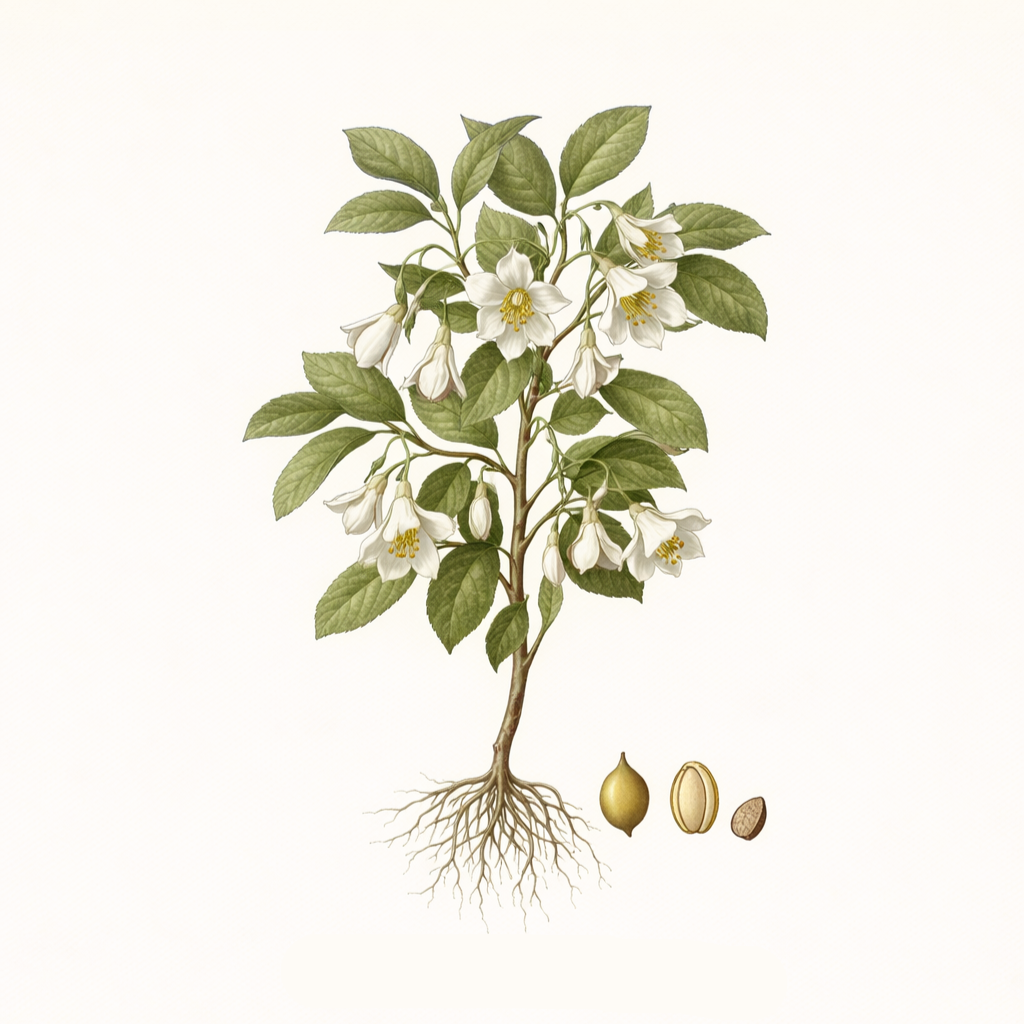
Styrax officinalis L. is a shrub or tree deciduous of the family Styracaceae, known as "sneeze tree" or "storax tree," native to Mediterranean regions and south-west Asia. It produces an aromatic oleoresin (storax) that exudes when the bark is injured.
Distribution and Biomas: Styrax officinalis It is naturally distributed in the eastern Mediterranean and adjacent parts of south-west Asia, including Greece, southern Italy, the Aegean coast of Turkey, Levante (Syria, Lebanon, Israel) and areas of Iran and Transcaucasia. It grows in Mediterranean shrubs and open forests: rocky slopes, ravines, sclerophile and clear forest margins with soft winters and dry summers, preferring well drained, often calcareous soils. These Mediterranean conditions, with marked seasons and long dry periods, seem to favour the production of more abundant and perfumed aromatic resin, so that the ethnobotanical sources highlight Greece (Peloponese), the Egea coast of Turkey and Italy as regions with high quality storax.
Major Producers: Unlike other species of the genus Styrax (as S. benzoin and S. tonkinensisthe main commercial sources of benjui in Southeast Asia), the resin of S. official is now produced in modest volumes and located in the Eastern Mediterranean. Historically, "storax in tears" or "storax in mass" was exported from regions of Greece, Anatolia and Aegean islands to Western Europe for medicinal uses and perfumers. At present, the resin of S. official is collected artisanal in some areas of Greece and Turkey for phytotherapy, incense and small perfumery production, while most of the styrax / benzoin-type resins market is supplied with Asian species such as S. benzoin.
Fast sources:
Styrax officinalis. "Trees and Shrubs Online (Arboretum of Cambridge University / IDS). 2024.
Species & Culture
Use: Odorifera resin Styrax officinalis used as the main component of an organic coating applied to human skulls decorated, in a cultual context; probable function both symbolic and ritual and olfactory (persmoking relics).
Evidence: The Nahal Hemar cave is famous for its exceptional collection of organic artifacts and decorated human skulls covered with a black coating applied in network pattern. A recent interdisciplinary study analysed these coatings by gas chromatography coupled to mass spectrometry (GC-MS) and other techniques, identifying a complex mixture of animal materials (collagen and bovine proteins) and plants.
The samples of waste in the skulls (e.g. sample NH2968) showed a spectrum of compounds dominated by benzoate and cinnamate derivatives, as well as pentacyclic triterpenes, the combination of which was closely in line with the known composition of the resin. Styrax officinalis. In addition, specific lignans typical of the crust of S. official, which suggests that crust fragments were accidentally incorporated during the preparation of the coating. The similarity between the profile of modern resin S. official and that of the coatings of Nahal Hemar led the authors to conclusively identify the resinous component as exuded from Styrax officinalis, being the oldest known evidence of the use of an odour vegetable resin in combination with an animal product in the Middle East.
The fact that this resinous coating applies exclusively to skulls —and not to other artifacts— suggests that storax was a rare and valuable material, reserved for objects of worship linked to the ancestor or the "life force" of the group. The authors argue that the addition of odoriferous resin would have given the skulls a particular perfume, strengthening their sensory dimension in rituals and ceremonies, perhaps associated with fertility and community welfare.
Fast source:
Regev, Liora, et al. "The Organic Coating from a Decorated Human Skull from the Neolithic Site of Nahal Hemar, Israel." (preprint / expanded article). 2025.
The resin of S. official It is obtained in a traditional way by wounds practiced in the bark during the warm season; the oleoresin exudes in the form of tears or masses that, when dried, are collected as "storax in tears" or "storax in mass." This raw resin can be used directly as incense (burned on brasses) or dissolved in alcohol, oils or fats to prepare perfumed ointment, ointment, aromatic water and other formulations.
In modern perfumery, storax is usually processed by solvent extraction (for example, obtaining a resinoid) or by steam distillation to produce an absolute or oil that concentrates the volatile and balsamic components, in part similar to those of other styrax and benjui. Although the most used commercial resin today comes from Styrax benzoin, S. official shares a balsamic-sweet aromatic profile, with vanilla nuances, light candy and warm resin.
Main Aromatic Molecules
Styrax Resins and Styrax profile
The resins of Styrax (including S. official and S. benzoin) are characterized by a high content in esters of aromatic acids (mainly kinamic and benzoic acid) and their derivatives, in addition to minor components such as aromatic aldehydes (benzaldehyde, vanillin) and triterpenes. In benjui resins (model near the storax), they have been identified as main components:
-
cinamyl cinnamate, methyl cinamate, benzyl cinnamate: zinc acid esters that provide warm, slightly spicy balsamic notes with chocolate or cocoa facets.
-
Free zinc acid and benzoic acid: contribute to the balsamic persistence and resinous quality of fragrance.
-
Benzaldehyde and vanillin: provide notes of bitter almond, cherry and vanilla, responsible for the sweet, slightly gourmet feeling of the storax.
-
Pentacyclic triterpenes: present in smaller proportions, act as fixers, providing body and stability to the resin and the coatings in which it is integrated.
In the specific case of Nahal Hemar, the coatings of the skulls showed a spectrum rich in benzoate and cinnamate derivatives and triterpenes compatible with a styrax-type resin of S. official, which suggests that skulls should exhale a sweet-balsamic, slightly spicy smell with vanilla nuances and hot resin. This profile contrasts with more strictly coniferous resins (pine, terebinto), providing a more "perfumistic" and sophisticated dimension to the cave's ritual practices.
Fast sources:
Asgharzadeh, Fereshteh, et al. "The Use of Styrax officinalis L. in Folk Medicine and Chemical Composition. "2023.
Kholibrina, Anastasiia, and Aswandi. "Styrax spp.: Habitat, Phenology, Phytochemicals, Biological Significance and Applications." Molecules 30, No. 5 (2025).
IFRA
IFRA has a specific standard for "Styrax" (Styrax oil / oleoresin spp., used as balsamic resin), with limits per category (e.g. 0.12% in category 1, 0.034% in category 2, higher values for others).
The standard applies to Styrax materials recognized as fragrance and flavouring ingredients; it establishes maximum concentrations in the finished product as a function of awareness assessment and other risks.
EU legislation
Styrax / benzoin is widely used in perfumery; its main components (styrene, alpha-pinene, beta-pinene, benzoates, etc.) include allergens that may be subject to individual labelling according to Regulation 1223 / 2009 and 2023 / 1545.
Styrax officinalis in particular has been studied by the composition of its essential oil of leaves, flowers and stems (germacrene D, borneol, cis-tuyone, etc.); any presence of listed allergens should be quantified for labelling and the PSRP should justify the level of use in perfumes.
Quick links:
PerfumersWorld. "Styrax - IFRA Standard (Amendment 49)." 2020.
Space under construction by collaborators.
The section Technical information and has a general arguative character. It is presented for information purposes to promote responsible knowledge. Because of the risks associated with the incorrect use of botanical extracts, aromatic molecules and the increase in unregulated practices in the production of aromatic products, Myrodia Khartes has chosen not to disclose complete extraction methodologies or specific concentrations that may compromise public safety. Health, ethics and scientific integrity guide our decision to limit the exposure of certain technical data.
- European Commission. (2009). Regulation (EC) No 1223 / 2009 on Cosmetic Products. Official Journal of the European Union, L 342, 59-209.
-
IFRA (International Fragrance Association). (2023). IFRA Standards Library: 52nd Amendment.
- The Good Scens Company. (2025). Fragrance Raw Materials Database

