

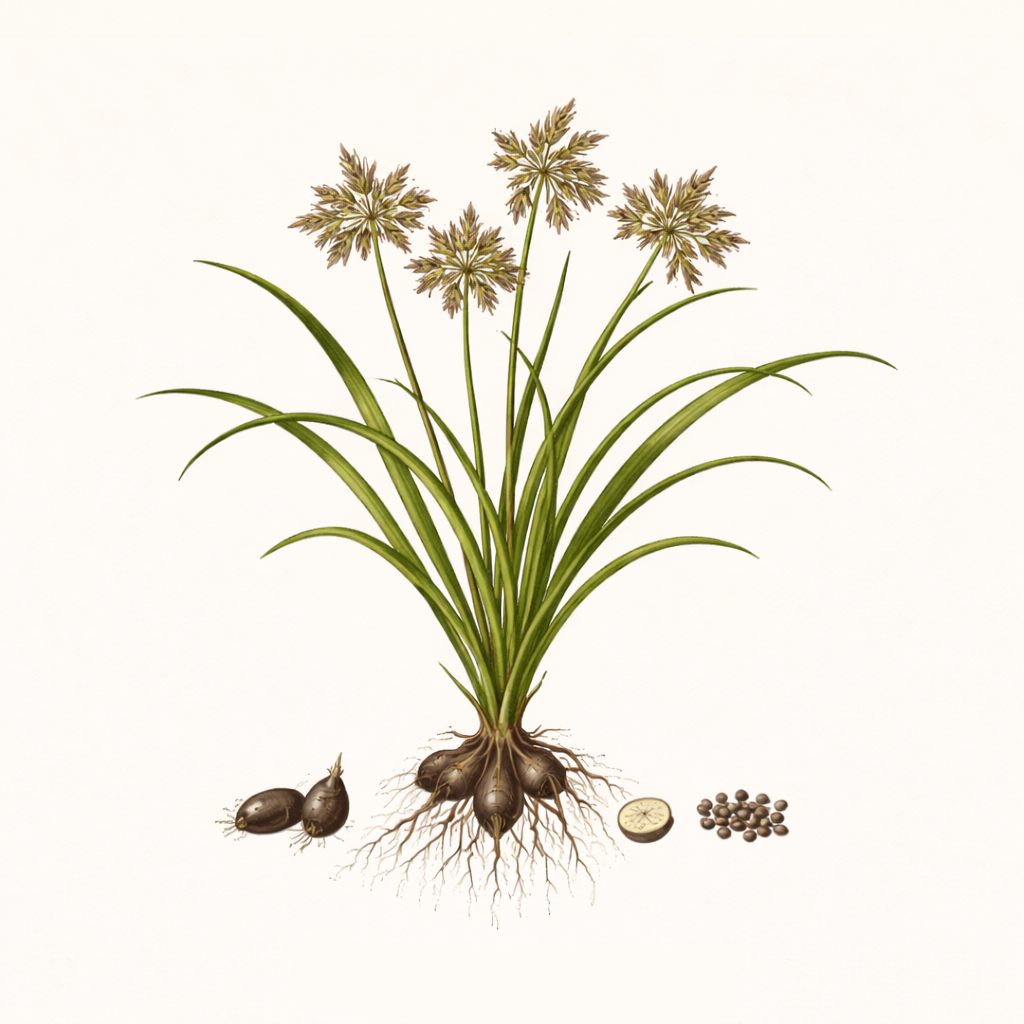
Cyperus rotundus L., known as purple nutsedge, nutgrass or abode chufa, is a perennial rizomatosa cyperacea considered one of the "most problematic weeds in the world," but also a traditional medicinal and aromatic plant with a long history of use in Africa, Asia and the Mediterranean. It has abundant rhizomes and underground tubers, of 1-3 cm long, of a black colour on the outside and white-reddish on the inside, with a characteristic odor; it also forms triangular stalks and umbelas of violet spikes. In traditional medical systems (Ayurveda, Arab medicine, Egyptian medicine and others) it has been used to treat digestive disorders, fever, inflammation, pain and gynaecological conditions, as well as as as as as aromatic and cosmetic plants.
Distribution and Biomas: Cyperus rotundus It is probably from the Old World (Africa, South Europe and South Asia), but today it is almost cosmopolitan in tropical, subtropical and warm temperate regions around the world. It grows as a colonial perennial herb in a wide range of disturbed habitats: fields of cultivation (especially rice and irrigated crops), road margins, orchards, moist grasslands and well drained sandy or limo soils. Its system of rhizomes and tubers allows it to survive in conditions of seasonal drought, temporary flooding and agricultural work, so it can form dense underground colonies difficult to eradicate.
Major Producers (modern forms): Although C. rotundus is considered mainly an agricultural weed, its rhizomes and tubers are collected or grown locally in various countries in Asia (India, China, Japan), Africa (Egypt, Morocco) and the Middle East for medicinal and aromatic uses. In Ayurvedic pharmacopoeia and related systems, dry tubers (often called musta or nagarmotha) are widely marketed as raw drugs in India and neighbouring countries, as part of digestive, tonic and aromatic mixtures; small-scale essential extracts and oils are also produced for the herbal and cosmetic industry. There is no global statistics as clear as for mint or sage oils, but ethnobotanical reviews highlight India, China and several countries in North Africa as major sources of medicinal use of the species.
Fast source:
Bhat, Supriya, et al. "Plants in Traditional Medicine with Special Reference to Cyperus rotundus L. "2018
Species & Culture
Use: Recurrent consumption of tubers of Cyperus rotundus as a source of carbohydrates, medicinal and aromatic plant, used in both pre-agricultural and agricultural periods; likely to also be used as flavouring and protective agent against dental caries.
Evidence: Hardy's and collaborators' study of dental calculation of Al Khiday's multi-period site analyzed the mineralized plate of three-phase individuals (pre-agricultural, neolithic and Merotic), combining chemical data (TD / Py-GC-MS) and plant microphones. In all periods, specific monoterpenic and sesquiterpenic compounds were identified, along with plant tissue remains, which coincided with the known chemical signature of the tubers of Cyperus rotundus from previous botanical studies. The authors conclude that "we demonstrate the ingestion, in both pre-agricultural and agricultural periods, of tubers of Cyperus rotundus"and that this plant provided carbohydrates and many medicinal and aromatic qualities.
The work highlights that today C. rotundus it is considered the most expensive weed in the world, but in Prehistory its abundant and prolific tubers made it an accessible and renewable resource. In addition, laboratory studies have shown that extracts of C. rotundus inhibit the growth of Streptococcus mutans, the main bacteria associated with dental caries. The prevalence of caries in the Merotic sample of Al Khiday is surprisingly low (less than 1% of the teeth have caries or abscesses), although they are farmers, which leads the authors to suggest that they chew tubers of C. rotundus helped protect the dentition.
The article and the related outreach notes also point out that, in addition to food, tubers appear to have been used for their aroma: historical literature shows that in Old Egypt, in micenic Greece and in other Mediterranean cultures the rhizomes of C. rotundus were used as aromatic and to smoke water, as well as in perfumes and ointment. So, the use of C. rotundus in Al Khiday fits into a long African-Asian tradition of exploitation of this plant as a multi-purpose resource: food, medicine and fragrance.
Fast source:
Hardy, Karen, et al. "Dental Calculus Rev. Unique Insights into Food Items, Cooking and Plant Processing in Prehistoric Central Sudan." PLUS ONE 9, no. 7 (2014): e100808.
In pharmacognosis and natural perfumery, the main aromatic product of C. rotundus are essential oils of tubers and rhizomes, obtained by hydrodistillation, and to a lesser extent extracts with solvents. These oils have a markedly terpenoid profile, rich in sesquiterpenes and sesquiterpenes oxygenates, with a small fraction of monoterpenes; they are described as dark oils, of a terrous odour, pasted, spicy and slightly smoked. Traditionally, rhizomas have been dried and ground for use as aromatic powder, or have been macerated in oils and cosmetic preparations, particularly in Egypt, India and northern Africa.
Main Aromatic Molecules
Cyperus rotundus essential tuber oil
The essential oils distilled from tubers of C. rotundus are composed mainly of hydrocarbon sesquiterpenes and oxygenated ssquiterpenes, with a smaller fraction of monoterpenes. Studies from different backgrounds (India, Germany, South Africa) have identified as characteristic components:
-
Cyperene and rotundene: Hydrocarbon scoterpenes, which, together with related compounds such as cyperorotundene, can constitute up to 60% of the fraction of sesquiterpenes in some oils; are associated with bended, terrous and slightly spicy notes.
-
Alpha-cyperone: Sesquiterpeno oxygenated, which appears as one of the majority components (about 8-11% in some oils), described as responsible for the bended, spicy and somewhat smoked facets.
-
Alfa-and beta-pinene, β-cariophylene, α-selinene, mirtenol and caryophylene oxide: Monoterpenes and sesquiterpenes that provide resin nuances, coniferous forest, warm spices and light balsamic notes.
This ensemble generates an olfactory profile characterized as well-walled, terrous, slightly smoked and spicy, with a warm and dry background; in perfumery, the extracts of C. rotundus They are used on a small scale for oriental chords, weaned, tabacose or leather, and can conceptually help to evoke the smell of tubers by drying, being burned or chewed, as in the case of Al Khiday.
Fast sources:
Oyedeji, Oluwatoyin A., and Ayoola J. Aholayan. "Chemical Composition of the Essential Oils of Cyperus rotundus L. from South Africa. " Molecules 14, no. 8 (2009): 2909-17.
Sonwa, Djoulde, and Wilfried Koenig. "Chemical Composition of Essential Oils from Cyperus rotundus Tuber. "(cited in Nagulendran 2015).
FRA
There is no specific IFRA standard published only for Cyperus rotundus; it is treated as complex essential oil whose use is limited by components (sesquiterpenes such as rotundona, ciperene, etc.) and its global toxicology.
The fragrance houses issue IFRA certificates for their "nagarmotha / cypriol" oils indicating maximum% per category; these levels depend on the specific analytical profile.
EU legislation
Cyperus rotundus oil is marketed for cosmetics and depilation not included in the lists of prohibited / restricted ingredients of Regulation 1223 / 2009.
Its use in perfume is assessed in the SSR as well as other related oils: possible irritating effects, awareness-raising and presence of fragrance allergens (e.g. trace of lemonene) are considered to be labelled according to Regulation (EU) 2023 / 1545 if they exceed the thresholds.
Fast source:
CIRS Group. "European Union Revised List of Prohibited and Restricted Substances in Cosmetics." 2024.
Space under construction by collaborators.
The section Technical information and has a general arguative character. It is presented for information purposes to promote responsible knowledge. Because of the risks associated with the incorrect use of botanical extracts, aromatic molecules and the increase in unregulated practices in the production of aromatic products, Myrodia Khartes has chosen not to disclose complete extraction methodologies or specific concentrations that may compromise public safety. Health, ethics and scientific integrity guide our decision to limit the exposure of certain technical data.
- European Commission. (2009). Regulation (EC) No 1223 / 2009 on Cosmetic Products. Official Journal of the European Union, L 342, 59-209.
-
IFRA (International Fragrance Association). (2023). IFRA Standards Library: 52nd Amendment.
- The Good Scens Company. (2025). Fragrance Raw Materials Database

