

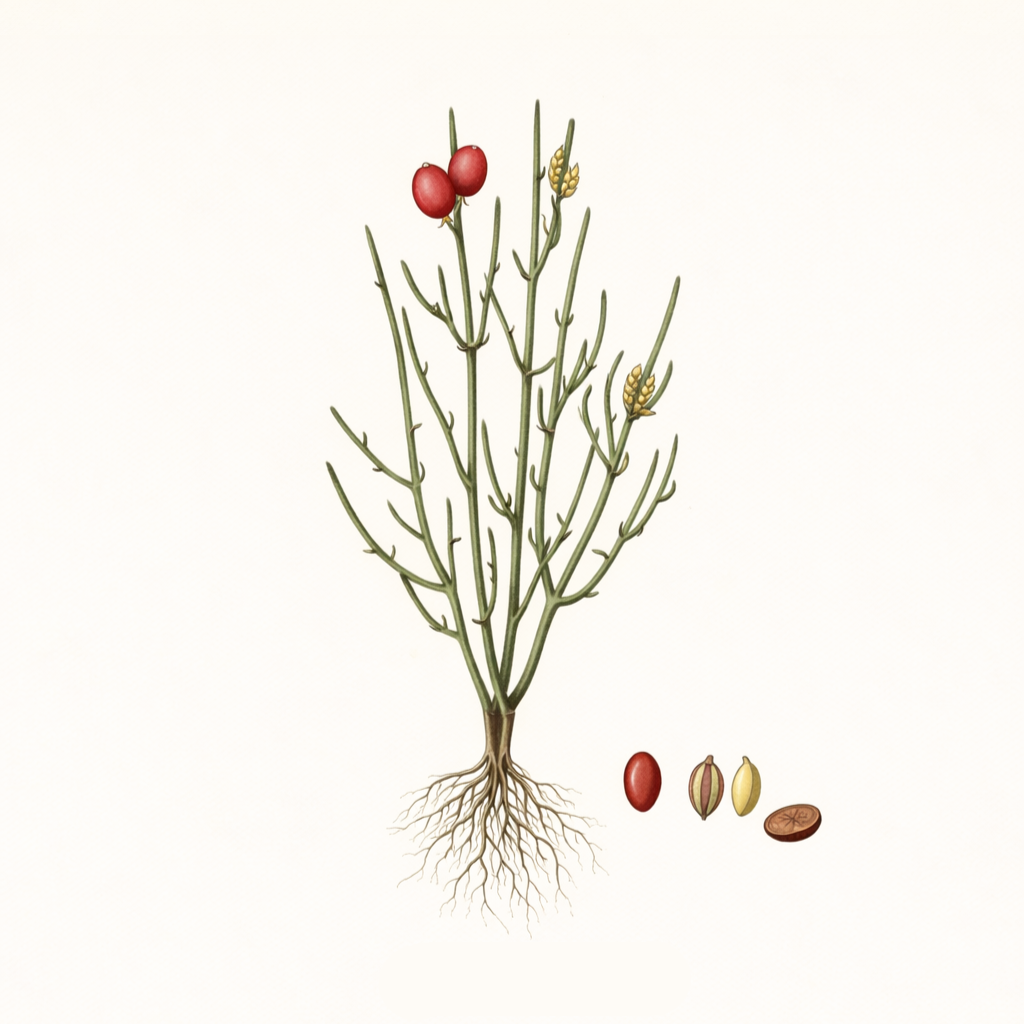
Gender Ephedra (Ephedraceae family) comprises about 60-70 species of dioic gymnosperm shrubs, of a very small appearance and leaves, which represent the only living genus of the order Ephedrales. They are plants of great evolutionary antiquity, with fossil records from the Cretaceous, and a long history of medicinal use: in various traditions in Asia, the Mediterranean and America, different species have been used to treat asthma, cold, nasal congestion and as stimulants, mainly for their content in ephedrine-type alkaloids.
- Distribution and Biomas: Ephedra is a typical genus of arid and semi-arid regions, mainly distributed in desert and stepparian environments of the eastern and western hemispheres, with the exception of Australia. Old World species range from the Mediterranean basin and North Africa to Central Asia, Himalaya and North China, while in the New World they appear in the deserts of the south-west of the United States, Mexico and Andean regions of South America. They occupy cold and warm desert biomas, steppes, xerophilic bushes and rocky slopes between depressions under the sea level (for example, the Death Valley and the Dead Sea Basin) and altitudes above 4000-5000 m in the Andes and Himalayas.
- Major Producers (modern forms): In contemporary times, the economic exploitation of Ephedra is concentrated in a few Asian species (e.g. Ephedra sinica, E. equisetin, E. intermediate), known in traditional Chinese pharmacopoeia as Má huáng, of which ephedrine and pseudoephedrine alkaloids are obtained for decongestant and bronchodilator medicinal products. China has historically been the leading producer of raw material of Ephedra for the pharmaceutical industry, although direct extraction of ephedrine from the plant has decreased in favour of chemical synthesis and strict regulation of its use. In the area of traditional supplements and teas, various species are also collected or grown in regions of Central Asia, Iran, the Middle East and Mexico, but their use is restricted in many countries due to the cardiovascular risks associated with alkaloids.
Fast sources:
Ephedra. " Encyclopaedia Britannica. Downloaded April 2026. [https: / / www.britannica.com / plant / Ephedra]
Species & Culture
Use: Desert arbustive plant (Ephedra sp.) exploited mainly in funerary contexts, with evidence of specialized ritual use and possible restricted consumption, rather than as a daily food resource.
Evidence: A recent study on the Grotte des Pigeons (Taporalt) analyzed carbonized plant macroesters from various sectors of the field, including sediments of daily activity areas and a specific Iberomaurusian burial (sector 10, an adult burial). The authors identified traces of stems and fragments of Ephedra sp. at different levels, but observed that the relative frequency of Ephedra was significantly higher in funerary filling sediments than in contemporary strata of domestic activity.
While in the daily use layers (sector 8) the remains of Ephedra are scarce and appear mixed with other taxons (e.g. wood cartons and edible coals), in the filling of the funerary pit a significantly higher concentration of Ephedra carbonized, suggesting a specific link to practices around burial. The study ruled out that Ephedra It will be a regular part of the diet: the plant is known for its stimulating effects and the cardiovascular risks from the usual consumption of ephedrine, so its recurrent use as daily food would be dangerous. The authors, on the other hand, propose that Ephedra was used during funeral ceremonies —perhaps burned as incense, macerated in drinks or deposited as a vegetable offering— reserving their consumption or manipulation to ritual or therapeutic contexts.
This finding is interpreted as the oldest known evidence of use of Ephedra in a funerary context, and is part of a wider set of Iberomaurusian symbolic practices in Taporalt, which includes the use of ocre, multiple burials and deposition of objects worked together with the bodies.
Fast source:
Morales, Jacob, et al. "Late Pleistocene Exploitation of Ephedra in a Funeral Context in Morocco. " Scientific Reports 14 (2024): 26443. [https: / / www.nature.com / articles / s41598-024-77785-w]
In the modern medicinal and pharmaceutical tradition, Ephedra is used mainly by its ephedrine / pseudoephedrine alkaloids, extracted from stems and branches by maceration and chemical purification, rather than by its essential oil in a strict perfumistic sense. However, several studies have also investigated the composition of essential oil in some species of Ephedra, obtained by hydrodistillation of air parts, containing a mixture of monoterpenes, sesquiterpenes and other volatile molecules.
The performance of essential oil is usually low, and its use in perfumery is very minority; however, at the aromatic level, the species analysed may have resinous, herbal, slightly citrus or floral notes, depending on the proportion of oxygenated monotherpenes (e.g. citronelol, linalool) and esters. In traditional contexts, before modern chemistry, the exploitation of Ephedra for rituals (as in Taporalt) has been based on the combustion of dry, infusions or macerated branches, releasing both alkaloids (with physiological effects) and aromatic volatile to the environment of the funerary caves.
Main Aromatic Molecules
Chemical and olfactory profile of Ephedra
The best known feature of Ephedra is its content in sympathomimetic alkaloids of the type phenylalkylamine, mainly ephedrine and pseudoephedrine, present in variable proportions according to species, origin and part of the plant. These compounds are practically odorous as pure molecules, but responsible for the pharmacological effects (stimulation of the central nervous system, bronchodilation, increased heart rate) that have caused their medicinal use and strict regulation.
For the aromatic volatile fraction, studies of essential oils have identified mainly monoterpenes and oxygenated monoterpenes, including:
-
Citronelol (monoterpenic, floral-citric-odour alcohol), which is Ephedra nebrodensis it reaches almost 30% of the oxygen monoterpene fraction.
-
Other components such as limonene, α-pinene, β-pinene, linalool and fatty acid esters (e.g. ethyl hexadecanoate), which provide citrus, resinous and slightly herbal facets.
Olfatively, this suggests that fresh or slightly crushed branches of Ephedra can emit a green, resinous aroma, with soft citrus / floral nuances, while the burning of dry stems in ritual contexts (as a possible interpretation for Taporalt) would produce a wood-resinous smoke with light aromatic touches, superimposed on the physical effects of alkaloids if there was direct consumption.
Fast source:
Giuffrida, Daniele, et al. "Essential Oil Composition of Ephedra nebrodensis…” Natural Product Communications 10, No. 5 (2015).
IFRA
There is no standard IFRA for "essential ephedra oil" in perfumery; the main concern is the ephedrine alkaloids (ephedrine, pseudoephedrine, etc.), powerful sympathomimetics.
IFRA, in its risk management approach, would disadvise the use of cardioactive alkaloids extracts in products of routine consumption; any use would be subject to very restrictive toxicological evaluation.
EU legislation
At the food level, EFSA has concluded that the preparations of Ephedra in supplements are of "major concern" for the risk of serious effects, and many Member States have adopted prohibitions on food.
For cosmetics, Ephedra does not appear as a "typical" cosmetic ingredient; an extract that provides active alkaloids would be difficult to justify in a PSRP for the possibility of skin absorption and systemic effects, so, in practice, its use in fine skin perfumes is not considered acceptable from the current European safety perspective.
Key references:
SG Systems Global. "IFRA compliance for fragrances." 2025.
Space under construction by collaborators.
The section Technical information and has a general arguative character. It is presented for information purposes to promote responsible knowledge. Because of the risks associated with the incorrect use of botanical extracts, aromatic molecules and the increase in unregulated practices in the production of aromatic products, Myrodia Khartes has chosen not to disclose complete extraction methodologies or specific concentrations that may compromise public safety. Health, ethics and scientific integrity guide our decision to limit the exposure of certain technical data.
- European Commission. (2009). Regulation (EC) No 1223 / 2009 on Cosmetic Products. Official Journal of the European Union, L 342, 59-209.
-
IFRA (International Fragrance Association). (2023). IFRA Standards Library: 52nd Amendment.
- The Good Scens Company. (2025). Fragrance Raw Materials Database

