

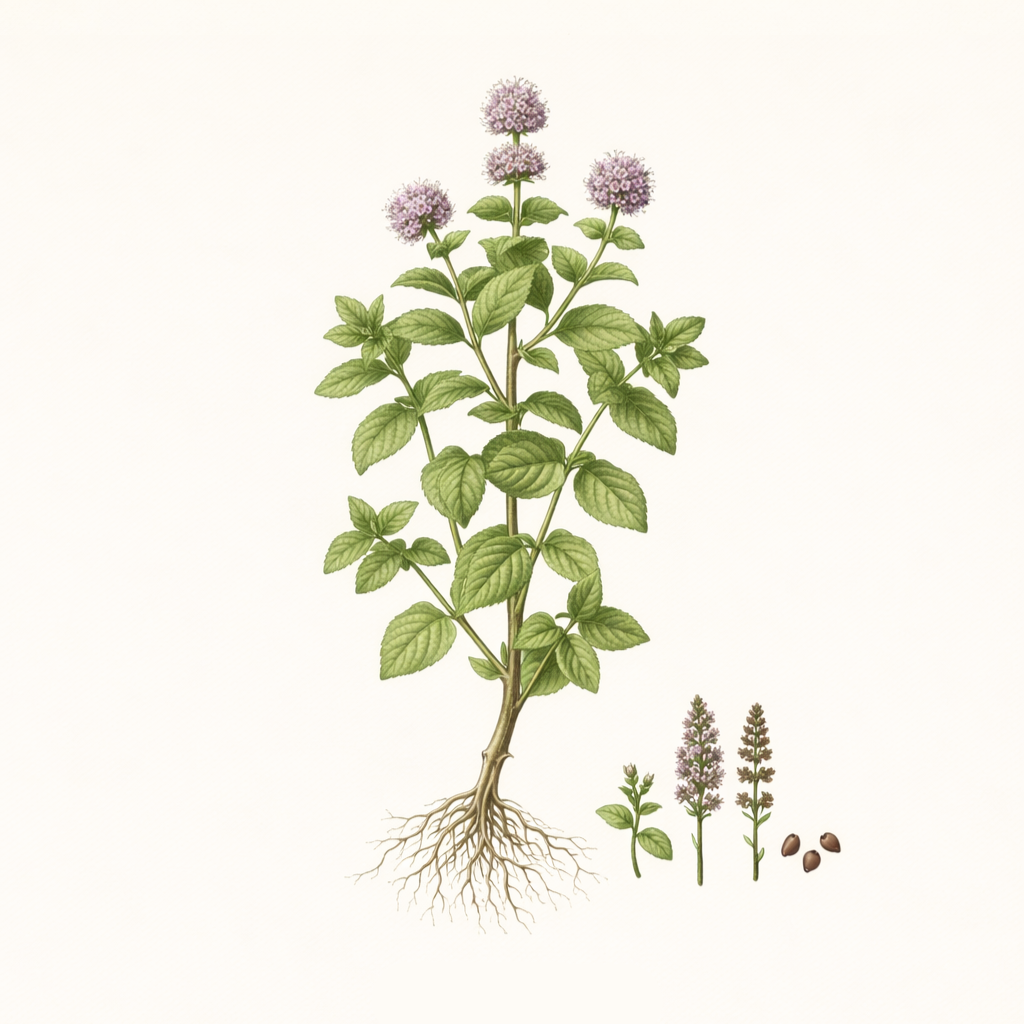
Gender Meth (Lamiaceae) comprises between 18 and 25 accepted species of perennial aromatic herbs, as well as numerous natural and cultivated hybrids (such as Mentha × piperite), widely used as medicinal, culinary and industrial plants. The mints are characterized by generally square stems, opposite leaves with abundant glandular tricomas producing essential oil and a strong mentholated, sweet or spicy aroma according to the species (for example, pepperite mint, peppermint, field mint). Historically, they have been used as digestive, carminative, antispasmodic and flavouring food and drink, and today they are one of the most important groups of aromatic plants economically and culturally.
Distribution and Biomas: Gender Meth It probably originated in the Mediterranean basin and south-west Asia, but today it has a virtually cosmopolitan distribution in temperate and subtropical regions of Europe, Asia, North Africa, Australia and North America. Most species of Meth prefer humid or fresh habitats: river banks, river margins, wet meadows, rich organic soils, cultivated fields and irrigated road edges; some species also tolerate moderately dry soils if there is nearby groundwater. These plants grow well in temperate climates with not too hot summers, but certain industrial cultivars have adapted to warmer regions under specific agronomic management.
Major Producers: Today, several species of Meth are grown as industrial crops for the production of essential oil, the most important being Mentha canadensis (Japanese mint), M. arvensis, M. spicata (peppermint), M. aquatica and the sterile hybrid Mentha × piperite (peppermint). The main world producers of essential mint oil are the United States, India and China, which supply the food, pharmaceutical and perfumery industry; other relevant producing countries include Brazil, Argentina, several European states (France, Germany, Bulgaria, Romania) and Mediterranean countries. Industrial minds are grown under intensive systems, where fertilization and water conditions are optimized to maximize foliar biomass and essential oil performance.
Fast sources:
Yadegari, Mehran, et al. "A Comprehensive Review of the Key Characteristics of the Genus Meth.” Plants 12, no. 19 (2023). [https: / / pmc.ncbi.nlm.nih.gov / articles / PMC10804064 /]
Species & Culture
Use: Aromatic plants of the family Lamiaceae, including Meth sp., used as part of the green and flower plant beds that covered the graves; possible parallel use in daily life as aromatic, medicinal or insect repellent herbs, although this remains inferred more than directly demonstrated.
Evidence: The study on the flower coatings of Raqefet describes impressions of stems and leaves belonging mainly to Lamiaceae (mint family), with square stems and opposite leaves that could correspond both to Salvia like other mints and close relatives. The combined analysis of macroscopic impressions and dicotyledoneal phytolytes showed an exceptionally high density of leaves and stems in four tombs, interpreted as evidence that the Natufienses deposited large amounts of fresh aromatic plants as "flower beds" under the deceased. In its article, Nadel and colleagues explicitly point out that, in addition to Fruit salvia As a candidate sage, other local Lamiaceae (including mints) were considered and analysed morphologically and the phytolytes of these species enter the group of dicotyledoneas identified in the graves sediments.
Press releases and notes on the finding emphasize that plant impressions include "sage stems and other species of the mint family" and that the Natufienses "extended green plant beds in flower" into the graves before depositing the bodies. Although no specific species of Meth (as M. longifolia or M. spicata), the floristic context of Mount Carmelo makes the presence of wild mints of nearby and moist watercourses, integrated into the branches deposited in the graves, likely. From the olfactory point of view, this implies a funerary environment marked by mentholated, green and fresh notes of the mints, superposed to the driest and most acuphorate perfume of the salvias and other Lamiaceae.
Fast source:
Nadel, Dani, et al. "Earliest Floral Grave Lining from 13,700-11,700-y-Old Natufian Burials at Raqefet Cave, Mt. Carmel, Israel." PNAS 110, no. 29 (2013): 11774-79. [https: / / pmc.ncbi.nlm.nih.gov / articles / PMC3718103 /]
In modern perfumery and aromatherapy, mints are used mainly through essential oils obtained by steam distillation of the air parts (leaves and florid sumities), as well as to a lesser extent by alcoholic extracts and supercritical CO. The essential oils of mint form a very important group within the commercial oils, highlighting those of pepperite mint (M. × piperite), Japanese mint (M. canadensis / M. arvensis) and peanut (M. spicata), each with a different chemical and olfactory profile.
In case of M. × piperitethe essential oil is characterized by high content of menthol and mentone, responsible for the refreshing effect and the intense smell of "classical" mint; M. spicata, the dominant component is carvone, which produces a softer, sweet and "chewy" aroma, without the extreme freshness of the menthol.
Main Aromatic Molecules
Essential Meth oils (generic profile)
The essential oils of Meth are dominated by monoterpenes and their oxygenated derivatives, with profiles that vary according to the species:
-
In peppermint (M. × piperite), the key molecules are menthol (monoterpenic alcohol), menthone (monoterpenic ketone) and its isomers (isomentone, neomentol), responsible for the intense refreshing effect, penetrating aroma and slightly sweet facet of the mint.
-
In peppermint (M. spicata), the dominant component is carvone (40-70% of essential oil), accompanied by lemonene, 1,8-cineol and other monoterpenes; this profile confers a sweet, green and "mint gum" aroma, with less cold freshness than the piperite.
-
In field mints (M. arvensis, M. canadensis), oil is often so rich in menthol that it is used as a primary source of crystallized menthol for the pharmaceutical and personal care industry.
At the olfactory level, we can summarize that the mints combine green, herbal, sweet and refreshing notes, with a more or less dominant mentholed axis depending on the species.
IFRA
Meth oils (especially M. piperita) have IFRA certificates issued by each supplier with use limits per category; an example of organic pepperite mint oil shows a maximum of 20% in category 4 (hydroalcoholic perfume).
IFRA controls components such as menthol, menthone, menthyl acetate, lemonene and other allergens, and has banned, for example, mintlactone in the 50th amendment.
EU legislation
Regulation (EU) 2023 / 1545 extends the list of allergens and includes Mentha piperite oil, Mentha viritis leaf oil, menthol and other mint derivatives to be labelled above 0.001% leave-on / 0.01% ruse-off.
There is no general prohibition for "Mentha" in cosmetics; the real limit comes from the sum of menthol and other allergens, and from safety reasoning (blushing feeling, irritation in mucous, etc.).
Fast sources:
NHR Organic Oils. "IFRA Conformity Certificate - Organic Peppermint Essential Oil (Mentha piperita)." 2020.
Nikura. "Certificate of Conformity with IFRA Standards - Peppermint Essential Oil." 2023.
Space under construction by collaborators.
The section Technical information and has a general arguative character. It is presented for information purposes to promote responsible knowledge. Because of the risks associated with the incorrect use of botanical extracts, aromatic molecules and the increase in unregulated practices in the production of aromatic products, Myrodia Khartes has chosen not to disclose complete extraction methodologies or specific concentrations that may compromise public safety. Health, ethics and scientific integrity guide our decision to limit the exposure of certain technical data.
- European Commission. (2009). Regulation (EC) No 1223 / 2009 on Cosmetic Products. Official Journal of the European Union, L 342, 59-209.
-
IFRA (International Fragrance Association). (2023). IFRA Standards Library: 52nd Amendment.
- The Good Scens Company. (2025). Fragrance Raw Materials Database

