

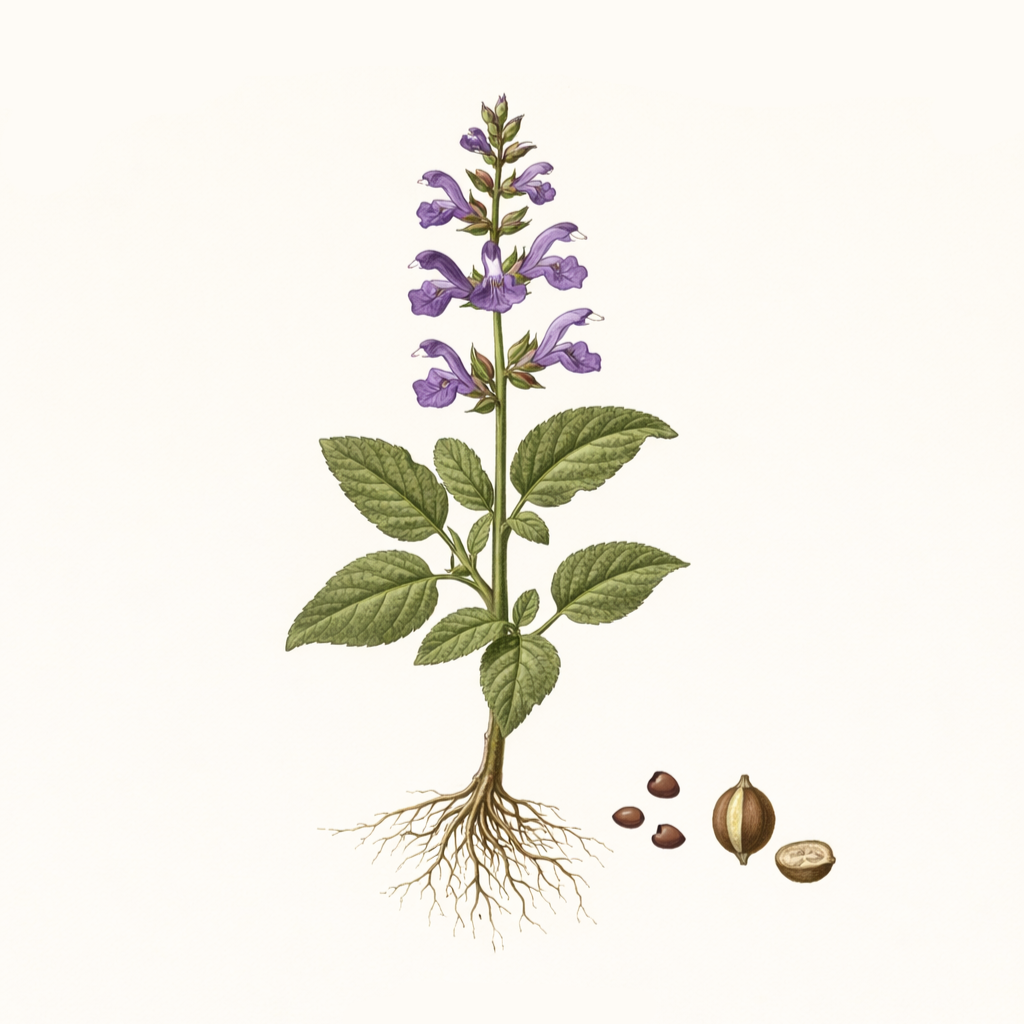
Gender Salvia is the most diverse of the family Lamiaceae, with between 900 and almost 1000 species of bushes, perennial and annual herbs distributed in temperate and tropical regions around the world. Several reviews indicate that gender is organized in large subgroups (e.g. subgender) Calospago in America) and which concentrates a very significant part of the diversity of Lamiaceae in areas such as Mexico, the Andes and the Mediterranean. Many species have been used historically as medicinal plants (digestive, antiseptic, tonic), culinary (condiment, infusions) and ritual, highlighting Salvia officinalis and Sage as reference species in phytotherapy and perfumery.
- Distribution and Biomas: Salvia It is widely distributed in temperate, subtropical and tropical regions with three major diversity centres: Central and South America (approx. 500-600 species), the Mediterranean-Western Asia region (about 250 species) and East Asia (about 90 species). On an ecological scale, the species of Salvia They mainly occupy biomas of Mediterranean bushes, dry grasslands and pastures, rocky slopes, light temperate forest and semi-arid mountain areas, although some species are adapted to moist or high mountain environments. Many Mediterranean and Mesoamerican salvias show adaptations to drought (pubescent leaves, high production of essential oils, deep roots) and thrive in well drained soils, from stony limestones to volcanic substrates.
- Major Producers: From an economic point of view, a few species concentrate most of the commercial crop: Salvia officinalis (common sage) for dry leaves and essential oil of "Dalmatian sage," Sage (sage clarifies) for essential and absolute oil of clary sage; and Fruit salvia in the Eastern Mediterranean for infusions and essential oil. Historically, the production of essential oil from S. official it was concentrated in the Dalmatian region of the former Yugoslavia and in Cyprus, then expanding to France, Bulgaria, Turkey, Malta, Germany, Morocco and Spain; today it is estimated that there are 5-15 tonnes of salvia oil per year, with Croatia, Albania, France, Bulgaria, Morocco and Spain as key producers. In case of Sage, the clear sage is widely grown for extraction in France, Bulgaria, several post-Soviet states, the United States, Morocco, Romania, Italy and parts of China, with an estimated global production of about 1500 tons of essential oil per year. These products mainly supply the perfumery and flavouring industry, as well as phytotherapy and the market for infusions and condiments.
Fast source:
Walker, Jason B., et al. "Richness and distribution of Salvia subg. Calospago (Lamiaceae). " Willdenowia 49, No. 3 (2019).
Species & Culture
Use: Aromatic and symbolic plant used as part of flower tombs (flower beds), probably selected by its intense perfume and its symbolic association with the montane environment; possible parallel use such as infusion, aromatized food or medicinal plant, although this cannot be demonstrated directly in Raqefet.
Evidence: The classic study on Raqefet published the finding of the oldest known floral coatings, in four Natufian tombs of the cave. From foliar impressions in the sediment, microscopic remains (phytolytes) and the disposition of the plants under the bodies, the authors identified several taxons of herbaceous plants, predominating Lamiaceae with linear-lanceolated leaves and floral verticules compatible with Salvia and Meth. In two of the best preserved tombs (for example, burial 8), the plants had been arranged to form a "bed" of stems and leaves under the deceased, indicating a deliberate action to cover the pit with newly collected aromatic plants.
Researchers point out that the Lamiaceae probably included local salvia species from Monte Carmelo, citing as candidates Fruit salvia (Greek sage / three lobes sage) and S. palaestine, abundant today on the nearby slopes and with a very intense aroma as you step on them. These powers are based on the coincidence between the morphology of the printed leaves, the current ecological context and the phenology (the florations coincide with the time of the year when the burials are most likely to have been performed). However, the authors maintain the identification at the level of Salvia sp. (Lamiaceae) for taxonomic prudence, so in this document we also talk about Salvia in a generic way.
Other works of microesters and phytostines in Raqefet have shown that, in addition to their role in graves, the Lamiaceae (including Salvia and mint) were used as plants of daily use (possible food, infusions, flavouring or insect repellents), strengthening the idea that the Natufiense community of Carmel had a sophisticated knowledge of local aromatic plants. From an olfactory point of view, Raqefet's "flower beds" involve a funerary environment saturated with the smell of fresh sage and other herbs, with an explicit sensory component in the ritual.
Fast source (Raqefet and Salvia):
Nadel et al. 2013, "Earliest floral grave lining from 13,700-11,700-and-old Natufian burials at Raqefet Cave, Mt. Carmel, Israel" - PNAS / open access version.
In modern perfumery and phytotherapy, various species of Salvia they are used mainly through their essential oil and, to a lesser extent, hydroalcoholic or CO-extracts. Although in the Natufiense context there is no evidence of distillation, these contemporary processes allow to translate the aromatic potential of Raqefet's sages into a current perfumistic language.
Essential oil (steam distillation):
In the case of Mediterranean sages (such as S. official and S. futicose), the essential oil is obtained by steam distillation of the air parts (leaves and florid sumities), with yields usually of around 1-2% by dry weight. The resulting oil is of intense odour, herbal, elongated and somewhat spicy, and consists mainly of monoterpenes and oxygenated diterpenes (e.g. 1,8-cineol, tuyone, borneol and its esters).
Hydroalcoholic and CO extracts:
In addition to essential oil, hydroalcoholic extracts of leaves of Salvia which concentrate both volatile components and phenolic compounds (rosmarinic acid, flavonoids), with a less incisive aroma, more "herbal infusion." Supercritical CO extracts allow for more selective fractions with less content in potentially neurotoxic compounds (such as tuyones), strengthening specific aromatic facets (colloated freshness, green notes) of perfumistic interest.
Main Aromatic Molecules
The essential oils of different Mediterranean sages share a core of monoterpenes and oxygenated monoterpenes responsible for their characteristic aroma. Quantitative composition varies between species and chemotypes (e.g., S. official rich in tuyone, S. futicose more rich in 1,8-cineol), but some components appear on a recurrent basis:
-
1,8-Cineol (eucaliptol): Oxygenated monoterpene with fresh odour, elongated and slightly mentholated; it provides the "eucalyptus-salvia" character of oil.
-
Alpha-and beta-tuyone: Monoterpenic ketone of dry odour, artemisia-salvia, which contributes to the camphoracea and somewhat medicinal facet; its presence and concentration vary between species and is regulated in perfumery and phytotherapy for safety issues.
-
Borneol and bornyl acetate: Alcohol and monoterpenic ester with balsamic notes, pine-resinous and something sweet, which round the herbal profile.
-
Alfa-and beta-pinene, lemonene and other monoterpenes: They provide nuances of coniferous forest, soft citrus and green freshness.
In all, the aroma of a typical Mediterranean sage can be described as herbal, elongated, slightly sweetly balsamic, with nuances of eucalyptus and dry forest, a profile that fits well with the imagery of aromatic rocky slopes of Mount Carmelo where Raqefet is located.
Fast sources:
Scenspiracy. "Salvia officinalis oil (CAS 8022-56-8 / 84776-73-8)." Technical sheet of fragrance ingredient, consulted April 2026. [https: / / www.scentspiracy.com / fragrance-ingredients / p / salvia-officalis-oil]
IFRA
Salvia officinalis oil is considered a restricted matter because it contains α-and β-tuyone, the limit of which is set by the IFRA standard for tuyone (49th and 51st amendment).
IFRA does not prohibit sage oil, but requires to calculate the contribution of tuyone in each product category (perfume = category 4) and to remain below the maximum% allowed for tuyone in that category for reasons of neurotoxicity.
EU legislation
The EU does not prohibit sage as a cosmetic ingredient, but tuyone is regulated and its use as a food flavouring is not authorised, reflecting its toxicological concern.
For cosmetics, sage should be evaluated in the RCP taking into account the content of tuyone and other terpenes (1,8-cineol, alcfor, etc.), and any fragrance allergic (linalol, lemonene, etc.) should be labelled as Annex III updated by Regulation (EU) 2023 / 1545.
Fast sources:
Critical Catalyst. "50th Amendment to the IFRA Code of Practice." 2021.
Scenspiracy. "Salvia officinalis (Sage) Essential Oil - Regulatory & Safety Overview." 2024.
Space under construction by collaborators.
The section Technical information and has a general arguative character. It is presented for information purposes to promote responsible knowledge. Because of the risks associated with the incorrect use of botanical extracts, aromatic molecules and the increase in unregulated practices in the production of aromatic products, Myrodia Khartes has chosen not to disclose complete extraction methodologies or specific concentrations that may compromise public safety. Health, ethics and scientific integrity guide our decision to limit the exposure of certain technical data.
- European Commission. (2009). Regulation (EC) No 1223 / 2009 on Cosmetic Products. Official Journal of the European Union, L 342, 59-209.
-
IFRA (International Fragrance Association). (2023). IFRA Standards Library: 52nd Amendment.
- The Good Scens Company. (2025). Fragrance Raw Materials Database

