

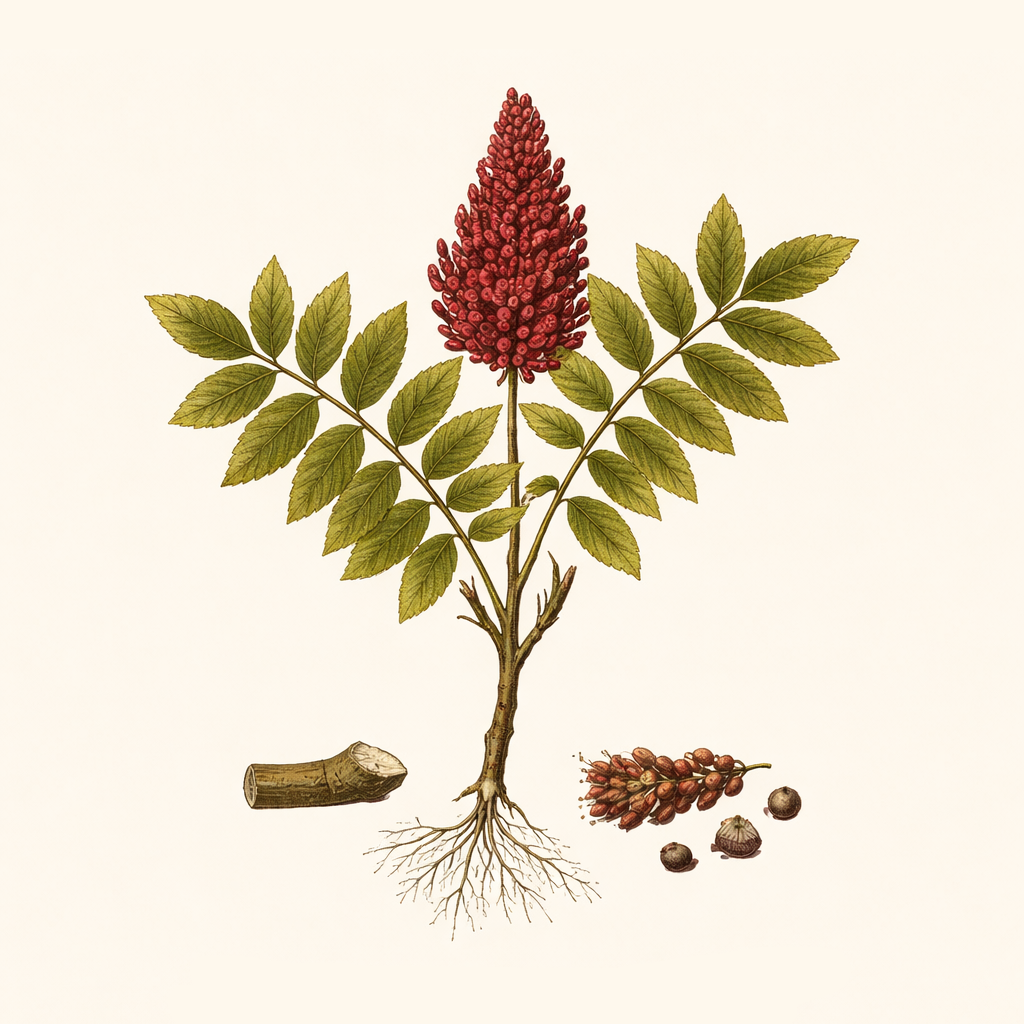
It is a shrub or tree deciduous of the Anacardiaceae family, commonly known as zumac or sumac, native to the eastern Mediterranean region and the Middle East. Its dried red infruities are used from the Antiquity as acid spice, colouring and medicinal remedy, and today they are the main culinary sumac in kitchens of the Middle East and the Mediterranean. Although it is mostly associated with historical times, the appearance of seeds and sumac wood in neolithic contexts suggests that its use as a useful plant has very old roots.
-
Distribution and Biomas: Rhus choriaria It grows on rocky slopes, bushes and forest borders in regions of Mediterranean and subMediterranean climate, from the Eastern Mediterranean and Anatolia to Western Iran; it is also grown locally in northern Iraq, Syria and other areas of the Middle East. It prefers well drained soils, sunny exposure and summer drought, so it is characteristic of dry hills and open valleys such as those surrounding the central Anatolia.
-
Major Producers (modern forms): Sumac is currently being grown. —mainly R. choriaria— in Turkey, Iran, Iraq, Syria, Lebanon and parts of the Mediterranean (e.g. Sicily), where infruities are harvested, dried and ground for use as spice and colouring. -
Fast sources:
IntechOpen 2020, chapter "Applications of Rhus...": synthesis on the genus Rhus and description of Rhus choriaria as the only species present in Iraq, growing wild and cultivated near villages.
Species & Culture
Use: Probably used as a collected wild plant, with possible functions such as acid condiment, dry aromatic fruit, colouring and wood; the available evidence is very little but suggests knowledge of sumac in the environment of Çatalhöyük.
Evidence:
In the Archive Report 1999 - "Archaeobotany and Related Plant Studies," Bogaard and Charles point out that "a single seed of sumac was found (Rhus choriaria) in space 181, the first example on the site, and that this seed finding is paralleled by a finding of its wood (see Eleni Asouti's file report). "This mention indicates that both seeds and wood coal attributable to Rhus choriaria were present at least in a stratigraphic context of the east mound.
The other macro-botanical reports for Çatalhöyük (focused on cereals, pulses, nuts and acorns) just again mention sumac, which reinforces the idea that Rhus choriaria was a very minority component of the plant spectrum used. However, the combination of seed and wood in the same space suggests that the plant could be used for both its fruits and as fuel or woody material, following documented ethnographic patterns for sumac in modern Anatolia and northern Iraq, where it is collected for culinary, medicinal and dye uses.
Fast sources:
Çatalhöyük 1999 Archive Report - "Archaeobotany and Related Plant Studies": mention of "a single seed of sumach (Rhus choriaria)... the first example on the site, "along with finding its wood.
Although Rhus choriaria is known mainly as culinary spices, several studies have shown that their fruits contain appreciable amounts of essential oil rich in monoterpenes and other volatile, which opens the door to its aromatic use. However, in perfumery it remains a rare raw material; most of the information comes from food chemistry and phytochemistry.
Traditional use as spice and aromatic:
The mature infruities of sumac are harvested when they take a dark red color, dry in the sun and grind until they get an acid-flavoured reddish powder, which is used as a condiment in numerous kitchens of the Levant, Anatolia and the Caucasus, and as a component of the mixture of spices' atar. Its acidity comes mainly from organic acids (malic, citric, tartaric) present in the pericarp, while the aroma is due to a volatile fraction composed of monoterpenes and other aromatic compounds.
Essential oil Rhus choriaria:
Recent studies have analysed the essential oil of Sumac fruits obtained by hydrodistillation. A work on Jordanian samples found that "the fruits of Rhus choriaria show essential oils composed of monoterpenes and / or sesquiterpenes, "with variable profiles per locality, but always with marked presence of terpenes such as carvacrol, p-cymeno, γ-terpinene, lemonene and others. Another study on 14 Iranian populations measured essential oil yields between 0.04 and 0.19% (v / p) and confirmed the dominance of oxygen and aromatic monoterpenes in several chemotypes. These oils have a fruity-resinous, slightly citric and spicy smell that complements the acidity of the spice.
Main Aromatic Molecules
olfactory profile of Sumac fruits (Rhus choriaria)
The analysis of the volatile composition of the fruits of Rhus choriaria have shown that, although the plant is not considered a classic "aromatic," its spice is enriched in essential oil with monoterpenes and sesquiterpenes that determine its aroma. The exact proportion of compounds varies between populations and regions, but several studies coincide with the recurrent presence of:
-
Carvacrol: Phenolic monoterpene with warm odour, spicy and slightly to oregano / thyme, which brings balsamic depth to the note of sumac.
-
p-Cymeno and γ-terpinene: Aromatic monoterpenes also present in oregano and citrus; they contribute to citrus, herbal and slightly resinous facets in the bouquet.
-
Limonene and other citrus monoterpenes: They add citric freshness and notes of lemon skin that accompany the taste acidity of the spice.
-
Miscellaneous sheshiterpenes: In some chemotypes, sesquiterpenes such as β-cariophylline and germacrene provide a bended-balsamic background.
Overall, the aromatic profile of Rhus choriaria It can be described as fruity-citric, slightly vinegar-frutal, with herbal and spicy nuances; in conceptual perfumery, a sumac chord could be built by combining an acid facet (for example by fruit-acid molecules and soft vinegar notes) with oregano / citrus aromatic monterpenes to evoke this species from the Middle East.
Fast sources:
Giovanelli et al. / Elshafie et al. 2021, "Volatile composition and biological activity of Jordanian Rhus choriaria fruit ": analysis by GC-HS-SPME and GC-MS of volatile and essential oil of sumac.
Daneshyari 2017, "Sumac (Rhus choriaria L.) fruit ": study on essential oils from 14 Iranian populations, performance and composition variability.
IFRA: there is no IFRA standard dedicated to "sumac extract" in public lists; the few commercial references are composite fragrances that carry "sumac" only as a marketing descriptor, with IFRA certificates that limit the mixture according to their compounds (smoked, phenolic, etc.).
EU: Zumac does not appear as a prohibited / restricted cosmetic ingredient in the updated lists of Regulation 1223 / 2009; any concerns (high tannins, irritation, phenolic compounds) are managed by safety assessment, not by a name ban.
Space under construction by collaborators.
The section Technical information and has a general arguative character. It is presented for information purposes to promote responsible knowledge. Because of the risks associated with the incorrect use of botanical extracts, aromatic molecules and the increase in unregulated practices in the production of aromatic products, Myrodia Khartes has chosen not to disclose complete extraction methodologies or specific concentrations that may compromise public safety. Health, ethics and scientific integrity guide our decision to limit the exposure of certain technical data.
- European Commission. (2009). Regulation (EC) No 1223 / 2009 on Cosmetic Products. Official Journal of the European Union, L 342, 59-209.
-
IFRA (International Fragrance Association). (2023). IFRA Standards Library: 52nd Amendment.
- The Good Scens Company. (2025). Fragrance Raw Materials Database

