

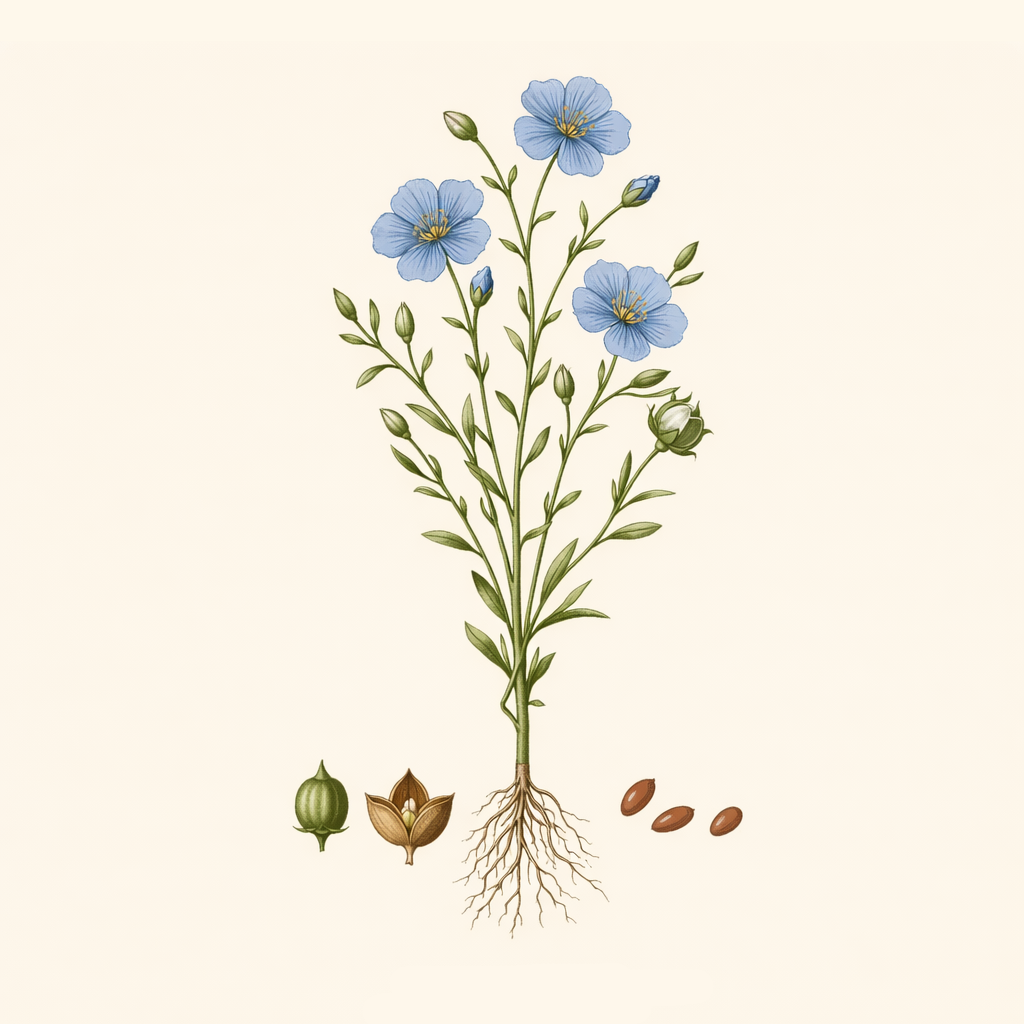
Gender Linum includes both wild species and cultivated flax (Linum usitatissimum), an annual plant of the family Linaceae used since Prehistory for its oilseeds (linaza) and its textile fibres. Domestic flax is derived from the wild species pale flax (Linum bienne = L. angustifolium), which is widely distributed in the Mediterranean and south-west Asia, including central Anatolia.
-
Distribution and Biomas: Linum bienne and other wild species of flax grow in open pastures, stony slopes and fallow fields of Mediterranean and steppe climate, tolerating relatively poor and well drained soils. The grown flax (L. usitatissimum) is well adapted to temperate climates with fresh growth stations and deep soils; historically it has been cultivated both by fiber (in more humid regions) and by oilseed (in somewhat drier regions).
-
Major Producers (modern forms): Today, seed flax (linseed) production is concentrated in Canada, Russia, Kazakhstan and China, while textile flax is grown in France, Belgium, the Netherlands and other European regions; in all cases, the main species is L. usitatissimum.
Fast sources:
Diederichsen & Hammer (cited in Rast-Eicher), on the origin of L. usitatissimum from L. bienne.
Species & Culture
Use: Possible source of oil (flax / linseed) and, more hypothetically, textile fibre; in the case of Çatalhöyük, evidence suggests that flax was extremely rare and that textile production was based mainly on tree bark fibres (base), not on flax.
Evidence:
In the Archive Report 1999 - "Archaeobotany and Related Plant Studies," Bogaard and Charles point out as one of the most interesting findings of the season "the presence of flax / linseed (Linum sp.) in a single sample of the lower levels of space 181, "and add that" this taxon had not been previously recovered in Çatalhöyük and we must still confirm whether it is wild or domestic. "Table 5 of the same report is ready Linum sp. as "flax (keten)" among domestic plants identified by seeds and fruits in the excavations of 1996-1999, although the total frequency is very low.
For years it was interpreted that the few remains of flax, together with the presence of very well preserved textiles in the east mound, suggested the use of flax imported for fine fabrics. However, recent studies of textile fibres from Çatalhöyük have shown that many of the tissues that were previously thought to be flax are actually made of local tree bark fibres (base), with specific identification of oak base (Quercus sp.) in several samples. These works underline that, given the rare nature of flax in the botanical register of the site, flax textiles, if any, were probably objects imported from other regions of the Fértil Growing and not large-scale local crop products.
In terms of subsistence, the shortage of Linum suggests that its role as an oilseed or textile crop in Çatalhöyük was at least marginal compared to cereals, pulses, nuts and other plant resources.
Fast sources:
Çatalhöyük 1999 Archive Report - "Archaeobotany and Related Plant Studies": mention of Linum sp. in a sample of the lower space 181 and list of Linum sp. as "flax" on the table of domestic plants.
Stop Linum sp. the most relevant aromatic raw material is linseed oil (linseed oil), obtained from flax seeds, which has historically been used as dry oil in paints, varnishes and, more recently, in cosmetics and food. Although it is not a classical perfumistic matter, its fatty smell, slightly to nut and drying oil, can be incorporated into sensory reconstructions related to seed and oil processing tasks.
Linseed oil:
-
Cold-pressed: The standard procedure for obtaining food-quality or cosmetic linseed oil consists of grinding and cold pressing of mature seeds. Linum usitatissimum to extract an oil rich in polyunsaturated fatty acids (especially alpha-linolenic acid), with a smell described as "clean, crisp and gently walnut."
-
Boiled / modified oil (non-food): For technical uses (paints, varnishes) linseed oil can be boiled or treated with metal secants, which intensifies its smell, which becomes stronger facets, something chemical or "varnish," due to oxidation and polymerization products during curing.
In artistic perfumery, macerated linen seeds or conceptual applications of linseed oil have been occasionally explored for "painting workshop" or "oiled wood" notes, but information on these uses is limited and usually maintained at the private formula level.
Main Aromatic Molecules
olfactory profile associated with Linum
The smell of linseed oil is dominated by its lipid composition and the oxidation products generated in contact with the air. At the chemical level, the main components are unsaturated fatty acids (alpha-linolenic, linoleic and oleic acid), which in themselves are low volatile, but during storage and curing are degraded in aldehydes, ketones and other volatile compounds responsible for the characteristic odour.
Key olfactory traits:
-
Fresh linseed oil: Technical sources describe crude or newly pressed linseed oil as odour "oily and slightly terrous," "clean, crisp and gently walnut," with low to moderate intensity.
-
Oil in the process of healing / aging: As the oil is oxidized and polymerized, stronger notes, described as "chemical" or "varnish," are shown due to the formation of aldehydes and other secondary products; when it is grown, the smell becomes significantly more intense and unpleasant.
In perfumery and in recreations of historical environments, these nuances can be used to evoke paint workshops, oil-impregnated wood or oilseed stores, although they do not constitute a "linen note" encoded as such in the standard perfumistic palette.
Fast sources:
The Young Chemist - technical description of "Linseed Oil": description of the cold pressing process and the smell / type of taste ("clean, crisp and mildly nutty").
IFRA: flax / linseed oil is used in soaps and cosmetics; it does not appear with specific restrictive standard for use as fragrance, although it must comply with the same rules as any vegetable oil (oxidation, peroxide formation, etc.).
EU: flax oil is considered a accepted and widely used cosmetic ingredient; the formulation guides indicate ranges of use (1-10% in care products) based on stability and sensory, not on hard regulatory limits.
Space under construction by collaborators.
The section Technical information and has a general arguative character. It is presented for information purposes to promote responsible knowledge. Because of the risks associated with the incorrect use of botanical extracts, aromatic molecules and the increase in unregulated practices in the production of aromatic products, Myrodia Khartes has chosen not to disclose complete extraction methodologies or specific concentrations that may compromise public safety. Health, ethics and scientific integrity guide our decision to limit the exposure of certain technical data.
- European Commission. (2009). Regulation (EC) No 1223 / 2009 on Cosmetic Products. Official Journal of the European Union, L 342, 59-209.
-
IFRA (International Fragrance Association). (2023). IFRA Standards Library: 52nd Amendment.
- The Good Scens Company. (2025). Fragrance Raw Materials Database

