

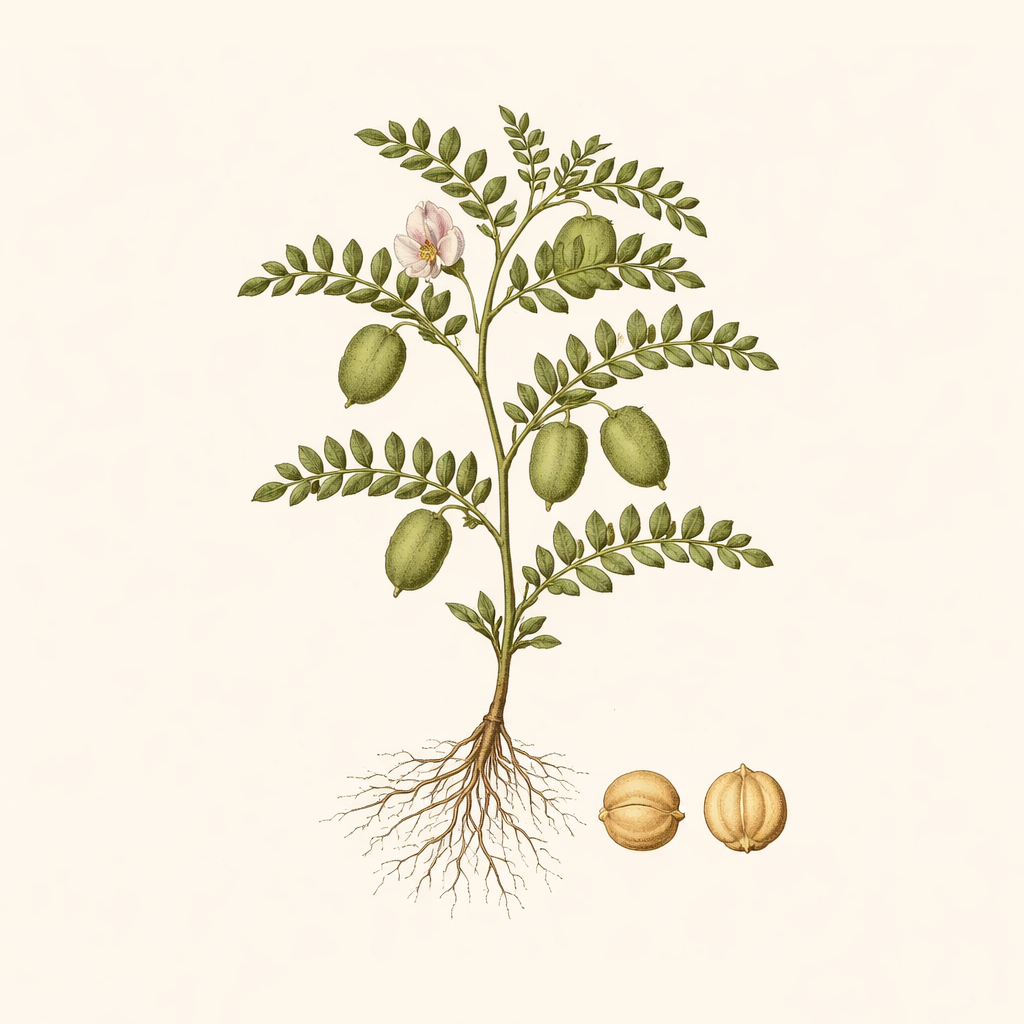
The chickpea (Cicer arietinum L.) is an annual leguminous of the family Fabaceae, domesticated from nearby wild forms (such as Cicer reticulatum) in the Fértil Growing region, probably in the southeast of Anatolia and adjacent areas. It is part of the classic package of neolithic pulse crops (along with lentice, bitter veza and pea), although it usually appears in a smaller amount than other legumes in early archeobotanic assemblies. In Çatalhöyük, garbanzo is mainly documented as a minority component of the pulses spectrum, but its presence at early levels indicates that it was already known and used as a source of plant protein.
-
Distribution and Biomas: The cultivated garbanzo is adapted to semi-arid and subhumid climates, with soft winters and hot and dry summers; it develops well in light and well drained soils and relatively tolerates drought, although it is sensitive to severe frost. The wild populations of Cicer related to C. arietinum are located on stony slopes and open bushes of southeast Anatolia and northern Syria, landscapes similar to those surrounding Çatalhöyük.
-
Major Producers (modern forms): Today, garbanzo is one of the most important pulses worldwide; India concentrates most of the production, followed by countries such as Turkey, Pakistan, Australia and Ethiopia, where it is consumed in peas, flour and dishes such as hummus and falafel. -
Fast sources:
Fuller & Harvey (cited in thesis on Cicer), synthesis on garbanzo domestication in the southeast of Anatolia.
Species & Culture
Use: Food (cultivated pulse, consumed in a smaller amount than others, probably in potages, mixtures with cereals and perhaps as pasta or dense mass; stored dry in small deposits).
Evidence:
In the analysis of the carbonized food remains of Çatalhöyük published in PLOS ONE, Marciniak and collaborators identify four main pulses in the analyzed fragments: Lens culinaris, Cicer arietinum, Pisum sativum and Sativa skills; together with Hordeum vulgare and Triticum spp., "these vegetables and cereals were the main ingredients of the food remains of Çatalhöyük." However, they point out that "Cicer arietinum (chickpea) is present only in a small minority of samples and at early levels of the site, "while Pisum is the most common pulse and lentils and bitter veza appear in 10-20% of the samples.
In the "What is hidden in a Neolitic midden?" report on a 2013 midden, Bode et al. describe that "the range of pulses found included: Cicer arietinum, Vicia ervilia, Lens culinaris, Vicia / Lathyrus and Pisum sativum, "confirming that the garbanzo is part of the cultivated spectrum, although with less relative abundance. In the Archive Report 1999 - Archaeobotany and Related Plant Studies, Bogaard and Charles indicate that" domestic pulses were common and included vetches (Vice sp.), lentils (Lens sp.) and pea (Pisum sp.), with occasional chickpeas (Cicer sp.), "strengthening the idea of Cicer as an episodic but significant presence.
This combination of evidence suggests that the inhabitants of Çatalhöyük knew and cultivated the garbanzo, but that this was not a majority volumetric component of the daily plant diet, but rather a complement in mixtures of legumes and cereals. However, in sensory terms, the peas and mixtures that included Cicer arietinum they would bring dense and slightly "broth" leguminous odors, different from the fresher green of Pisum and the bitterness of Vicia ervilia.
Fast sources:
Çatalhöyük 1999 Archive Report - "Archaeobotany and Related Plant Studies" (mention of "occasional chickpeas (Cicer sp.)." -
There is no essential or absolute garbanzo oil widely used in perfumery; the interest in its volatile profile comes mainly from food science and food applications. However, the chickpea extracts and, more recently, the aquafaba (cooking water of the chickpeas) have been studied for its characteristic aroma, described in English as beany, brothy or legume-like, which provides a chemical base for perfumistic chords inspired by legumes.
Relevant extracts and fractions:
-
Garbanzo ethanolic extract (Cicer extract, CE): A 2001 study described the extraction of volatile compounds of garbanzo by solvents, finding "numerous alcohols, aldehydes and medium-chain alifatic ketones" which are interpreted as final fatty acid degradation products, in addition to specific compounds such as 7-hydroxy-1-methoxy-6-methylantraquinone, cyclohexadecane and 6-( aminomethyl )-2-naphthol, which "contribute to the characteristic aroma of Cicer arietinum”.
-
Hairdryer and fermented chickpeas: Recent research on the scent profile of garbanzo aquafaba, including fermented aquafaba, identifies a number of aldehydes, alcohols, ketones and azufrated compounds responsible for the smell "beany" and "caldoso"; its impact on the use of aquafaba as a vegan egg substitute is discussed. These aromatic systems are relevant as an analogy for the smell of ancient chickpeas.
Main Aromatic Molecules
Studies of volatile composition and chickenpox extracts show a set of alcohols, aldehydes and medium chain aliphatic ketones, as well as specific aromatic compounds, which result in a leguminous, slightly fat and caldy smell. Relevant molecular groups include:
-
Medium-chain alcohols and alifatic aldehydes: The chickenpox extract (CE) studied by Indian scientists included "numerous alcohols, aldehydes and medium chain aliphatic ketones," interpreted as products of the oxidation of fatty acids; these compounds, similar to those found in other legumes, contribute to fat, leguminous and slightly rich notes if concentrated.
-
Cicer extract specific compounds: The same study identified 7-hydroxy-1-methoxy-6-methylantraquinone, cyclohexadecane and 6-( aminomethyl )-2-naphthol, noting that these "contribute to the characteristic aroma of C. arietinum. "Although they are not standard perfumistic molecules, they illustrate the aromatic complexity of the garbanzo extracts.
-
Acute and fermented chickpeas: Recent work on fermented aquafaba aroma describes profiles dominated by aldehydes, alcohols and a certain proportion of light azufrated compounds, responsible for the smell beany and broth that characterizes both chickenpox and cooking water.
In perfumery, a conceptual chord of garbanzo could be built by combining aldehydes and fatty alcohols of medium chain (for the feeling of cooked leagues) with nuances of broth / umami (soft pyrazins, controlled azufrated compounds) and a light cereal background to anchor the chord in the context of mixed cereal-pulse peas as documented in Çatalhöyük.
Fast sources:
Article 2026, "Characterization of the aroma profile of fermented chickpea (Cicer arietinum L.) aquafaba by GC-MS and sensory analysis "- description of aldehydes and compounds responsible for the aroma beany.
IFRA: There is no specific IFRA standard for "chickpea extract"; any restriction will come from present molecules (e.g., Maillard aldehydes if a roasted / fermented chord is generated).
EU: Garbanzo is used in cosmetics mainly for its proteins and conditioning properties; the technical sheets of cosmetic extracts present it as safe, without specific regulatory restrictions beyond the individual safety assessment.
Space under construction by collaborators.
The section Technical information and has a general arguative character. It is presented for information purposes to promote responsible knowledge. Because of the risks associated with the incorrect use of botanical extracts, aromatic molecules and the increase in unregulated practices in the production of aromatic products, Myrodia Khartes has chosen not to disclose complete extraction methodologies or specific concentrations that may compromise public safety. Health, ethics and scientific integrity guide our decision to limit the exposure of certain technical data.
- European Commission. (2009). Regulation (EC) No 1223 / 2009 on Cosmetic Products. Official Journal of the European Union, L 342, 59-209.
-
IFRA (International Fragrance Association). (2023). IFRA Standards Library: 52nd Amendment.
- The Good Scens Company. (2025). Fragrance Raw Materials Database

