

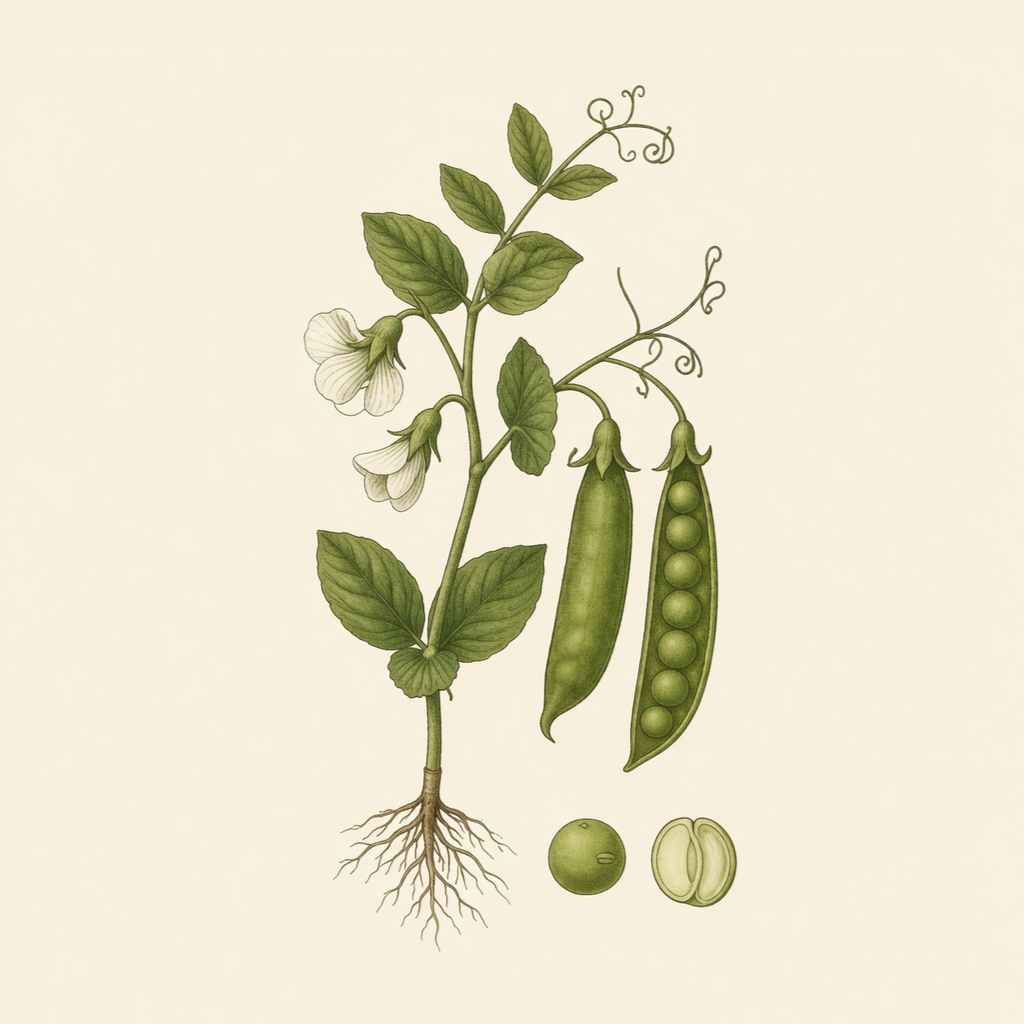
The pea (Pisum sativum L.) is an annual leguminous temperate climate, belonging to the family Fabaceae, domesticated in the Middle East from wild populations of Pisum sp. (including forms close to P. sativum subsp. elatius). It is one of the classic pulses of the neolithic agricultural systems of southwest Asia, cultivated along with lentice, bitter veza and garbanzo as an important source of plant protein. In Çatalhöyük, excavations since the 1960s have recovered so much from Pisum sativum subsp. sativum as generic specimens attributed to Pisum sp., which indicates continued cultivation and consumption of peas throughout the occupation.
-
Distribution and Biomas: The wild forms of Pisum (e.g. P. sativum subsp. elatius) are distributed on rocky slopes, field margins and shrubs of Mediterranean and steppe climate of the Levant, Anatolia and northern Mesopotamia. The cultivated pea is well adapted to temperate climates with fresh winters and enough humidity in spring; it is now widely grown in Eurasia, from the Mediterranean basin to cold regions in northern Europe and Asia.
-
Major Producers (modern forms): Currently, important producers of dry and green peas include Canada, Russia, China, India and several European countries, where it is used for human consumption, feed and, increasingly, as raw material for processed vegetable proteins.
Fast sources:
Guindon et al. 2020, "Population genetic structure and classification of cultivated and wild pea (Pisum sp.) based on morphological trains and SSR markers. "
Species & Culture
Use: Food (grown pulse, consumed alone or combined with cereals in potages, dense breads and other preparations, and stored in the form of dry seeds in domestic spaces).
Evidence:
In the 1995 file report, Butler notes that the recovered plant remains include "several species of grain legumes (pulses), mainly pea (Pisum sativum), with lentil (Lens culinaris), a kind of Lathyrus and one Vice sp.; "; also mentions" small deposits of identified seeds in situ "composed of peas, lentils and fruits of Celtis (hackberries) A small 125 ml vegetable remains lens documents a concentration of pulses (pea, lentice, veza, garbanzo) mixed with cereals and acorn fragments, interpreted as a stored food tank or concentrated waste. Subsequent studies of macrorestos have confirmed that "pulses, bitter vetch (Vicia ervilia), lentil (Lens culinaris) and probably pea (Pisum sativum) were cultivated "in Çatalhöyük, being part of the agricultural package along with barley and tribos.
The analysis of carbonised food remains from vessels and cooking surfaces has shown that, in the preparations studied, three pulses —Pisum sativum, Lens culinaris and Vicia ervilia— are regularly combined with cereals (mainly Hordeum vulgare and Triticum spp.), so "these four legumes and cereals were the main ingredients of the food remains of Çatalhöyük." The 1999 and 2013 file reports also document carbonized seeds identified as Pisum sativum and fragments of Pisum sp., from storage and dump spaces ("middens") with high density of plant remains.
For olfactory reconstruction, this evidence indicates that the interior of the houses and certain discarding spaces had to be filled with odors of cooked legumes, flour and mixed masses of cereal-pulse, in which the pea played a recurring role as a protein-rich component.
Fast sources:
Çatalhöyük Archive Report 1995 - Ann Butler, "The Plant Remains, Preliminary Report 1995" (detailed mention of Pisum sativum and peas deposits)
Stop Pisum sativum There is no, in perfumery, a classic essential oil or an absolute of extended use comparable to those of resins or flowers; however, chords and food extracts have been developed that explore its green, herbal and slightly flour facets. In the food industry, pea protein extracts and meal are used as "vegetable" or "leguminous" flavour ingredients in processed products, and may occasionally provide olfactory nuances that inspire pea-pox perfumistic chords.
- Green pea cords ("pea pod accords"): In perfumery, the effect "fresh pea pods" is usually achieved by combinations of green aldehydes (e.g. cis-3-hexenal, cis-3-hexenol) and ionone-type molecules / green vegetables, rather than from a natural pea extract; these chords are used to add vegetable freshness and garden notes.
Main Aromatic Molecules
olfactory profile associated with Pisum (conceptual approach)
Specific studies on the volatile composition of pea are mainly in the field of food science, but they converge in the importance of green, herbal and slightly terrous compounds derived from lipids and amino acids of seeds and pods. Families of relevant molecules to recreate the smell of fresh and cooked peas include:
-
Short and medium chain aldehydes (e.g. hexanal, nonanal), with green notes, herbals and fats of vegetables and newly cut legumes.
-
Green alcohols as cis-3-hexen-1-ol, responsible for green leaf facets and wet grass, used in perfumery for pea and vegetable sheath chords.
-
Light azufrated compounds and pyrazins in cooked or roasted products of legumes, which provide notes of broth, walnut and toasted when the seeds are subjected to prolonged or roasted cooking.
In perfumistic practice, a "Pisum chord" would be built by combining these materials (especially aldehydes and green alcohols) with notes of cereal / soft starch to evoke both fresh pods and dry legumes stew.
Fast sources:
The Good Scents Company - lists of descriptors and odour molecules "vegetable, green, legume, cereal," including aldehydes C6-C9, green alcohols and pyrazins.
IFRA: without specific standard for "pea extract / pea aroma"; the general assessment of awareness is applied according to the volatile molecules present (aldehydes, acids, etc.), which in pea have been characterized for food applications but not with their own IFRA restrictions.
EU: pea is not on the classic list of major food allergens in the EU, and pea protein (including hydrolysed) is generally considered safe in cosmetics; it is used in many products without special restrictions beyond the safety assessment.
Space under construction by collaborators.
The section Technical information and has a general arguative character. It is presented for information purposes to promote responsible knowledge. Because of the risks associated with the incorrect use of botanical extracts, aromatic molecules and the increase in unregulated practices in the production of aromatic products, Myrodia Khartes has chosen not to disclose complete extraction methodologies or specific concentrations that may compromise public safety. Health, ethics and scientific integrity guide our decision to limit the exposure of certain technical data.
- European Commission. (2009). Regulation (EC) No 1223 / 2009 on Cosmetic Products. Official Journal of the European Union, L 342, 59-209.
-
IFRA (International Fragrance Association). (2023). IFRA Standards Library: 52nd Amendment.
- The Good Scens Company. (2025). Fragrance Raw Materials Database

