

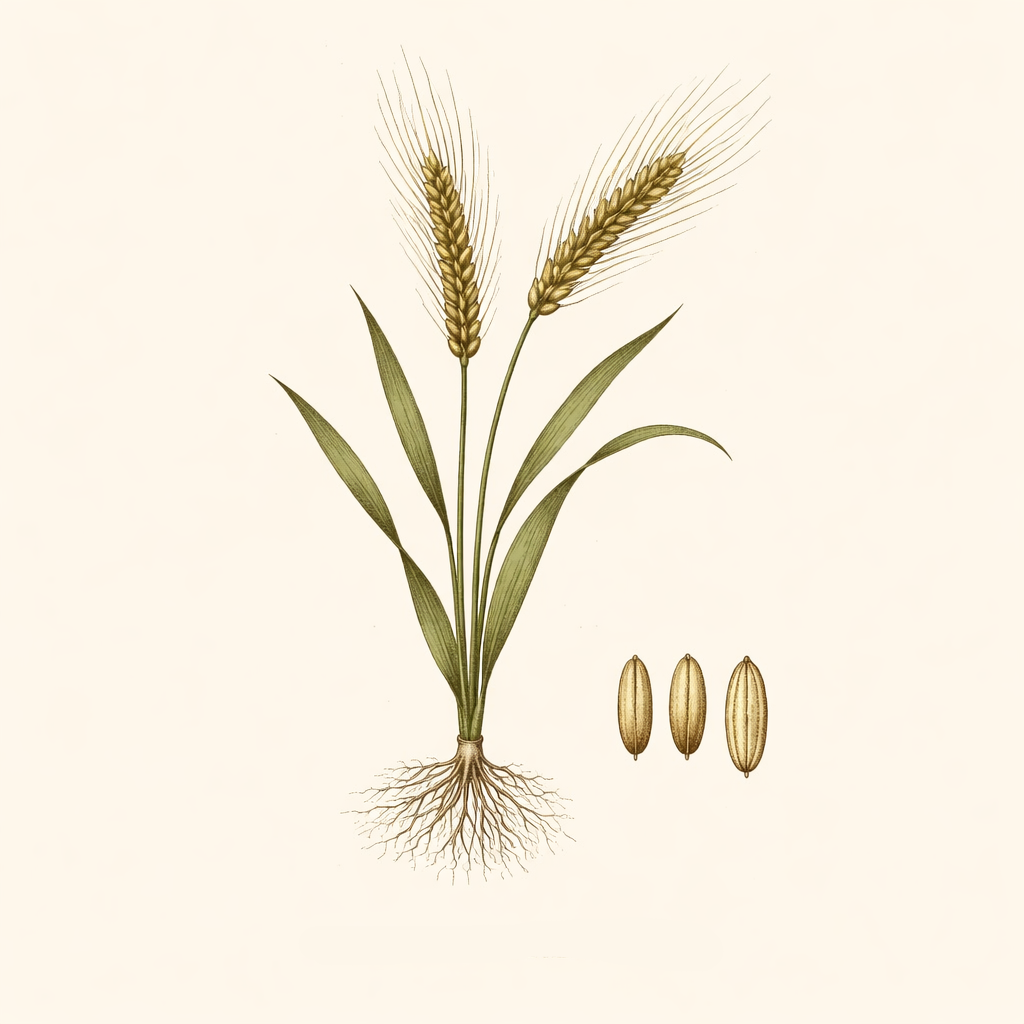
The cultivated rye (Secale cereale L.) descends from wild forms of the gender Secale (especially S. cerale subsp. vavilovii and S. strictum), originating in south-west Asia and adjacent regions of Central Asia. Unlike wheat and barley, rye appears to have started as "field weed" in crops of other cereals and was only later domesticated as the main cereal, especially in colder and poorer areas of northern Europe. The oldest domestic rye macroesters known so far come mainly from Neolithic and Bronze Age contexts in South-East and Central Europe, although there are signs of wild forms and possible early crops on the Levant and the High Mesopotamia.
- Distribution and Biomas: Wild species of Secale are distributed on steeped slopes, open pastures and crop edges of the Fértil Crest, Iran and Central Asia, adapted to poor soils, continental climates and marked seasonality. The cultivated rye has expanded mainly to temperate-cold regions of Europe and Eurasia, with high tolerance to the cold, acid soils and low fertility, allowing it to thrive where wheat and barley yield worse.
- Major Producers (modern forms): At present, the largest rye producers are Germany, Poland, Russia and other countries in Eastern and Northern Europe, where it is used for bakers, feed and distillation (vodka, other spirits). -
Fast sources:
Yang et al. 2024, "Evolutionary Biology of Rye (Secale cereale): Domestication and Adaptation "- Trends in Genetics & Genomics.
Seabra et al. 2023, "The introduction and spread of rye (Secale cereale) in Europe '- Frontiers in Plant Science.
Zeder 2011, "The Origins of Agriculture in the Near East" - Current Anthropology (mentions Triticum boeoticum / Secale in epipaleolithic contexts). -
PNAS 2016, "Regional diversity on the timing for the initial appearance of cereal cultivation and domestication in southwest Asia." -
Species & Culture
Use: Food (grains of wild and perhaps incipient cereals, including einkorn, barley and possible forms of wheat / rye, processed by milling and cooking in the framework of banquets and ritual practices).
Evidence:
Macrobotanic analyses in Göbekli Tepe show the presence of wild einkorn (Triticum cf. boeoticum / urartu), wild barley (Hordeum cf. Spontaneum) and "possible wild wheat / rye" registered as Triticum / Secale. The amount of carbonized remains recovered is low, but complementary evidence of phytolytes and footprints in moler stones indicate an intensive processing of cereals in several structures at levels III and II. In the regional discussion on the origin of agriculture in the Middle East, it has been noted that combinations of einkorn and rye (e.g. Triticum boeoticum / Secale in Jerf the Ahmar) appear in pre-domestic farming contexts, suggesting that forms of Secale were present in the early cereal landscapes of the region.
For Göbekli Tepe, therefore, the reference Triticum cf. / Secale sp. It reflects a prudent identification of grains or phytolytes that may correspond to diploid tritimes or early rye, without a safe determination of their domestication status. In the olfactory reconstruction we take as reference the cultivated rye (Secale cereale L.) and its modern aromatic derivatives, as a sensory approach to the set of wheat / rye cereals that were processed on the site.
Fast sources:
Dietrich et al. 2019, "Cereal processing at Early Neolitic Göbekli Tepe, southeastern Turkey" - PLOS ONE.
DAI - Deutsches Archäologisches Institut, "Cereals, feasts and monuments at Göbekli Tepe." -
PNAS 2016, "Regional diversity on the timing for the initial appearance of cereal cultivation and domestication in southwest Asia." -
Zeder 2011, "The Origins of Agriculture in the Near East." -
In perfumery it is not common to find a classic "rye essential oil," but chords and extracts that interpret its cerealera, smoked and slightly pany facets. Some manufacturers work with macerates or alcoholic extracts of rye roasted grains, and more often with fantasy compositions that combine "cereal" and "malt" materials to recreate the smoked character of rye in bread and distilled.
Rye extracts and chords (in analogy with other cereals):
- Hydroalcoholic extracts of roasted grain: Grain similar to the treatment of barley or wheat; the roasted rye grain is extracted with ethanol or other food solvents to concentrate Maillard molecules (pyrazins, furanones, lactones) responsible for notes of black bread, roasted bark and slightly smoked nuances. The result is made as an aromatic ingredient for perfumery or as part of "malt / rye" bases in catalogues of fragrance houses (detailed information is usually owned and not always public, but is mentioned in recent olfactory literature).
- Invented "rye / cereal": The modern development of cereal chords and nuts has incorporated the "rye" as the most smoked and dark nuance compared to wheat or oats, combining cereal, toasted, spicy and slightly phenolic notes. These chords are built from materials already known as absolute cereals, malts, coumarins, lactones and roasted molecules, rather than a single natural rye extract.
Main Aromatic Molecules
Rye cords (Rye accords)
From the olfactory point of view, rye is perceived as "more smoked" cereal than others: the descriptor "rye is smokier" appears explicitly in the contemporary specialized literature on notes of cereals and nuts. In perfumery this character is exploited through chords that combine facets of roasted cereal, black bread, dried spices and a slightly tabaracaractura or phenolate background, being inserted into the gourmand / walled family.
Families of relevant (conceptual) molecules:
- Tasted pyrazins and quinoxalines: They provide notes of roasted cereal, coffee, nut and cocoa; in lists of odour descriptors for "cereal" quinoxalin derivatives with astringent, bitter, cereal-nut and cocoa facets, used in cereal and chocolate bases are mentioned. -
- Cereal aldehydes and lactones: In cereal-malt bases, medium and long chain fatty aldehydes (e.g. 2-nonrenal, described with green, cherry and cereal notes) are used together with lactones with caramel and honey nuances, which contribute to the character of miga and bread bark. -
- Other roasted components: Furanones, soft phenolic compounds and spicy molecules (e.g. isoeugenol in small doses) may be added to strengthen the spicy and slightly smoked side associated with rye, as perfumists interviewed in recent analysis on cereal notes discuss. -
Fast sources:
Nez, la revue olfactive, "Nuts and cereals: the new tasty traps" (interviews and descriptors on cereal notes, including comment that "rye is smokier"). -
The Good Scents Company - "Odor Descriptor Listing for Cereal" (input for cereal, malt extract, quinoxaline, 2-nonrenal and other related components). -
PNAS 2016, "Regional diversity on the timing for the initial appearance of cereal cultivation and domestication in southwest Asia" (context of Triticum boeoticum / Secale).
Zeder 2011, "The Origins of Agriculture in the Near East" (mention of Secale early in Abu Hureyra and other sites). -
Yang et al. 2024; Seabra et al. 2023 (origin and dispersion of Secale cereale).
No specific known IFRA standard; general assessment is applied according to composition and other allergens that it may contain.
- considered gluten cereal (food allergic); if the extract conserves proteins / gluten, it is appropriate to declare its presence and assess the risk of skin awareness.
Space under construction by collaborators.
The section Technical information and has a general arguative character. It is presented for information purposes to promote responsible knowledge. Because of the risks associated with the incorrect use of botanical extracts, aromatic molecules and the increase in unregulated practices in the production of aromatic products, Myrodia Khartes has chosen not to disclose complete extraction methodologies or specific concentrations that may compromise public safety. Health, ethics and scientific integrity guide our decision to limit the exposure of certain technical data.
- European Commission. (2009). Regulation (EC) No 1223 / 2009 on Cosmetic Products. Official Journal of the European Union, L 342, 59-209.
-
IFRA (International Fragrance Association). (2023). IFRA Standards Library: 52nd Amendment.
- The Good Scens Company. (2025). Fragrance Raw Materials Database

