

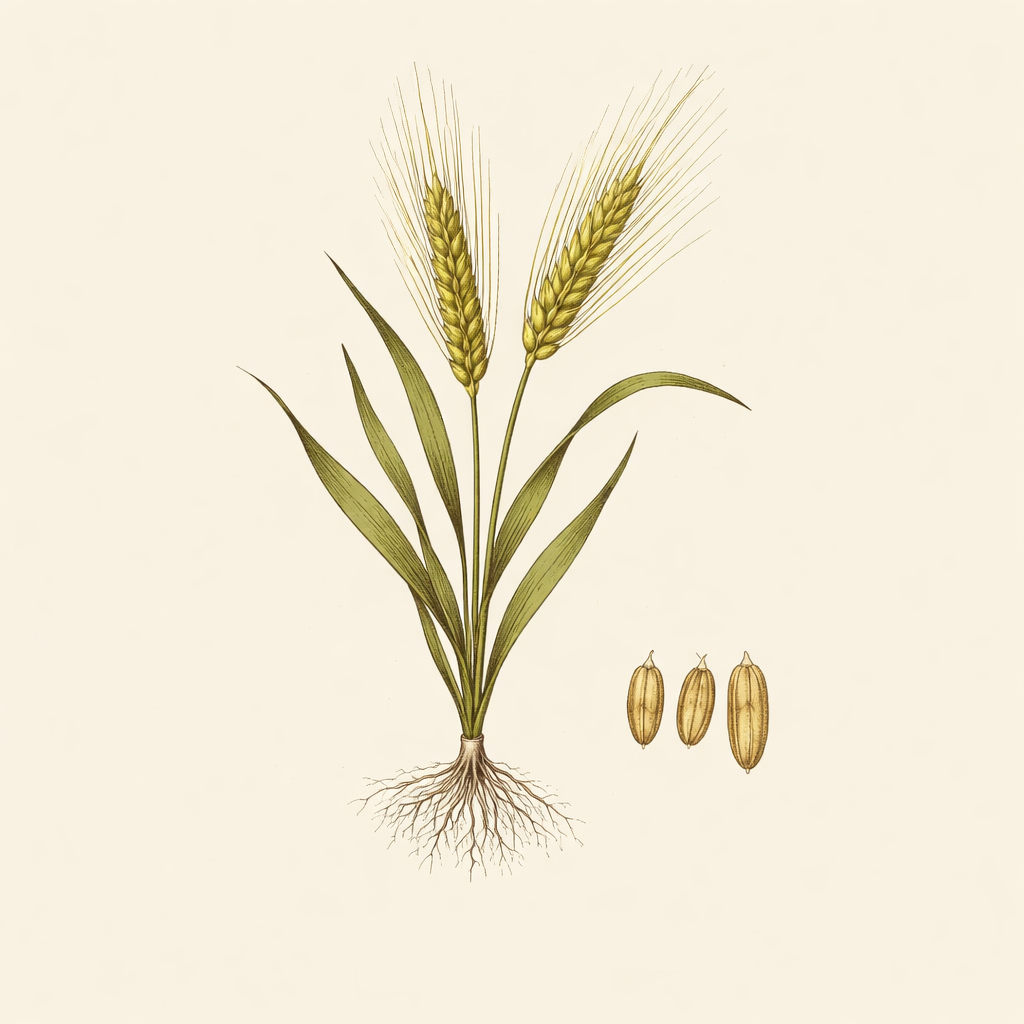
The cultivated barley (Hordeum vulgare) derived from wild barley Hordeum Spontaneum, extended by the Fértil Growing from the Levant to Central Asia, and is one of the oldest domesticated cereals in the world. The barley grains appear in many pre-historic and protohistoric deposits of the Middle East, and their domestication is around the tenth millennium BC, in parallel to the first agricultural processes with wheat. Recent genetic studies indicate a complex history, with at least two domestication and subsequent mixing of wild lineage from different regions.
- Distribution and Biomas: The wild barley (H. spontaneum) occupies stony slopes, steppes and edges of open forests of the Eastern Mediterranean, the Fértil Crest and semi-arid areas of Western Asia, where it forms communities of annual grasses adapted to soft winters and dry summers. The cultivated barley (H. vulgare) has expanded to a much wider climate range, from cold and humid northern regions to semi-arid areas, thanks to its tolerance to salinity and relative drought.
- Major Producers (modern forms): Today barley is a global cereal, with large production volumes in Russia, the European Union, Australia, Ukraine and Canada, where it is mainly for feed, beer / whiskey malting and human food uses. -
Fast source:
Badr et al. 2000, "On the origin and domestication history of barley (Hordeum vulgare)" - Molecular Biology and Evolution.
Jakob et al. 2014, "Evolutionary history of wild barley (Hordeum vulgare sp. Spontaneum)" - Molecular Ecology.
Zohary et al., Domestication of Plants in the Old World (synthesis on barley). -
Guo et al. 2025, "A haplotype-based evolutionary history of barley" - Nature.
Species & Culture
Use: Food (wild barley grains) Hordeum cf. Spontaneum and possible incipient forms domesticated, ground and processed along with other cereals in food and banquet preparation contexts).
Evidence:
The analysis of macrophotanic and phytosite remains in Göbekli Tepe has identified the presence of wild barley, reported as Hordeum cf. Spontaneum, along with wild einkorn (Triticum cf. boeoticum / urartu). Although the amount of carbonized remains recovered is low, the high frequency of fatty phytolytes in sediments and moler stone surfaces indicates an intensive processing of barley and other cereals in rectangular buildings associated with food preparation activities. The "kit" distribution studies of milling (slices, hands, mortars) show limited areas of work where flour and masses were produced, probably consumed in ritual and festive contexts linked to monumental structures.
In these layers, some morphometric data from phytolytes suggest the possible presence of H. spontaneum and H. vulgare Early domesticated in the same stratigraphic units, which is interpreted as a transition scenario between wild barley collection and initial handling / domestication. For olfactory and sensory reconstruction purposes, we start from the direct evidence of Hordeum cf. Spontaneum in Göbekli Tepe, but we use the cultivated barley (H. vulgare) and its modern aromatic derivatives as an approach to the type of cereal that was processed on the site.
Fast source:
Dietrich et al. 2019, "Cereal processing at Early Neolitic Göbekli Tepe, southeastern Turkey" - PLOS ONE.
DAI - Deutsches Archäologisches Institut, "Cereals, feasts and monuments at Göbekli Tepe." -
Neef, en Neo-Lithics 2 / 03, synthesis on phytolytes and cereal macroesters in Göbekli Tepe.
Name in old languages
Sumerium: še (grain), kaš (for beer)
Acadio: šeħum (barley), šikārum (beer)
The six-row barley (Hordeum vulgare var. hexastichum) was the most important cultivation of alluvial Mesopotamia since the end of the 5th millennium BC and for several millennia later. Its primacy is found both archeobotanically and in thousands of cuneiform tablets that record their production, storage, distribution and transformation.
Food and beverage processing: The barley was the basis of the diet of large sections of the population. It was consumed in the form of bread, papilla and especially as beer (kaš/šikārum), omnipresent drink in all social strata. The ration boards of the period Ur III (ca. 2100-2000 BC) document barley and beer distributions to workers, soldiers and temple dependents, functioning as a currency of exchange and measure of sustenance. A Uruk III tablet (ca. 3200-3000 BC) conserved at the British Museum records beer distributions from the institutional warehouses, which shows that already in the most remote antiquity the production of beer was a major administrative matter.
Economy and writing system: The barley was so central that the first pictograms of cuneiform writing include specific signs for grain and beer. The sexagesimal sumerian numbering has a possible morphological relationship with the six-row barley ear. The texts of barley rations of ca. 3000-1400 a. C. are the main source for the reconstruction of mesopotamic diet.
Ritual and symbolic use: The barley beer was offered to the gods in the temples; the goddess Ninkasi was specifically the divinity of the beer. The Himno to Ninkasi (ca. 1800 a. C.) describes in detail the process of making beer based on barley and fermented bread (bappir). The barley was, together with the datile, the most frequent food offering in the temperate rituals.
Medicinal uses: Mesopotamic medical texts include barley-based preparations for the treatment of skin, gastrointestinal and febrile conditions. The barley water (mê šeħim) is mentioned in recipes of the medical corpus of the 1st millennium a. C.
Agriculture: The barley was the dominant cereal in southern Mesopotamia for its tolerance to the salinity of the soils. In the north (Assyria) it coexisted with wheat under dry conditions. Its agricultural cycle structured the mesopotamic calendar and its changes in performance determined the political stability of the kingdoms.
Quick links:
Civil, M. (1964). "A Hymn to the Beer Goddess and a Drinking Song." In Studies Submitted to A. Leo Oppenheim. Oriental Institute, Chicago, pp. 67-89.
Englund, R. K. (1998). "Texts from the Late Uruk Period." In Späturuk-Zeit und Frühdynastische Zeit. Orbis Biblicus et Orientalis 160 / 1. Fribourg / Göttingen.
Geller, M. J. & Bloch, M. (2010). "Diet in Mesopotamia: The Evidence of the Barley Ration Texts (c. 3000-1400 B.C.)." Iraq, Cambridge University Press. [^ 3]
Tasted barley extracts
Extract of roasted barley (solvent / ethanol): In perfumery and aromatization, extracts of roasted barley obtained from the extraction of roasted grains are used. Hordeum vulgare with ethanol or other food solvents, followed by concentration to obtain an extract rich in Maillard compounds (pyrazins, furanones, lactones) responsible for malted and roasted notes. These extracts are often placed on the market in ethanol (e.g. "Roasted Barley Extract 40%" in a 60% alcohol solution) to facilitate its dosing in perfumes and cosmetic products.
Tasted and malted profiles: During the beehive of barley, Maillard's reactions between sugars and amino acids generate a complex matrix of aromatic molecules that provide nuances of coffee, cocoa, candy, honey and freshly baked bread, which are concentrated in these extracts. The result is a brown liquid material, olfatively powerful, used in small doses to enrich gourmand chords, ambarated and gourmet.
Main Aromatic Molecules
Extracts of roasted barley (Roasted Barley Extract)
The extracts of roasted barley used in perfumery have a rich and warm smell, described as malted, roasted cereal, with nuances of express coffee, cocoa, candy, honey, fresh bread and light memories of beer or whiskey. In perfumistic composition they are used to provide a complex gourmand character, to deepen vanilla chords, coffee, cocoa and orange, and to add warmth and texture to ambarade, tabacosas and adored bases. Its high content in Maillard compounds (especially pyrazins and other heterocyclos) gives them great tenacity and ability to transform the bottom of a perfume into a record of "bakery" or distillery, in addition to the cereal environments we can imagine associated with the Göbekli Tepe banquets.
Characteristics (at the conceptual level):
Although the exact composition varies according to the manufacturer and the degree of tweets, the extracts of roasted barley concentrate families of typical molecules of cereal toasting, including pyrazins (e.g. 2-methoxypyrazins and alkyl-pyrazins with notes of walnut and coffee), furanones and lactones with caramel facets, as well as light phenolic compounds that remember beer and wood. These molecules are not usually marketed individually under the name "barley molecules," but are integrated into natural extracts themselves or in malted fantasy chords developed by aromatic houses.
Fast sources (oilseed raw materials):
- Eden Botanicals - "Barley, Roasted Extract 40%." -
- Fraterworks - "Roasted Barley Extract 40% ETH." -
- Agoratopia - note "Barley Note." -
No specific IFRA standard; it is usually declared "compliant" without limit if the supplier does not identify restricted substances.
Gluten cereal; cosmetic derivatives are generally considered safe if composition and low awareness are documented, but proteins / gluten and possible mycotoxins must be monitored.
Space under construction by collaborators.
The section Technical information and has a general arguative character. It is presented for information purposes to promote responsible knowledge. Because of the risks associated with the incorrect use of botanical extracts, aromatic molecules and the increase in unregulated practices in the production of aromatic products, Myrodia Khartes has chosen not to disclose complete extraction methodologies or specific concentrations that may compromise public safety. Health, ethics and scientific integrity guide our decision to limit the exposure of certain technical data.
- European Commission. (2009). Regulation (EC) No 1223 / 2009 on Cosmetic Products. Official Journal of the European Union, L 342, 59-209.
-
IFRA (International Fragrance Association). (2023). IFRA Standards Library: 52nd Amendment.
- The Good Scens Company. (2025). Fragrance Raw Materials Database

