

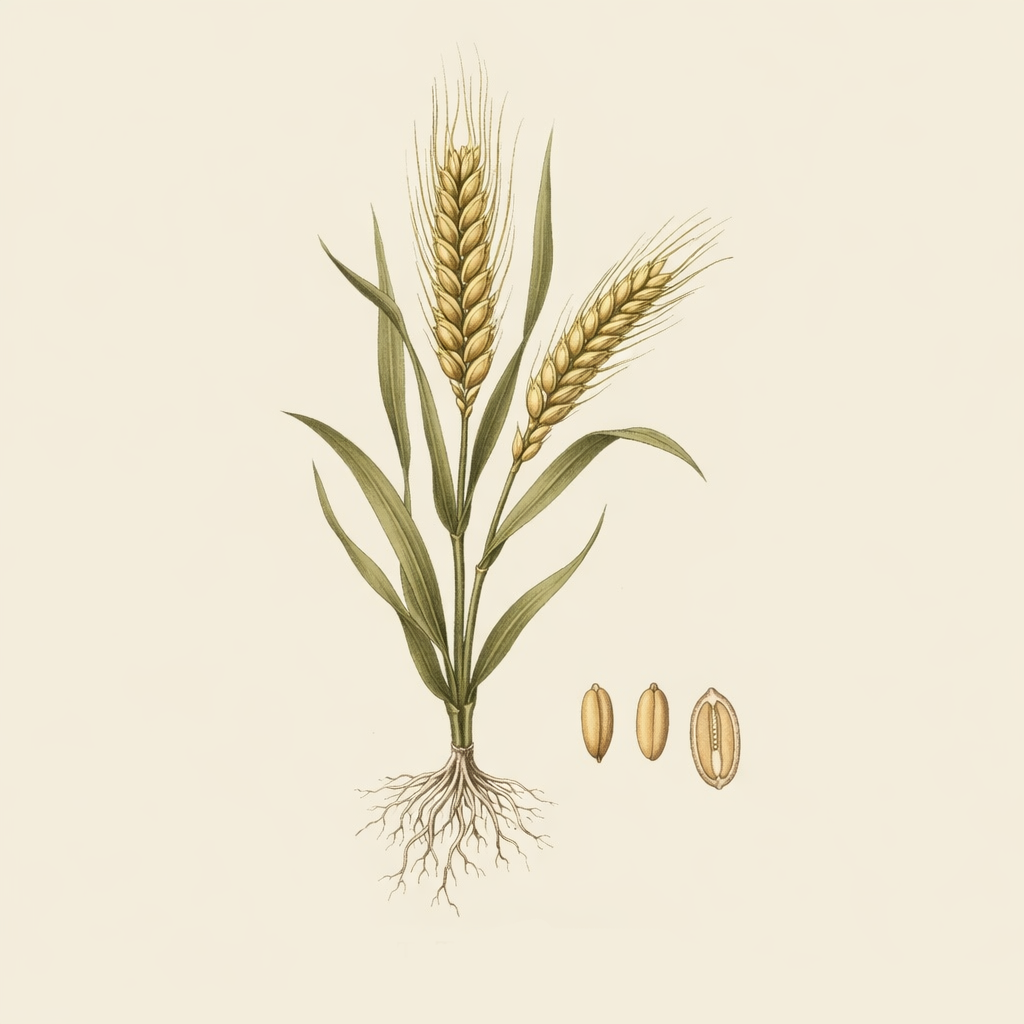
The wild ancestor of the first tribos consumed in the Fértil Growing corresponds to the so-called diploid or wild einkorn tribides, which are botanically identified as Triticum boeoticum and Triticum urartu. These wild forms grew on the mountain slopes of South-East Anatolia, the Zagros and adjacent regions, where they were part of the "founding crops" of Neolithic along with barley, legumes and other cereals. The domestication of einkorn (cultivated form T. monococcum) occurred in this same macro-region towards the tenth millennium BC, although during the Göbekli Tepe phase botanical sets indicate an intensive use of forms still wild or incipient managed.
- Distribution and Biomas: The wild diploid tritimes are distributed in steppe and mountain environments of the Fértil Crest, especially in South-East Anatolia, northern Syria and the Zagros, where they form communities of grasses on stony slopes, open and clear forests of dry Mediterranean bushes. They prefer well-drained soils, with cold and wet winters and hot and dry summers; their annual cycle adapts to marked seasonality, germinating in autumn, spying in spring and completing maturation in early summer.
- Major Producers (modern forms): At present, wheat (Triticum aestivum) and durum wheat (T. turgidium ssp. durum), distant descendants of these wild tribos, are grown in a massive way in temperate regions around the world, with high volumes in China, India, Russia, the United States and the European Union; the cultivated einkorn is now a minority cereal, produced mainly in Turkey, Balkans and Italy as a traditional or "rediscovered" crop.
Fast source: Einkorn; Kilian et al. 2007; Mahmood & Mansoor 2023; Ahmed et al. 2023.
Species & Culture
Use: Food (wild einkorn grains and other cereals, processed by milling and cooking; probable consumption in the form of papiles, primitive flat breads or gachas in ritual banquet contexts).
Evidence: The archeobotanic studies of Göbekli Tepe have identified carbonized remains and phytolytes attributable to wild einkorn, described as Triticum cf. boeoticum / urartu. The macrobotanical set is limited by the formation processes of the site, but is complemented by analysis of phytolytes taken from sediments and surfaces of mould stones, which show a significant presence of cereals in all the excavated layers. Experiments with replicas of the found teeth indicate that cereals were intensively ground, generating flour that could be used in food preparations served in festive contexts linked to the monumental structures of the compound.
Fast source: Dietrich et al. 2019 - "Cereal processing at Early Neolithic Göbekli Tepe"; Neef, ex-East 2003; DAI - Cereals, feasts and monuments at Göbekli Tepe.
Name in old languages
Sumerium: GIG or ziz (emmer / scan)
Acadio: kibtu (bare wheat / flour wheat), kunāšu (emmer)
The wheat forms, together with the barley, the pair of founding cereals of the neolithic civilization of the Middle East. It was domesticated in the Fértil Growing around ca. 9600 a. C. from their wild ancestors (T. urartu, T. turgidium subsp. dicoccoides).
Food: The wheat —mainly in its emmer form (kunāšu) during most mesopotamic history— was the second most important cereal after barley in the south, though predominant in some regions of the north (Assyria). It was used to make flour, breads, papillas and pastas. The distinction between "wheat" and "barley" is constant in the cuneiform texts and reflects their different position in the social hierarchy: wheat was considered a more refined grain and was preferred for higher quality bread and offerings to the gods.
Ritual use and offerings: The wheat (along with the barley) was part of the regular food offerings to the temples, called ginù (fixed daily rations for the gods). The Templar files of Sippur, Nippur and Ur document specific quantities of wheat intended for the maintenance of the cult.
Economy and administration: The cuneiform texts of the period Ur III (ca. 2100-2000 BC) and of the Paleobabilonic Period contain comprehensive records of the production, storage and distribution of wheat. The mesopotamic vocabulary accurately distinguishes between the emmer (kunāšu), the einkorn (kibtu) and the flour wheat of bare grains.
Agriculture: In the north of Mesopotamia (Assyria), wheat could be grown in a dry form. In the south, it required irrigation, but it produced comparatively high yields. The rotation between barley (salinity tolerant) and wheat was a documented practice for the management of mesopotamic soils.
Quick links:
Algaze, G. (2008). Ancient Mesopotamia at the Dawn of Civilization: The Evolution of an Urban Landscape. Chicago: University of Chicago Press.
Nesbitt, M. & Samuel, D. (1996). "From Staple Crop to Extinction? The Archaeology and History of Hulled Wheats." In Padulosi, S. et al. (eds.), Hulled Wheats. IPGRI, Rome.
Paulette, T. L. (2015). "Grain Storage and the Moral Economy in Mesopotamia (3000-2000 BC)." Dissertation, University of Chicago.
Riehl, S. et al. (2014). "Agronomic Conditions and Crop Evolution in Ancient Near East Agriculture." Nature Communications 5: 3953.
Velimirović, A. et al. (2021). "Ancient Wheat and Barley from Kish, Mesopotamia." Agriculture Conspectus Scientificus.
wheat bran absolute
Volatile solvent extraction (concentrate / concrete): The wheat bran, by-product of the molding of grains of Triticum aestivum or related tritimes, is submitted to extraction with organic solvents (e.g. hexane) to obtain a concrete rich in waxes, lipids and aromatic compounds.
Purification in ethanol (absolute): The concrete is dissolved in ethanol, cooled to precipitate waxes and heavy components and, after filtration, the ethanol evaporates into the vacuum, obtaining the absolute of wheat bran (CAS 68916-76-7), suitable for perfumery.
Other techniques: Some manufacturers mention process variants such as the use of modified ethanol, temperature adjustments to modulate the aromatic profile, or additional fractionations to reduce too much fat or phenolic notes.
Main Aromatic Molecules
wheat bran absolute (Bran Absolute, Triticum aestivum L.)
The wheat bran absolute has an olfactory profile described as warm cereal, amber soft and slightly roasted, with honey facets, vanilla, freshly baked bread, walnut and hay. In fine perfumery it is used to confer gourmand effects, to add realism to chords of cocoa, tea, nuts and cereals, and to round intense floral notes providing warmth in the background. Although applicable in the practice of modern wheat bran (T. aestivum), is considered a good sensory approach to the aromas that could generate the processing of diploid tribos as T. boeoticum / urartu in contexts like Göbekli Tepe.
2-acetyl-1-pyrrolin (2-AP)
2-acetyl-1-pyrrolin is a heterocyclic compound with extremely low olfactory threshold that provides the characteristic smell of fresh baked bread, jasmine rice, basmati and popcorn. It is formed mainly through Maillard reactions during baking of masses rich in starch and proteins, such as those made with wheat flour; its presence contributes to the toasted and "bread cortex" notes associated with cereals. Although used mainly in food flavouring, there are degrees of purity for fraternal applications and their formation in whole wheat and other cereals is studied.
Fast sources:
ScenTree - Bran absolute; Robertet Groupe - Bran absolute ingredient for perfume; MRL Naturals by IFF - Bran Absolute; The Perfume's Apprentice - Bran Absolute; Zurma Botanical Oil Studio - Bran Absolute; Hermitage Oils - Bran Absolute; Fragrance University - Bran absolute; PubMed - Jost et al. 2019 "Efficient Analysis of 2-Acetyl-1-pyrrol in Foods'; ACS - articles on 2-AP in wheat matrices; Wikipedia - 2-Acetyl-1-pyrroline.
No specific IFRA standard for "wheat aroma" as such; there are IFRA standards for molecules that could appear in derived products (e.g. some aldehydes), which would apply on a case-by-case basis.
) Main food allergy; specific regulation for hydrolysed wheat proteins (≤ 3.5 kDa in cosmetics) for allergy risk, applicable if used as a functional ingredient, also in perfumed products.
Space under construction by collaborators.
The section Technical information and has a general arguative character. It is presented for information purposes to promote responsible knowledge. Because of the risks associated with the incorrect use of botanical extracts, aromatic molecules and the increase in unregulated practices in the production of aromatic products, Myrodia Khartes has chosen not to disclose complete extraction methodologies or specific concentrations that may compromise public safety. Health, ethics and scientific integrity guide our decision to limit the exposure of certain technical data.
- European Commission. (2009). Regulation (EC) No 1223 / 2009 on Cosmetic Products. Official Journal of the European Union, L 342, 59-209.
-
IFRA (International Fragrance Association). (2023). IFRA Standards Library: 52nd Amendment.
- The Good Scens Company. (2025). Fragrance Raw Materials Database

