

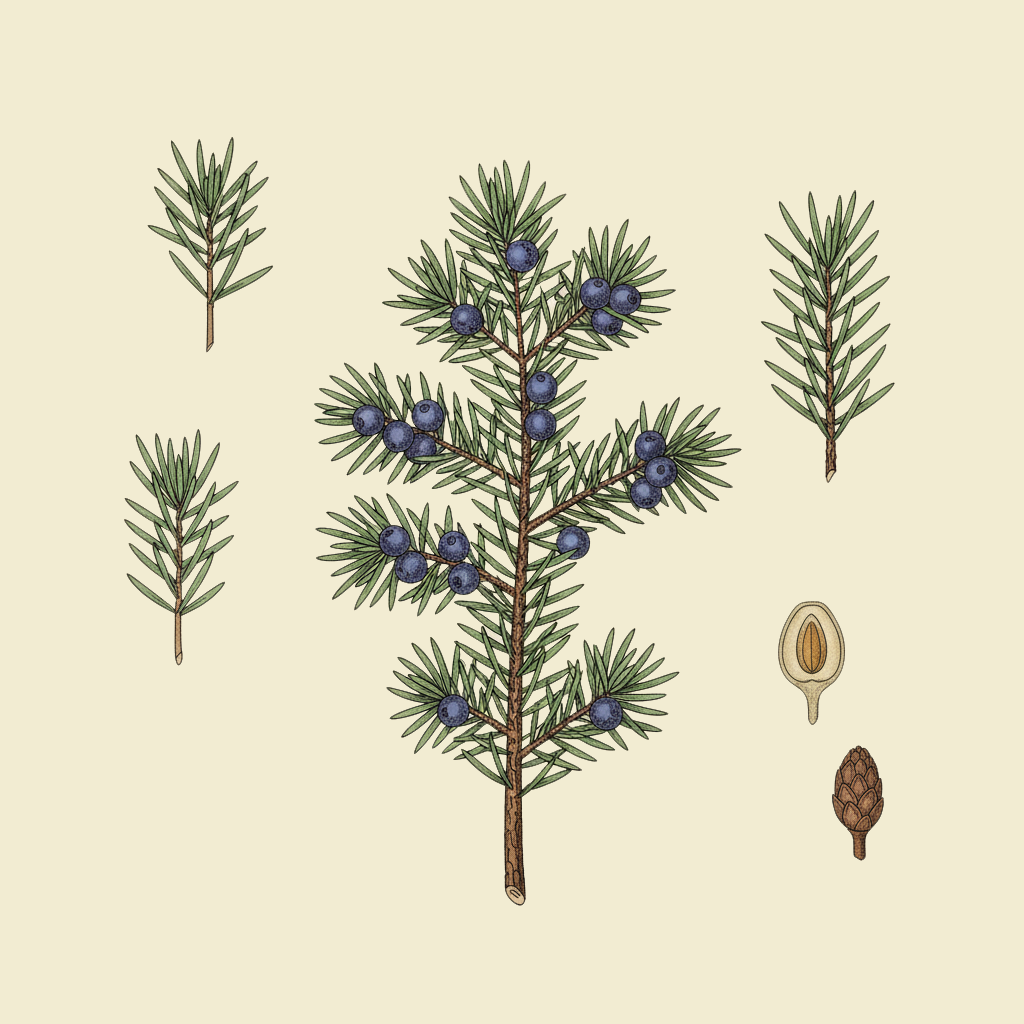
The Juniper is very old and widely distributed. Its species are native to the northern hemisphere, from the Arctic to the tropical mountains of Africa. The common juniper (Juniperus communis) has a circumboreal distribution and has been present for millions of years.
-
Distribution and Biomas: They occupy an incredible diversity of biomas: from the Arctic tundra and the boreal forests to the dry Mediterranean bushes, steppes and high mountains. They are extremely adaptable and tolerant to stress conditions.
-
Major Producers: "Production" is not on a massive agricultural scale. Juniper berries (Juniperus communis) are mainly harvested from wild populations for use in the food (mainly gin) and pharmaceutical industry. The main harvesters and exporters are Eastern European countries (Hungary, Albania), the Balkans and India (for other juniper species).
Fast source: Royal Botanic Gardens Kew
Species & Culture
Use: Environment (shrubs), raw material (wood, fibres).
Evidence: Juniper as part of the environment and fuel use: Juniper is identified as part of the neandertal environment. For example, in the landscape of Gibraltar, where the last Neanderthals lived, a forest savannah is described with pineapple, cork and juniper. In the El Salt field (Alicante, Spain), studies on neandertal homes show that various wood species, including pine and juniper, were burned. In the rocky shelter of Abric del Pastor, also in the south-east of Iberia, the main fuels found in the homes are juniper and terebinto, although it is noted that the juniper is a less ideal, slow-growing fuel with very woody branches and produces little dead wood, which makes it difficult to collect. Fiber braided in Abri du Maras (France), remains in deposits.
Fast source: Nature
Name in old languages
Sumerium: GIŠ.ŠIM.LI or li (possibly juniper / cedar)
Acadio: burāšu (juniper or related cypresacea)
The juniper (Juniperus spp., especially J. excellent, J. oxycedrus and J. phoenicia) was one of the most used coniferous aromatics in the ancient world. In the mesopotamic context, the term acadium burāšu is usually identified with the juniper, although its precise distinction with respect to the cipris and the cedar requires case-by-case analysis.
Incense and ritual fumigation: The juniper was one of the main ingredients of mesopotamic temperate incense. Next to the cedar and the ciprés, it appears on the lists of aromatics (rīqūtu) intended to be burned before the statues of the gods to purify the sacred space and please the deities. The tablets of the Assyrian and Babylonic ritualistic corpus —including Maqlu (spell against witchcraft) and the Šurpu (series of exorcisms)— They mention juniper fumigation as part of the procedures to expel demons and diseases.
Medicine: In the medical texts of the 1st millennium a. C. from the Nineveh Library, the juniper appears in medicinal preparations. Mesopotamic medicine used coniferous, and in particular juniper, for its antiseptic properties, in therapeutic fumigations for neurological, skin, ocular and demonic possession-related diseases. The juniper was considered a purifier of both the physical and the ritual bodies.
Manufacture of perfumes: The juniper was an ingredient in the perfumed oils used in the anointing of the king and priests, as well as in the purifying rituals recorded in the Menology of the Lying (Lying Down Menology) of the Neo-Assyrian period. The perfumer Tappūtī-bēlet-ekallim, from the 13th century BC, worked with aromatics that included coniferous of this type.
Construction: The juniper species available in the peripheral mountain areas (Tauro, Zagros, Sinai) provided good quality wood, but secondary to cedar.
Quick links:
Alchemessence (2026). "Smoke, Resin, and Oil: A Brief History of Sacred Stent from Sumer to Now."
Böck, B. (2014). The Healing Goddess Gula: Towards an Understanding of Ancient Babylonian Medicine. Leiden / Boston: Brill.
Geller, M. J. (2010). Ancient Babylonian Medicine: Theory and Practice. Wiley- Blackwell.
Janowski, B. & Welker, M., eds. (2003). Sacrifice: The Religious-Theological, Philosophical, and Social Dimensions of Sacrifice. Tübingen: Mohr Siebeck.
Köcher, F. (1963-1980). Die babylonisch-assyrische Medizin in Texten und Untersuchungen (BAM). 6 vols. Berlin: De Gruyter.
hypotheses.org (2014). "A Peculiar Late Babylonian Recipe For Smoking Against Epilepsy."
The essential oil of juniper berries is obtained by steam distillation of shredded dry berries. It also produces oil from needles and juniper wood. The typical performance is 1.2-1.98% of the weight of the material.
Main Aromatic Molecules
- α-pinene (80-56-8): 18-51% - Main component
- Sabinene (3387-41-5): 5,8-27,6%
- Mirceno (123-35-3): 5,5-8,3%
- β-pinene (127-91-3): 5,0-10,8%
- Limonene (5989-27-5): 4,3-13,8%
- Terpinen -4-ol (562-74-3): 4,0-15,3%
- β-cariophylline (87-44-5): 2,0%
- Bornyl acetate (5655-61-8): 0,3-9,3%
Use in Perfume
Rectified oil is used for:
- Acordes gin- like fresh and sparkling
- Coniferous notes in fugères and chypres
- Male and strawberry fragrances
- Modifier for other pine oils
- Base for spicy compositions
Fast sources: Aliksir
IFRA 51:
- Maximum concentration in finished product: 18,18% (Category 4)
- Average use in perfume compounds: 1,1%
- No restrictions in most product categories
EU Regulation 1223 / 2009:
- Limonene should be declared as allergic when above the established thresholds
- Restricted components: Carvone ≤0,003%
Space under construction by collaborators.
The section Technical information and has a general arguative character. It is presented for information purposes to promote responsible knowledge. Because of the risks associated with the incorrect use of botanical extracts, aromatic molecules and the increase in unregulated practices in the production of aromatic products, Myrodia Khartes has chosen not to disclose complete extraction methodologies or specific concentrations that may compromise public safety. Health, ethics and scientific integrity guide our decision to limit the exposure of certain technical data.
- European Commission. (2009). Regulation (EC) No 1223 / 2009 on Cosmetic Products. Official Journal of the European Union, L 342, 59-209.
-
IFRA (International Fragrance Association). (2023). IFRA Standards Library: 52nd Amendment.
- The Good Scens Company. (2025). Fragrance Raw Materials Database

