


Çatalhöyük has been there for over nine thousand years. Thirteen hectares of adobe stacked in the Konya plain, at the center of what we call Turkey today. At the time of its highest density, between 8,000 people lived on it. No streets. No temple. No king. The houses attached to each other as in the cell, the ceilings worked as squares, without cemeteries, temples or monumental constructions, even the dead were buried under the floor of the rooms where the living were sleeping, eating and giving birth.
To understand Çatalhöyük we must leave our modernity, allow us disorientation and also try to put aside the romanticism with which we see the past. Because Çatalhöyük sucked, but before we got into those aromas that would be unbearable for our nose, let's go to the structure of the site.
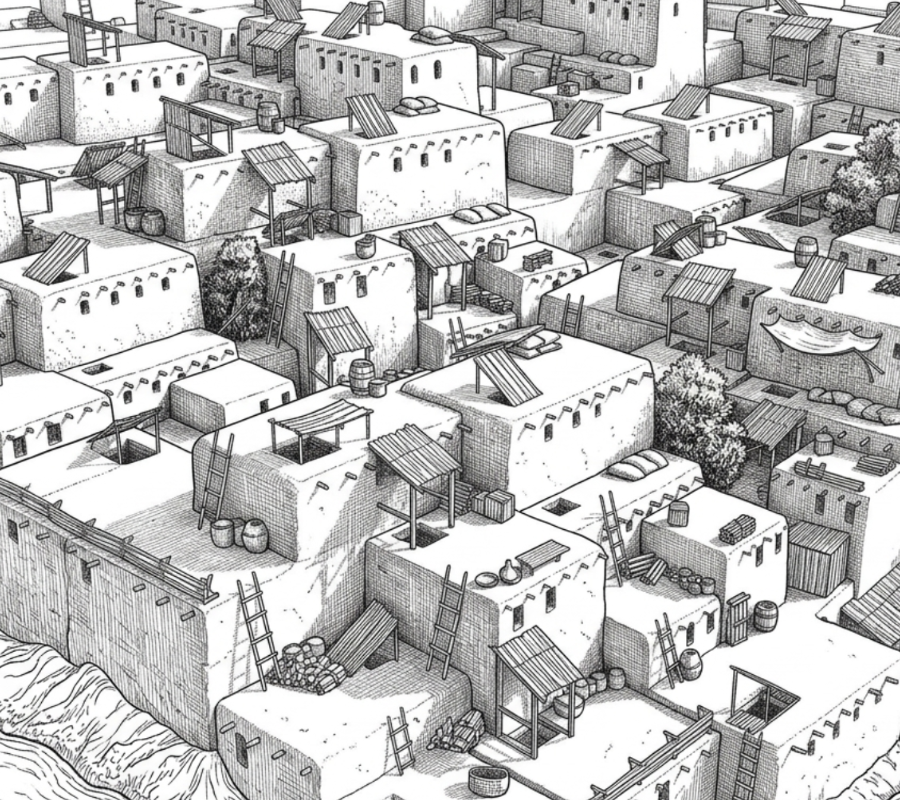
The houses of Çatalhöyük have no entrance to the ground. To access you have to go up to the roof and down a wooden staircase through a hole. There are no streets because they don't need them: the roof is the street, the square, the collective space. Inside, the rooms are small and without windows. The home burns dry manure cakes, the fuel available on the plain, and that specific, dense and low smoke, permeates the plaster walls, clothes and hair of those who sleep there. The layers of black soot on the white plaster record the years as an involuntary file. The only fresh air goes through the same hole where people come down and smoke up.
Why live like this, half buried, without natural light, without separation between smoke and sleep? Maybe because winters on Konya's plain reach less than 25 degrees. The shared walls remain warm. A house attached to five neighbors loses much less temperature than an isolated house. The roof as the only entrance also functions as a barrier against predators and the cold. Maybe that extreme density, living without physical separation between houses means living without the possibility of secretly accumulating, without being able to build something that others don't see. Architecture made opacity almost impossible. And that impossibility may have been precisely the mechanism that maintained egalitarianism for centuries.
When the eyes adapt to the darkness, the paintings appear. Large fields of intense red, geometric bands that are repeated with the artist's interpretation, animals of impossible proportions: bulls, deer, vultures, leopards. And by emerging directly from the wall, in slabs and in relief, the royal skulls of bovids with the horns intact. The animal is incorporated into the house architecture.
These paintings are renewed. When something important happens, a death, a birth, the wall is linked in white and repainted. Under today's cast there are scenes that no one has ever seen. Some houses accumulate dozens of layers. Art doesn't decorate space, it records its history.
On a wall at the deepest level of the site something different appeared: a grid of rectangles that someone interpreted as the houses of the settlement itself, and behind it, a bicuspid form with black dots that could be the erupting Hasan Dağı volcano, a hundred and thirty kilometres away. If the interpretation is correct, it is one of the first known maps of human history. Someone looked at their own world from the outside and drew it. And he chose to paint it next to what could destroy it. The paintings cover the walls. The dead occupy the ground.
The dead are buried under the platforms where the living sleep, inside the active house, with the family living on top. Over time the soil is opened to add to another, the bones of the former are reordered, some skulls are recovered, painted from red ocre and stored. There are houses with more than twenty individuals accumulated under the floor over generations. The house is the place where everyone who lived is still there.
The smell that this produced in the first days after a burial, in a space without windows, with the only hole in the roof, was part of domestic life. There was no way to separate it. The smoke of the manure, the fat boiling in the mud bowl, the animal skins hanging on the north wall, and below all that, the earth just removed. For those born there, that smell was just the smell of home. The same air that brought the smoke from the manure and the ground removed also brought roasted cereal, sheep fat boiling in mud, fermented almez. Smells that any nose would recognize as good, mixed without possible separation with those we would consider unbearable today. There was no way to choose one and rule out the other. They were the same air.
The settlement from the outside
From the roof, Çatalhöyük smells different. The middens, the common dumpsters located between houses and in abandoned buildings, accumulate decaying houses, faeces, ashes and bones. Dogs are around their edges. In some building without owner, a flock of sheep spend the night. The smoke of thousands of homes on simultaneously forms a low cloud on the mound. When the wind changes, it all comes at once.
For the modern visitor, unbearable. For those who lived there, invisible. The human olfactory system used to a constant stimulus stops recording it. What for our nose would be an alarm signal, for them was the sign that everything was still in place. The world was working.