



Göbekli Tepe

approx. 9600 - 8000 BC

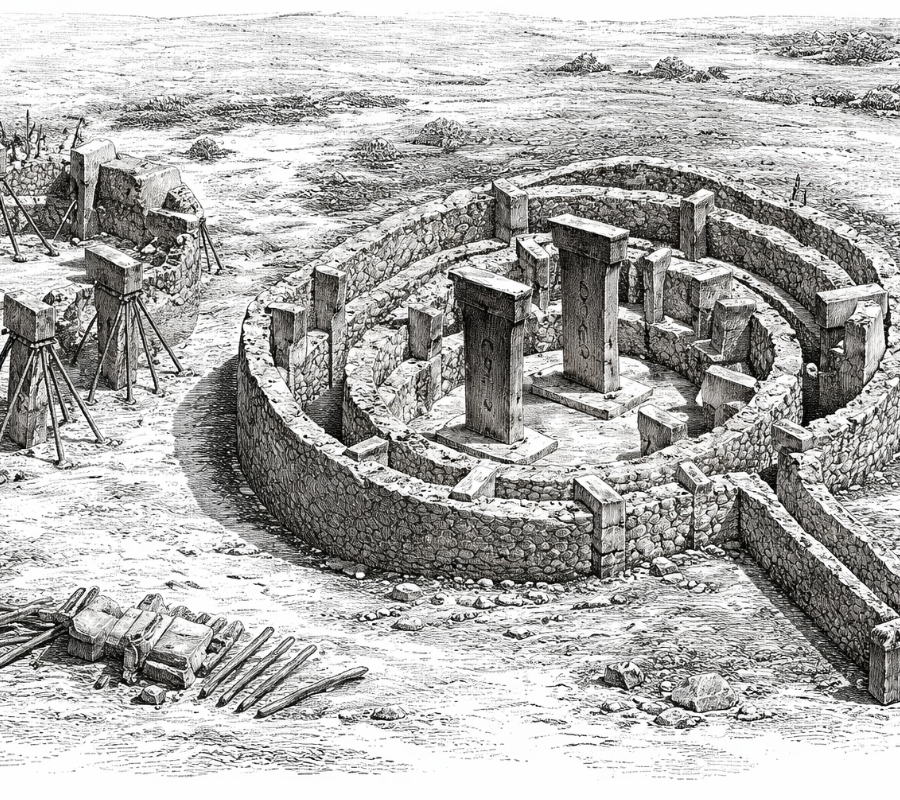
In the region of Şanlıurfa, to the south-east of present-day Turkey, a discreet hill hid for millennia stone enclosures with monumental pillars. Its antiquity, prior to agriculture, reveals an unprecedented ritual and collective organization in its time.

It was between 9600 and 8000 BC, right in the crucible of the pre-ceramic Neolithic, that a sanctuary of prodigy stone emerged from the order. There, imposing T-shaped pillars were raised as silent sentries. On them, a bestiary of reliefs (snakes that twirl, foxes that stalk, vultures with wings deployed, scorpions, boars, fellines) narrated a system of thought so complex that its obsessive repetition can only be explained by a deliberate transmission of knowledge over generations. The same motifs appear faithfully in sites more than three hundred kilometres away, in southern Jordan and in the scattered enclaves of Alta Mesopotamia: someone was carrying with them, in memory, something equivalent to a style manual.

Building these spaces involved a planning that anticipated what we know today as sacred geometry (modeling studies propose that at least three enclosures were drawn on equilateral triangles, using strings and benchmarks with a precision that left little margin at random), a coordination that synchronized hunters and collectors in a cohesive workforce, and a continuity in the execution that kept the work alive for more than a thousand years. The pillars, up to six meters high and several tons of weight, were removed from nearby quarries with basalt percusters and silex tools, exploiting the relatively soft limestone of the hill. In a single small space, almost seven hundred political artifacts were found: the quarterers were concentrated, in mass, with a division of tasks that requires supervision and judgment. The stylistic uniformity of the reliefs, maintained over centuries and with different hands, is the most eloquent evidence that someone taught, someone learned and someone decided what was worth preserving.

But the fascinating thing about Göbekli Tepe is all that happened within those pillars in T. In the same palpiting proximity they converged activities that our modern mentality often separated: the silex carved by a boar shared the space with which it molested wild cereal in one of the more than seven thousand mortars and moler stones scattered around the site. The ritual consumption of animals (sixty percent of the recovered bones belong to gazelle, the rest to uro and boar hunted around) intermingled with the delicate handling of human remains: three skulls with deep incisions, a deliberate drilling and red ocre strokes, modified to be hung or exposed, as if the ancestors, the living and the gods shared the same table. And on that table, most likely, there was drink: the large canisters of carved stone (a huge investment of work and time in a time without ceramics) show deposits of calcium oxalate that researchers interpret as signs of fermentation of wild cereal. The beer, or something functionally equivalent, that was part of the ritual. In Göbekli Tepe, the technical, practical and symbolic could be the same substance.

Whoever called the feast also controlled the time, the calendar and access to the sacred. The work celebrations (work fears, in the terminology of the archaeologists who have studied the faunistic deposits) they worked as the mechanism that made it possible to bring together hundreds of people for months of collective effort: you arrive, loads stones, reliefs, and in return there is meat, there is drink, there is ritual. But apparently this reciprocity had an asymmetry. Some sites are more elaborate than others, with denser iconography and more restricted accesses. The researchers propose that certain rituals and knowledge were reserved for specific groups, for those who had shown something or belonged to something. The hierarchy in Göbekli Tepe was symbolic: what raised a person was the knowledge he controlled, the stories he could invoke. A status society, in the weberian sense: without visible economic classes, with an order of prestige based perhaps on the monopoly of the sacred.

And this is where the archaeological look becomes a mirror of our own condition. This site could be a laboratory where the gears of social complexity were welded. We note how sustained cooperation, the production of resources and the repetition of symbolic forms ceased to be independent elements in order to become an indissoluble practice. Knowledge became action; action, materiality; materiality, the foundation of a new order. The anthropomorphic pillars (with carved arms, hands, belts, covers) are the point where this fusion becomes literal: the figure that presides over the enclosure is human and is something else at the same time, and who carved it knew exactly the difference.

Göbekli Tepe is far from being the origin of architecture or art. But it is close to being the point where humanity showed that to change the world, it first had to build a place where the world could be another. A perfect fabric where to make, organize and mean operated in unison, anticipating (in stone and bone, in modified skulls and in the pose of a fermented drink) all the temples, all the cities, all the systems that would come later. As we look at it, we find ourselves in a field of the past that can be the first beat of a future that still holds us today.
The literature and additional research, explanation, didactics and study materials are provided only to Myrodia Khartes subscribers.

olfactory functions in Göbekli Tepe

Incentive function: the smell of roasted cereal, of animal fat on brases, of thick papillas cooking in stone activated the attraction responses to the available food.

Avoiding function: the smell of decomposing viscers, of burned bones, of waste areas under the summer sun indicated biological danger.

Social communication and reproduction function: the density of sweaty bodies during collective work, the smell of uncursed skins and smoke-impregnated clothing, transmitted information on physical status, proximity and group membership.

Attachment and link function: the recurrent aromas of the place (the specific smoke of Pistacia, the fermentation of the einkorn) could be associated with security and belonging experiences for those who returned season after season.

hedonic evaluation function: the roast meat, the fermented drink, the fruits of Prunus could generate resuscas of pleasure that reinforced collective behaviors beneficial to the group.

Space orientation function: the sudden change in the olfactory profile when entering the monumental area (from dry steppe to smoke, meat and fermentation) worked as a sensory border marker, orienting the body in space before the view processed the architecture.

Olfactory nodes

In Göbekli Tepe three olfactory nodes are identified: points where the biological function is captured by use and becomes cultural construction. The three nodes set out below converge in their nature —all operate in ritual and feast spaces, all involve shared exposure— but each reveals a different layer of sophistication in that use.

Collective odors
The feast in Göbekli Tepe was an inescapable olfactory experience. The ointment fat on brasses, the smoke of Pistacia impregnating the enclosures, the sour smell of cereal fermenting in large stone containers saturated the space so that it reached all present without distinction of rank or function. The expert and the newcomer. The one who had access to the indoors and the one who worked on the periphery. They all inhaled the same, and that physiological indifferentiation was the condition of the possibility of cohesion: the moment when the social structure was loosened enough to allow the link to deepen. In a world without writing, written law, the collective aroma was the beginning of the contract of Liminality.

The Smell of the Sacred
The olfactory profile changed radically as it entered the monumental area. From the dry steppe and the limestone dust was moved to a dense atmosphere of smoke, ritual flesh and fermentation, a transition that the body recorded before the architecture could be visually processed. The smoke of Pistacia, with its specific and recognizable balsamic note, was repeated in the same sites for generations to become the aroma that announced that ordinary time had been left behind. The modulation of consciousness through the fermented drink deepened that state. The aroma was part of the ritual mechanism, as constitutive of the sacred threshold as the pillars that delimited it.

The Memory of the Olfate
That the same iconographic motifs appeared faithfully reproduced in sites over three hundred kilometres suggests a network of deliberate transmission of knowledge. This network also transmitted aromas: the same smoke, the same fermentation, the same olfactory profile of the ritual. For those who came from afar and recognized that smell, the aroma worked as a shared sensory file, as a password of belonging. The body remembered with an intensity that other senses hardly equal, and the next aroma of burned Pistacia activated that memory from within, as a convention that no one had formulated but that everyone felt.

Human sweat
Chemical sign: Carboxylic acids (isovaleric, butyric), sulphide compounds
Common scenarios: Intense physical activity (hunting, size), inside caves, shared spaces.

Fresh blood and viscers
Chemical signal: 1-octen-3-ol, volatile amines
Common scenarios: Carnicery of large dams (mammoth, bison, horse), initial break areas.

Fresh hides and skins
Chemical sign: Medium-chain fatty acids, nitrogenated compounds
Common scenarios: Initial processing of skins for clothing and shelter.

Excrements and urine
Chemical sign: Scatol, indol, ammonia
Common scenarios: Cave room areas, organic waste areas.

Sílex Tallado
Chemical sign: volatile silicon compounds, ozone by impact
Common scenarios: Litic-sized workshops, tool manufacturing, seasonal camps.

Dry earth / mineral dust
Chemical sign: volatile clay compounds (such as adsorbed short chain aldehydes), calcium and magnesium ions (in mixture with residual moisture)
Common scenarios: Dry steppes, ventilated caves, daily outdoor activity areas.

Wet Land (Petricor)
Chemical sign: Geosmine, 2-methylisoborneol
Common scenarios: External after the rain, collection areas, coastal environments.

Meat rot
Chemical sign: Putrescin, cadaverine, dimethyl sulfide, isovaleric acid
Common scenarios: Organic waste areas, abandoned butcher areas, decomposing food remains.

Accidental Fermentation
Chemical sign: Ethanol, ethyl acetate, acetic acid
Common scenarios: Storage of fruit, accumulation of wet plant matter, organic containers.

Smoke of fire
Chemical sign: Guayacol, sirengol, phenolic compounds, polycyclic aromatic hydrocarbons
Common scenarios: Central homes, meat and fur smoking, shelter heating.

Asada meat
Chemical sign: 2-methyl-3-furanitiol, alkyl sulphides, pyrazins (Maillard Reaction products)
Common scenarios: Kitchen stoves, food preparation, after-hunting celebrations.

Tired Leather
Chemical sign: Rust fatty acids, degradation carbonylcompounds
Common scenarios: Advanced processing of skins, manufacture of clothing and containers.

Petricor (post-rain)
Chemical sign: Geosmine released by mechanical impact, petricorces
Common scenarios: Rain after storms, collection areas after precipitation, cave entrances.

Burn coal / wood (not complete combustion)
Chemical sign: Phenol, cresol, furfural, light aromatic hydrocarbons
Common scenarios: Manufacture of fire-hardened tools, household remains, controlled combustion management.

Hot / melted animal fat
Chemical sign: Alifatic aldehydes (hexanal, nonanal), oxidized volatile fatty acids
Common scenarios: Tuetane and sebo heating for consumption or storage, fat processing for technological or food use.

Tasted cereal
Main chemical sign: Maillard and toasted reaction compounds: pyrazins (e.g. 2-ethyl-3,5-dimethylpyrazine), furfurals and furfuryl alcohol, 2-acetyl-1-pyrrolin, aldehydes such as hexanal and nonanal, heterocyclic azufrated compounds (2-acetyl-2-thiazoline).
Common scenarios: Tasting of grains (einkorn, barley or other cereals) on hot surfaces or on brases; preparation of toast, "cereal coffee" drinks or beer bases; pre-ground toasting.

Einkorn beer fermented in stone containers
Main chemical sign: Ethanol; upper alcohols (3-methyl-1-butanol, 2-methyl-1-propanol, 2-methyl-1-butanol); esters (ethyl acetate, isoamyl acetate, ethyl lactate, other ethyl esters); organic acids (acetic, lactic); fatty aldehydes (hexanal, (E) -2-nonrenal) derived from cereal.
Common scenarios: Fermentation of einkorn must in stone containers by yeast and lactic bacteria; storage in fresh or semi-buried spaces; areas where containers are concentrated in simultaneous fermentation.

Bones burned
Main chemical sign: Bone organic matrix combustion products (collagen, residual fat): nitrogenated and azufrated compounds, phenols, aromatic derivatives (e.g. naphthalene, replaced phenolic), mixtures related to "burning / fire smell."
Common scenarios: Bones thrown into fire after consumption; use of bones as additional fuel; homes where brases, calcified bone remains and partially carbonized fragments coexist.

Smoked skins
Main chemical sign: Smoke phenols (guayacol, cresoles, siringol and derivatives), aldehydes and ketones of burned wood, more fatty acids and collagen and skin lipids degradation products; typical mixture of smoke + fat + protein.
Common scenarios: Curing and conservation of skins hung on household smoke; prolonged exposure to woody smoke in closed spaces; reuse of smokedown and skin drying.

We appreciate your contribution.

Open access sustained by cultural co-responsibility.