
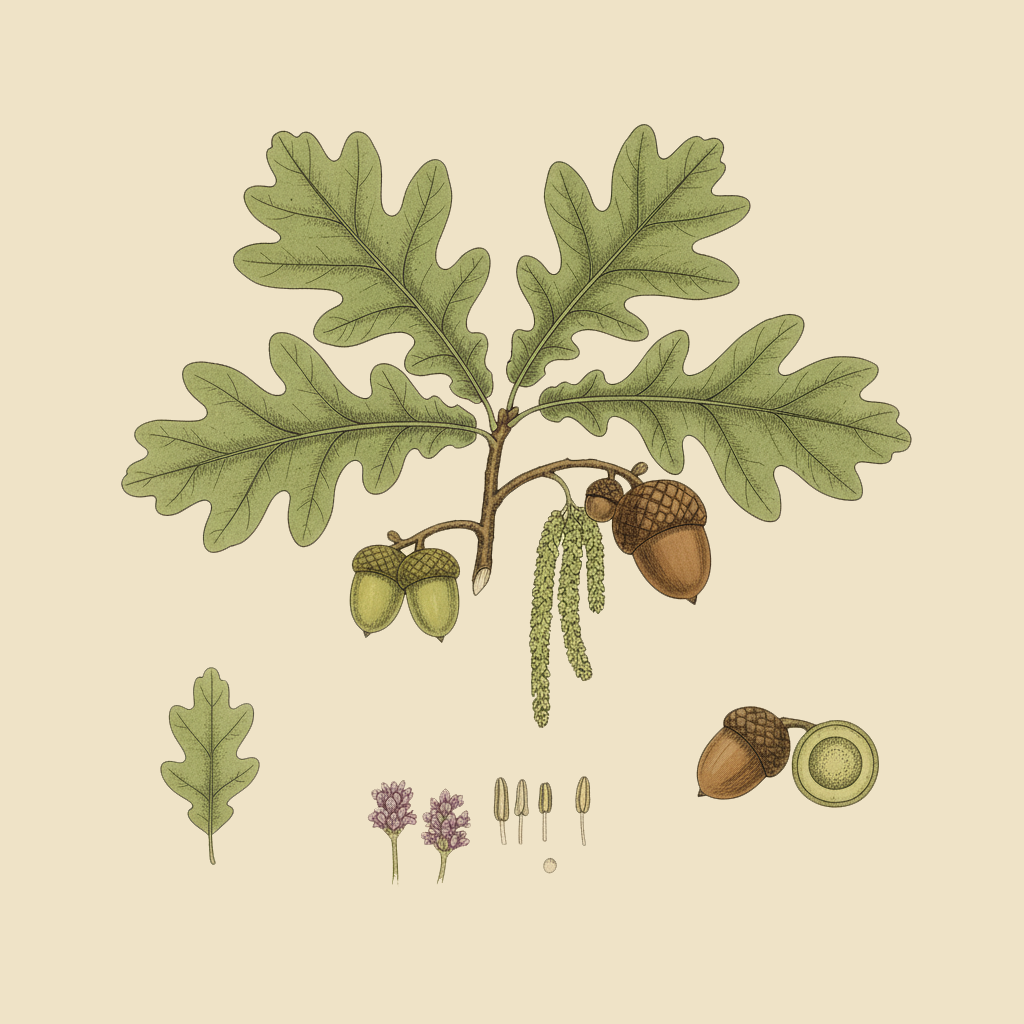
The Roble it originated in the northern hemisphere during the Paleocene. It has been a dominant component of forest ecosystems for millions of years. Encine (Quercus ilex subsp. ilex) is an emblematic species of the Mediterranean.
-
Distribution and Biomas: The oaks (Quercus robur, Q. petraea) are native to temperate deciduous forests in Europe, Asia and America. The oak (Quercus ilex) is perennial and characteristic of the Mediterranean forest and bush (maquia), adapted to dry summers and fires.
-
Major Producers: For wood products, countries like the United States, Russia and China are leaders. For cork (Quercus suber), Portugal is the absolute producer, followed by Spain, France, Italy and Morocco.
Fast source: Royal Botanic Gardens Kew
Species & Culture
Use: Food (berries), Environment (forests).
Evidence: In the Kebara cave, some acorns were found among the carbonized remains, indicating that the neanderthals included them in their diet when they were available. Studies of plant remains in Neandertal homes in sites in the Near East (Kebara, Amud, Gibraltar) and in northern Europe during the Eemian (Neumark- Nord, Rabutz in Germany) have documented the presence of acorns (oak fruits) along with other types of nuts. The acorns are known to be highly nutritious, but they need to be removed to remove bitter tannins before their consumption, suggesting that neanderthals knew and applied processes for their preparation.
In the surroundings of the Gorham Cave in Gibraltar, where the last Neanderthals survived, a tree savannah made up of pineapple, alcornoques (Quercus suber) and junips was described, indicating that the oaks were part of their habitat. Analysis of phytolytes (microscopic remains of plants) of the Tabūn layer associated with a 122,000-year-old neandertal revealed a Mediterranean forest environment with species such as Palestinian oak (siempregreen) and Tabor oak (deciduous).
Fast source: PNAS
For oak wood (Quercus robur, Q. petraea, Q. alba) is used mainly:
- CO2 extraction: preferred method for roasted oak chips, producing extracts rich in aromatic compounds without degrading natural components
- Softact extraction: Alternative to CO2 extraction for oak chip extracts
Main Aromatic Molecules
Key aromatic compounds include:
- β-methyl-γ-octalactone (lactone whiskey): Present as isomers cis and transwith cis being more aromatic (detection threshold: 49 ng / L vs 193 μg / L for verbenone)
- Timoquinone: Associated with pencil and cedar aromas
- Verbenone: With fresh, mentholated notes and tea leaves
- Vainillin and eugenol: Phenolic compounds characteristic of roasted oak.
Fast sources: Oene
The CO2 oak extract has an IFRA 51 restriction of 0.14% in finished product for Category 4. The oak extracts are used as a regulatively more favourable alternative to the oak moss, which is severely restricted by IFRA due to its allergenic potential.
Space under construction by collaborators.
The section Technical information and has a general arguative character. It is presented for information purposes to promote responsible knowledge. Because of the risks associated with the incorrect use of botanical extracts, aromatic molecules and the increase in unregulated practices in the production of aromatic products, Myrodia Khartes has chosen not to disclose complete extraction methodologies or specific concentrations that may compromise public safety. Health, ethics and scientific integrity guide our decision to limit the exposure of certain technical data.
- European Commission. (2009). Regulation (EC) No 1223 / 2009 on Cosmetic Products. Official Journal of the European Union, L 342, 59-209.
-
IFRA (International Fragrance Association). (2023). IFRA Standards Library: 52nd Amendment.
- The Good Scens Company. (2025). Fragrance Raw Materials Database