

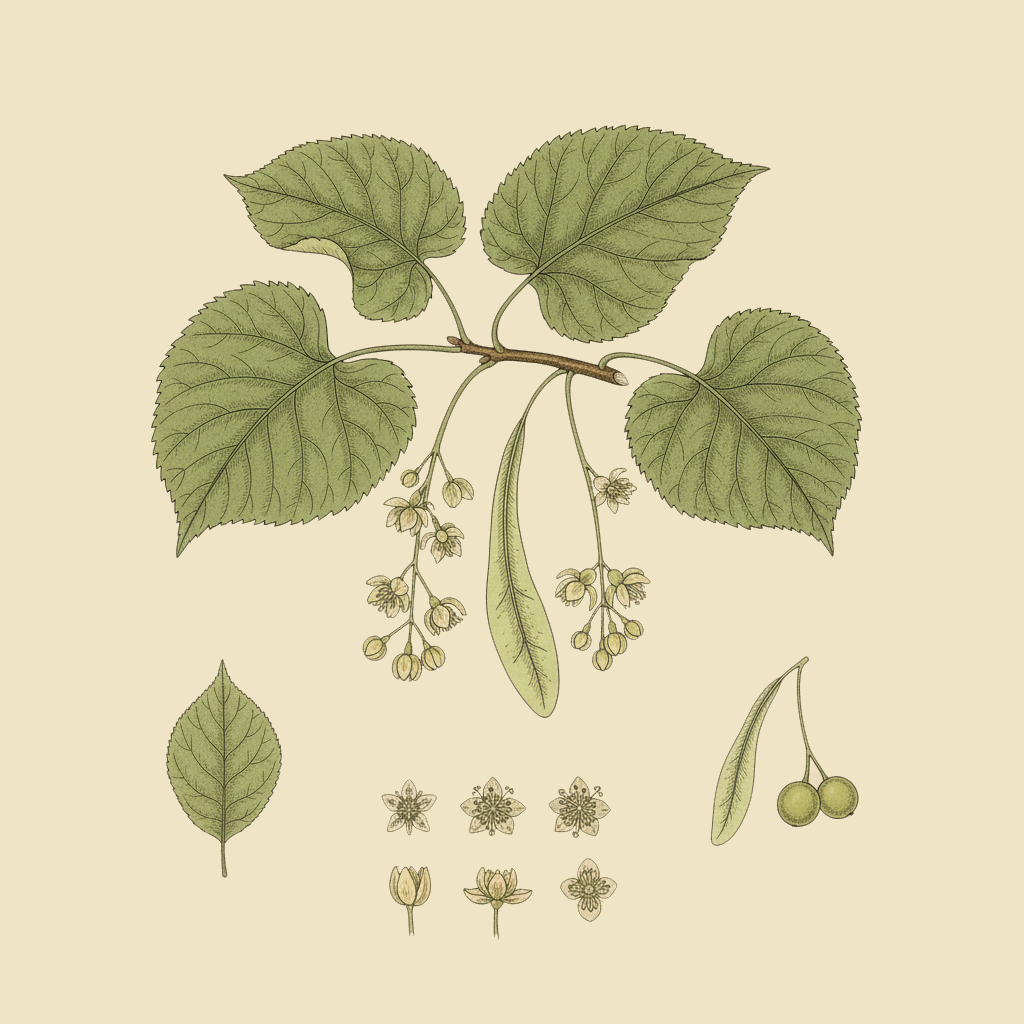
The Tilo It is native to the temperate regions of the northern hemisphere. It is present in Europe, East Asia and North America. Its fossil record is ancient, and has been a tree venerated in Germanic, Slavic and Celtic cultures for its medicinal properties and shadow.
-
Distribution and Biomas: It is developed in temperate mixed deciduous forests, preferring deep, fresh and humid soils. It is a common species in river valleys and slopes with good water availability.
-
Major Producers: It's not a massive agricultural crop. The production of tyl flowers for infusions is mainly based on wild harvesting or small-scale crops in countries of Eastern and Central Europe (Bulgaria, Poland, Romania, Turkey) and China.
Fast source: Royal Botanic Gardens Kew
Species & Culture
Use: Food (seeds), possibly medicinal.
Evidence: In Neumark-Nord and Rabutz, Germany, carbonized tyl seeds were found, suggesting that they could have been consumed by neanderthals during the Eemian period, being used as food.
Fast source: Researchgate
For tyl flowers (Tilia cordata, T. American) are used:
- Steam distillation: Main method for obtaining essential oil from flowers
- Extraction with solvents: To produce more concentrated absolutes with hexane or ethanol
Aromatic composition
The tyl flower absolute has a sweet floral aromatic profile with honey notes, described as soothing and reminiscent of a summer breeze. The essential oil shows floral, sweet and aromatic characteristics.
Fast sources: Madarcorporation
The tyl flower absolute (3% dilution) has variable IFRA restrictions: not approved for Category 1, 44.66% for Category 2, and without limit for several categories (3, 4, 5A-C, 7A-B, 9, 10A-B, 12). It is registered under CAS 84929-52-2 and complies with the European Cosmetics Regulation.
Space under construction by collaborators.
The section Technical information and has a general arguative character. It is presented for information purposes to promote responsible knowledge. Because of the risks associated with the incorrect use of botanical extracts, aromatic molecules and the increase in unregulated practices in the production of aromatic products, Myrodia Khartes has chosen not to disclose complete extraction methodologies or specific concentrations that may compromise public safety. Health, ethics and scientific integrity guide our decision to limit the exposure of certain technical data.
- European Commission. (2009). Regulation (EC) No 1223 / 2009 on Cosmetic Products. Official Journal of the European Union, L 342, 59-209.
-
IFRA (International Fragrance Association). (2023). IFRA Standards Library: 52nd Amendment.
- The Good Scens Company. (2025). Fragrance Raw Materials Database

