

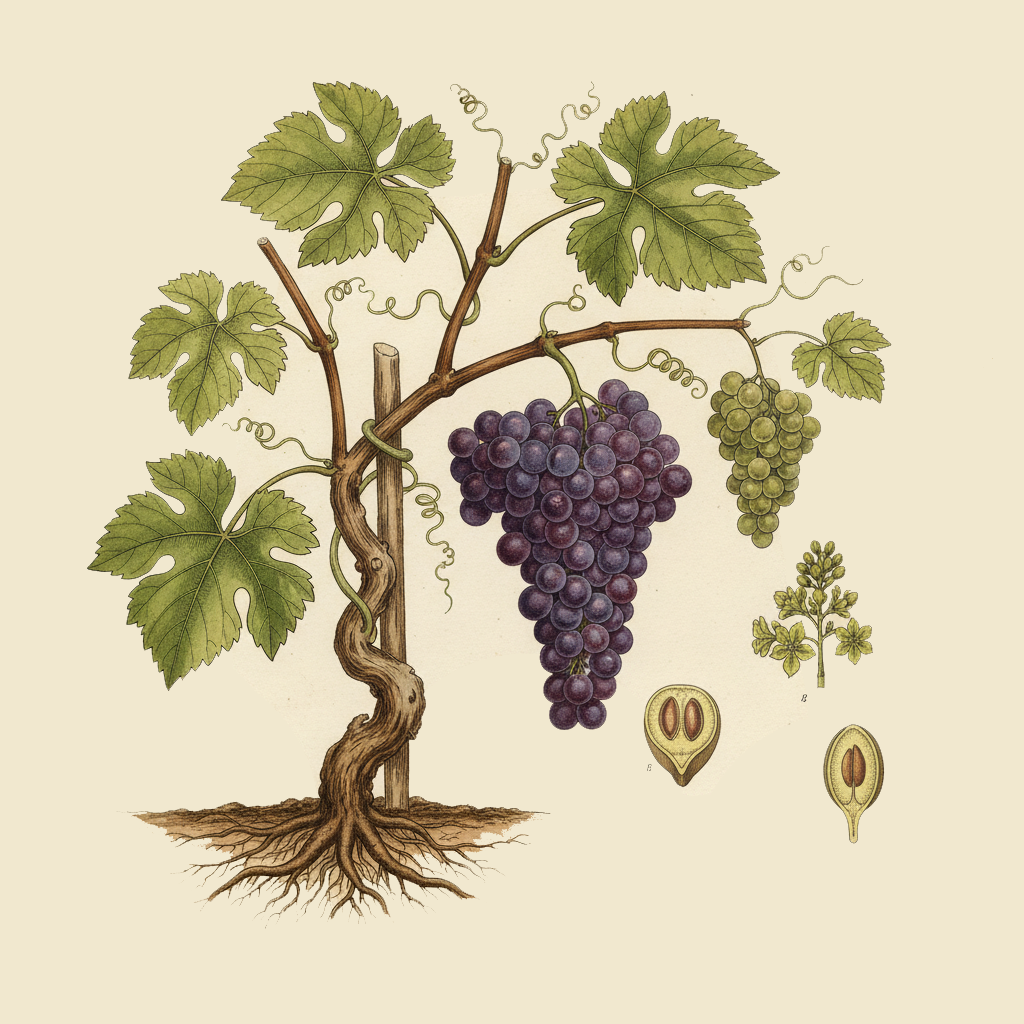
The Wild grapes is the wild form and direct parent of the cultivated grape (Vitis vinifera subsp. vinifera). It is native to a vast region from Western and Central Europe to the Caucasus and the Mediterranean. Its domestication began in the Caucasus and the Fértil Growing about 6000-8000 years ago.
-
Distribution and Biomas: It grows naturally in coastal and riverside forests (gallery), hedges and forest lines in temperate climates. It prefers wet and well drained soils and needs to climb the trees to access the light. It is currently at risk of extinction in many areas of its original distribution area.
-
Major Producers: It's not produced. Its importance is critical as a genetic reservoir for the improvement of the varieties of cultivated grapes, as it has genes of resistance to diseases and abiotic stress. Conservation efforts focus on countries in their natural distribution area.
Fast source: Royal Botanic Gardens Kew
Species & Culture
Use: Food (grapes).
Evidence: The presence of grapes (along with dates, figs, wild olives and palm trees) in the plant remains of neandertal homes in the Near East such as Kebara, Amud and Gibraltar, indicates that it was part of their diet.
Fast source: Nature
Name in old languages
Sumerium: gišgeštin (vine / grapes)
Acadio: karānu (wine), kīma karānim ("like wine"), inbu ša karāni (grapes)
The vine (Vitis vinifera subsp. sylvestris) was domesticated in Transcaucasia and Eastern Anatolia, peripheral regions of Mesopotamia, more than 8 000 years ago. In the mesopotamic plain itself, the cultivation of the vine was limited by the climate; the wine was mainly a well imported from the northern and eastern mountain areas.
Wine as a luxury and ritual article: In the cities - the Sumerian state and acadias of the 3rd millennium a. C., wine was an elite commodity, consumed mainly by royalty, aristocracy and clergy. The cuneiform tablets of Ebla (Syria, ca. 2300 BC) and Mari (ca. 2000 BC) document an abundant wine trade for the royal court and temples. The Herodotus points out that in its time (5th century BC) the wine came to Babylon by the Euphrates in circular barges from Armenia.
He came to the Epopeya of Gilgamesh: The Tabernera Siduri, the guardian of the "sea of death," lives at the end of the world by guarding the divine vineyards. The wine appears in the poem as a product of civilization and connection with the gods.
Medicinal use: The first recorded medicinal uses of wine date from the Sumerian period; the "Farmacopeo Sumerio" (Nippur tablet, ca. 2100 BC) —the oldest known pharmacological text— mentions wine as an excipient for medicinal preparations, along with barley beer.
Viniculture in the north mesopotamic: In the northern Mesopotamia (Assyria), climatic conditions allowed the cultivation of vineyards. Neo-Assyrian texts from the IX-VII centuries a. C. They mention royal gardens with vineyards around the cities of Nineveh, Assur and Kalhu. The Assyrian kings sent expeditions to the production regions to obtain quality wine for the palace rituals.
Art and symbolism: The vine and the cluster of grapes appear in cylinders - seal, reliefs and mesopotamic goldsmiths as symbols of abundance, fertility and vitality. The wine was an offering to the gods in the temperate ceremonies and component of the funeral banquets of the elite.
Quick links:
Aladabj, University of Baghdad, 2021. "Fruits and their uses in Mesopotamia light of published Cuneiform texts."
Berkowitz, M. (1996). World's Earliest Wine. Archaeology 49(5): 26.
García, J. A. Z. (2011). "First written references to viticulture in the Middle East." I came to Wine Circle.
Joannès, F. (1989). "La culture du palmier dattier et de la vigne en Babylonie." In Refluses des Deux Fleuves. Leuven.
Johnson, H. (1989). Vintage: The Story of Wine. Simon & Schuster. (Referred in Académie du Vin Library).
McGovern, P. E. (2003). Ancient Wine: The Search for the Origins of Wine. Princeton University Press.
"Land Between Rivers: Wine and Trade in Ancient Mesopotamia."
There are no specific references on extraction processes for essential or absolute oils intended for perfumery.
The aromatic molecule of the grape in perfumery
The main molecule used to recreate the grape aroma in perfumery is the Methyl antranylate (methyl anthranylate), also known as MA or methyl 2-aminobenzoate.
Chemical characteristics
Methyl antranylate has the following properties:
- Chemical formula: C-H-NO-NO
- CAS number: 134-20-3
- Appearance: Colourless to pale yellow liquid
- Merger point: 24 ° C
- boiling point: 256 ° C
- Fluorescence: Blue-violet under UV light
Olfactory profile
This molecule has a characteristic aroma of Concord grape with the following facets:
- High concentration: Fruity and sweet aroma intense to grapes
- 25 ppm: Sweet, fruity, similar to Concord grape with musk and berries nuances
- Secondary notes: Azahar, neroli, medicinal and naphthalene
Use in Perfume
Main applications
Methyl antranylate is used in perfumery for:
- Flower compositions: Neroli, jasmine and tuberous power
- Fruit acordes: Base for the recreation of artificial grape aromas
- Eastern Floors: When mixed with inles or musks
- Schiff foundation building: Especially aurantiol (combined with hydroxytronelal)
Typical Concentrations
- Perfume: 5-100 ppm depending on formulation
- Saborators: Variable dose by end product
Origin and Synthesis | Natural occurrence
Methyl antranylate is naturally found in:
- Grape Concord (Vitis labrusca): Main source of the "foxy" aroma
- Essential oils: Bergamota, jasmine, mandarin, orange, ylang-ylang
- Other fruit: Strawberries and apples
Synthetic production
It is produced commercially by:
- Antranylic acid sterification with methanol
- Petrochemical processes traditional
- Microbial fermentation (sustainable development alternative)
Fast sources: Scenspiracy
IFRA
- Classification: Non-dangerous under IFRA / FEMA standard limits
- Precautions: P280 (wear gloves), P261 (avoid inhaling vapors in large-scale applications)
European legislation
- EC number: 205-132-4
- Approved applications: Cosmetics, perfumes, food products
Important note: Unlike wine grapes (Vitis vinifera), which contain more than 200 different aromatic compounds, the perfumery industry mainly uses this synthetic molecule to consistently recreate the recognizable aroma of "artificial grapes" that we associate with sweets, soft drinks and commercial products.
Space under construction by collaborators.
The section Technical information and has a general arguative character. It is presented for information purposes to promote responsible knowledge. Because of the risks associated with the incorrect use of botanical extracts, aromatic molecules and the increase in unregulated practices in the production of aromatic products, Myrodia Khartes has chosen not to disclose complete extraction methodologies or specific concentrations that may compromise public safety. Health, ethics and scientific integrity guide our decision to limit the exposure of certain technical data.
- European Commission. (2009). Regulation (EC) No 1223 / 2009 on Cosmetic Products. Official Journal of the European Union, L 342, 59-209.
-
IFRA (International Fragrance Association). (2023). IFRA Standards Library: 52nd Amendment.
- The Good Scens Company. (2025). Fragrance Raw Materials Database

