

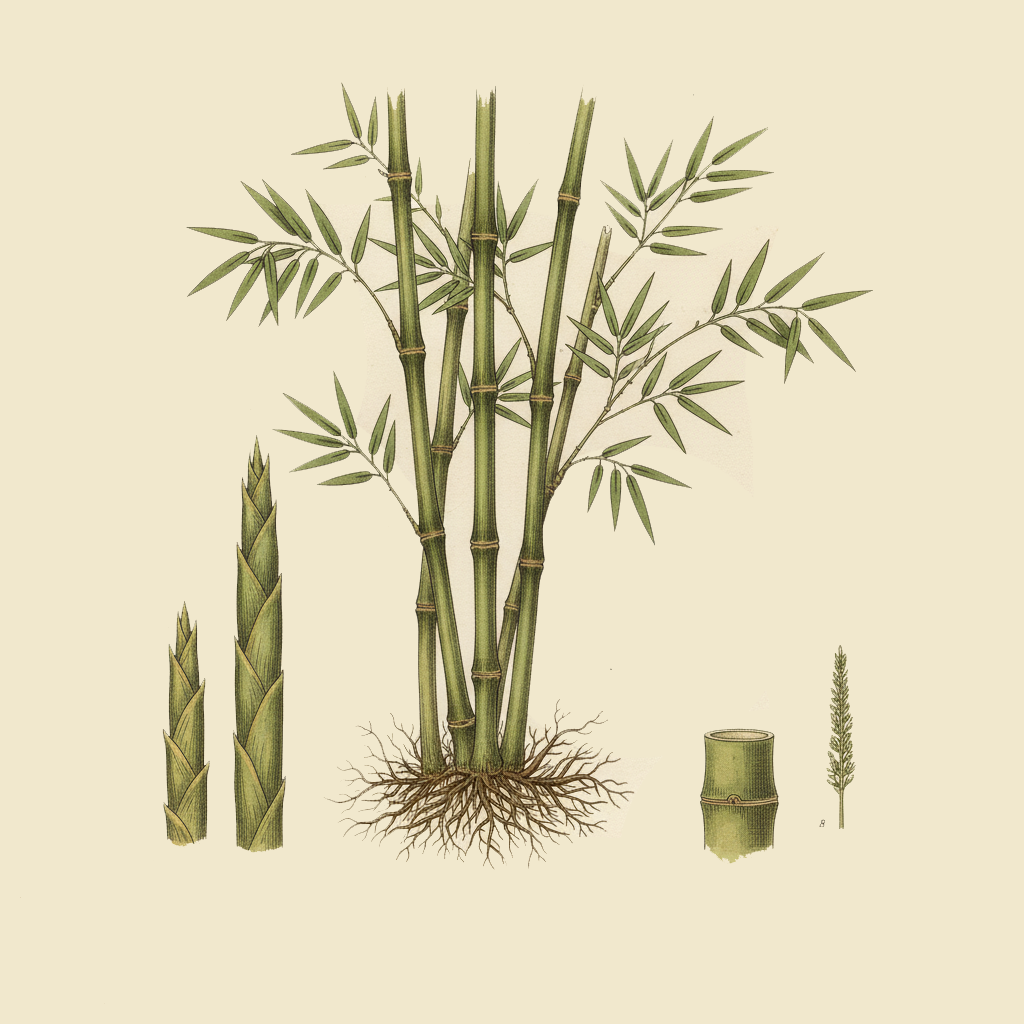
The bamboo are an old group of plants. Fossil evidence suggests that its lineage originated in the Cretaceous period, between 30 and 40 million years ago, probably in what is today South America or Africa, when these continents were still united in Gondwana. From there, they diversified globally. Their presence has been documented in the human cultures of Asia and America for millennia, being fundamental for construction, food, role and as a cultural and spiritual element in countries such as China, Japan and India.
- Distribution and Biomas: While they are native to all continents except Europe and Antarctica, their centre of diversity and ecological importance is in South-East Asia and South America. They develop mainly in tropical and subtropical biomasincluding tropical rainforests, cloudy mountain forests and coastal areas. Some species are very adaptable and can grow in temperate regions and even in alpine conditions at high altitudes.
- Major Producers: China is by far the largest bamboo producer and processor in the world, dominating the international market. It is followed by India, which has the largest area of bamboo forests, and other South-East Asian countries such as Indonesia, Vietnam and Thailand.
Fast source: Botanical Sciences
Species & Culture
Use: Food, Material, Environment.
Evidence: Food. Potential use of bamboo outbreaks as food (inferred from modern human consumption). Key raw material for making tools, utensils, weapons (knives, spears) and housing construction (huts, houses on pillars). He was able to replace stone in the manufacture of tools in Asia. It grows into vast forests in Asia, from tropical to temperate climates, and up to 3,800 meters of altitude. Evidence: Asia (general, especially South-East Asia), southern denisovan areas.
Fast source: ResearchGate
The bamboo presents a particular challenge in perfumery because there is no traditional process of extraction of essential bamboo oil. The bamboo plant does not produce a removable essential oil by conventional methods such as steam distillation or solvent extraction.
Aromatic compounds Identified
Scientific studies have identified several aromatic compounds in bamboo by analysis of solid phase microextraction head space (HS-SPME-GC-MS):
Phyllostachys edulis (Moso bamboo):
- Limonene: 32.95% (form R with 98.17% enantiomeric excess)
- Yomogi alcohol: 5.8%-30.8%
- Santolin oxide: 1.7%-10.5%
- Alcanfor: 5.2%-20.1%
Dendrocalamus latiflorus:
- Limonene: majority component with fresh lemon and citrus fragrance
- 2-furan pentyl: provides floral and fruit aroma
Synthetic Molecules Used
In perfumery, the bamboo aroma is rectified by synthetic molecules:
- Hexenol (cis-3-hexen-1-ol): for green and fresh notes
- Isocyclocytral: for penetrating green effects
- Synthetic cords that combine water notes, green and slightly weaned
Fast sources: Jstage
Commercial bamboo fragrance oils are formulated according to the IFRA regulations 51:
- Category 4: up to 2,641% in finished product
- Average use in perfumistic compounds: 0.56%
- Compliance with IFRA limits for different product categories
Space under construction by collaborators.
The section Technical information and has a general arguative character. It is presented for information purposes to promote responsible knowledge. Because of the risks associated with the incorrect use of botanical extracts, aromatic molecules and the increase in unregulated practices in the production of aromatic products, Myrodia Khartes has chosen not to disclose complete extraction methodologies or specific concentrations that may compromise public safety. Health, ethics and scientific integrity guide our decision to limit the exposure of certain technical data.
- European Commission. (2009). Regulation (EC) No 1223 / 2009 on Cosmetic Products. Official Journal of the European Union, L 342, 59-209.
-
IFRA (International Fragrance Association). (2023). IFRA Standards Library: 52nd Amendment.
- The Good Scens Company. (2025). Fragrance Raw Materials Database

