

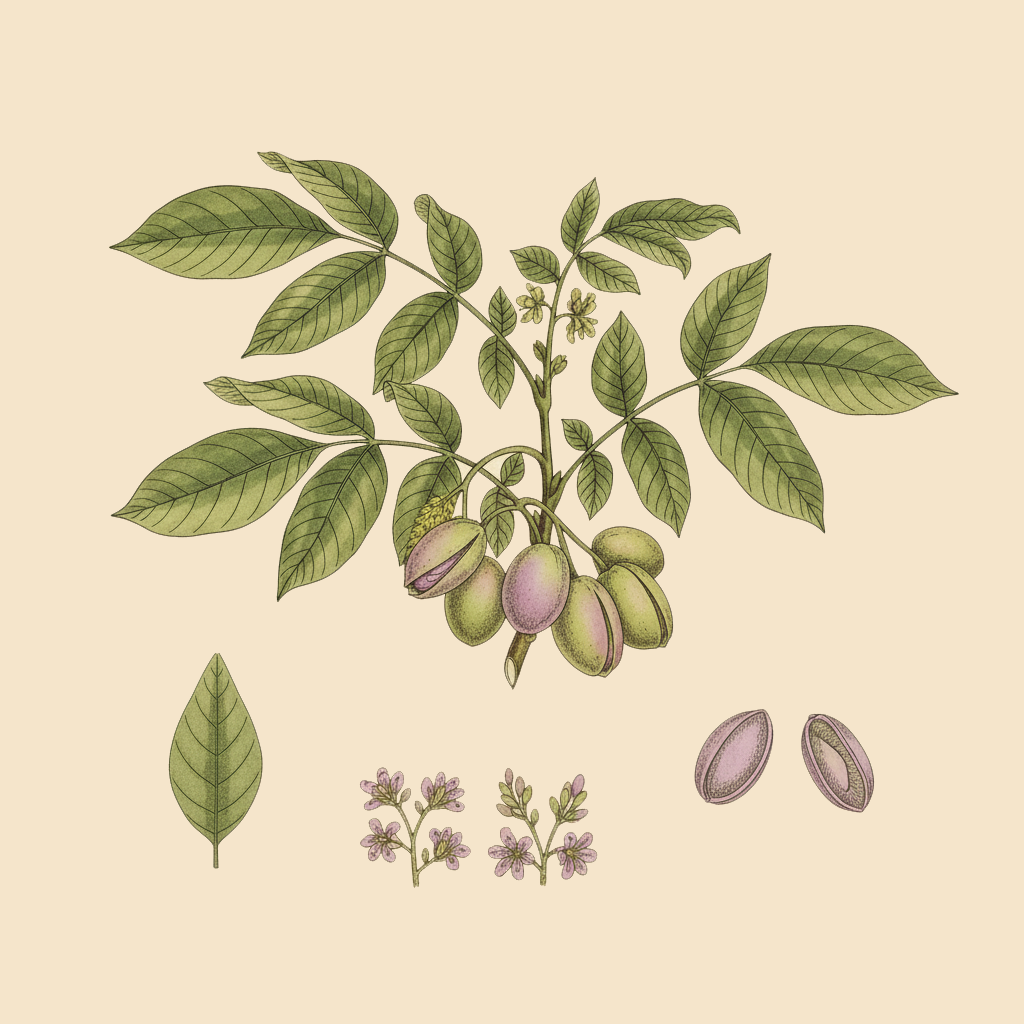
The Pistache It is native to Central and Western Asia, specifically the region that includes Iran, Afghanistan and Turkmenistan. Archaeological evidence suggests that its human consumption dates from 6000 BC. It was cultivated and marketed in the former Persian Empire and later introduced into the Mediterranean basin by the Romans.
-
Distribution and Biomas: It is naturally developed in biomas of deserts and arid steppes, on stony slopes and dry valleys. It is extremely resistant to drought and saline soils. Its commercial cultivation is concentrated in arid and semi-arid regions with long, hot and dry summers.
-
Major Producers: The world's largest producers are the United States (mainly California), Iran, Turkey, China and Syria.
Fast source: Royal Botanic Gardens Kew
Species & Culture
Use: Food (fruits).
Evidence: In the cave of Kebara, on the Mediterranean coast, pistachios were found in significant quantities among the carbonized remains, suggesting that neanderthals incorporated them into their diets when they were available, being a good source of protein and fat. Near East sites such as Kebara, Amud and Gibraltar have revealed that nuts such as pistachio (along with acorns, nuts, hazelnuts and piñones) were part of the impressive variety of plant remains found in the Neandertal homes. It was also observed in Gesher Benot Ya'aqov, a 780,000-year-old field in Israel, a unique association of edible nuts with hammers and human-made minced yunks, indicating the use of nuts by previous hominines.
Fast source: Elsevier
Use: Consumption of Oilseeds (wild pistachios) as a source of fat and energy in combination with cereals and other plants, and likely to use wood and resin as fuel and light construction material in the forest-steppe landscape of almonds and pistachios that surrounded the sanctuary during the early Neolithic. The fruits could be eaten raw, toasted or slightly crushed, both in the context of daily subsistence and integrated in special preparations (mixtures with cereals, enriched papiles, meat accompaniments) served during the "work feasts" documented for Göbekli Tepe.
Evidence: The analysis of plant macroesters by R. Neef for Göbekli Tepe, although numerically poor, identifies pistachio (Pistacy sp.), which indicates that the shrine's user groups collected fruit from typical woody forest-steppe pistacho. Neef points out that these taxons, still few in absolute quantity, are diagnoses of a regional environment dominated by pistachio and almond formations during the early Holocene, a landscape that is confirmed in other deposits of South-East Anatolia where the nuts Amygdalus and Pistacy they reach high proportions in the seed sets of the oldest levels.
In Göbekli Tepe, the low density of carbonized remains (both in hand and by flotation samples) prevents the precise quantification of the relative importance of pistachios in the diet, but their repeated presence, together with the regional subsistence model, allows to consider Pistacia sp. as a regular component —but not dominant— of the plant spectrum exploited. On a landscape scale, paleoenvironmental data for the southeast of Anatolia describe a mosaic of herbaceous steppe and woody bushes where Pistacy It forms dense spots on stony slopes and the edges of the ravine, providing not only fruits, but also dense wood and resin that can potentially be used as aromatic fuel or as a component of compound adhesives, by analogy with its ethnographic and archaeological use in other regions of the Middle East.
Fast sources: https: / / pmc.ncbi.nlm.nih.gov / articles / PMC9864209 /
Name in old languages
Sumerium: GIŠ. BAN or GIŠ.HA.LU. UB (ID discussed)
Acadio: butnu (probably pistachio /Pistacy)
Gender Pistacy includes several species distributed by the old Middle East, including terebinto (P. terebinthus, P. atlantica) —providing resin— and the pistachio (P. vera) —providing oilfruits—. The terminological distinction between them in mesopotamic texts is not always clear.
Aromatic resin and incense: The terebinto resin was one of the oldest aromatics in the old Middle East. The most spectacular evidence comes from the Uluburun specie (Turkey, ca. 1300 BC), where more than one metric ton of terebinto resin (Pistacy) stored in ~130 canaanean amphoras as part of the load of a long-distance merchant ship. This finding shows the scale of the Pistacia resin trade in the Late Bronze.
Perfume: Terebinto resin was an ingredient in the perfumed oil industry of the former Middle East. Its use in perfumes is similar to that of other aromatic resins, and it appears to be linked to the flavour trading network that connected Palestine, Syria and Mesopotamia.
Fruit and feed: The pistachio (P. vera) and nuts of other species of Pistacy they were consumed as food. Biblical texts (Genesis 43: 11) that reflect practices of the Middle Bronze quote pistachio nuts and terebinto resin as trade articles with Egypt. The fruit was also used for oil extraction and skin tannins to toss skins.
Medicine: In ancient Israel and the areas of the Fértil Growing (with practices shared with Mesopotamia), terebinto resin was used as an astringent and in medicinal ointment. Jeremiah (8: 22 and 46: 11) refers to the "balm of Galaad" which was probably identified with the resin of Atlantics, an export product from Palestine to Egypt.
Quick links:
Caris, R. & Weinstein-Evron, M. (2015). "The Use of Pistacy in Ancient Israel. " Jornal of Archaeological Science Reports.
Weinstein, I. (2015). "Use of Terebinth in Ancient Israel: Fruits, Oil and Resin." (Hebrew).
Kamar, Y. (2021). "Pistacia Terebinthus, the Terebinth Tree of the Agora in the Eastern Mediterranean and Smyrna. "
Texas A & M University (1995). "Terebinth Resin in Antiquity: Possible Uses in the Late Bronze Age Aegean Region."
The species Pistacia vera allows multiple methods of aromatic extraction. The essential oil is obtained mainly through:
- Steam distillation: It is removed from the outer shells of the pistachio by steam distillation, producing a pale yellow oil with green, citrus and herbaceous notes
- Extraction with solvents: To obtain absolutes with higher aromatic concentration
- Overcritical CO2 extraction: For species such as Pistacia lenticus, optimized at 160 ° C for 120 minutes with a performance of 5.7%
Molecular composition
The main components identified in Pistacia lenticus include α-pinene as a predominant compound, along with trans-verbenol, verbenol, cis-verbenone, kangene, β-myrcenum, d-lemonene and cimeno. Stop Pistacia vera, shell oil contains mainly lemonene (25.9-47.69%) and terpinolene (> 24%).
Fast sources: Trends in Pharmaceutical Sciences 2021
Pistachio products are subject to IFRA regulations. A specific example shows restrictions for "PISTACHIO PUDDING" with limits ranging from 0% in Category 1 to 2.7% in Category 3. European legislation considers these extracts as complex natural ingredients subject to safety assessment under Cosmetics Regulation 1223 / 2009.
There is no specific regulation on "pistachio" in perfumery, but European regulations regulate the ingredients of fragrances that can cause allergies, such as those obtained from plants. The law obliges manufacturers to declare 81 allergens of fragrances (formerly 26) in the labelling of cosmetics, to protect consumers with sensitivity.
Space under construction by collaborators.
The section Technical information and has a general arguative character. It is presented for information purposes to promote responsible knowledge. Because of the risks associated with the incorrect use of botanical extracts, aromatic molecules and the increase in unregulated practices in the production of aromatic products, Myrodia Khartes has chosen not to disclose complete extraction methodologies or specific concentrations that may compromise public safety. Health, ethics and scientific integrity guide our decision to limit the exposure of certain technical data.
- European Commission. (2009). Regulation (EC) No 1223 / 2009 on Cosmetic Products. Official Journal of the European Union, L 342, 59-209.
-
IFRA (International Fragrance Association). (2023). IFRA Standards Library: 52nd Amendment.
- The Good Scens Company. (2025). Fragrance Raw Materials Database

