

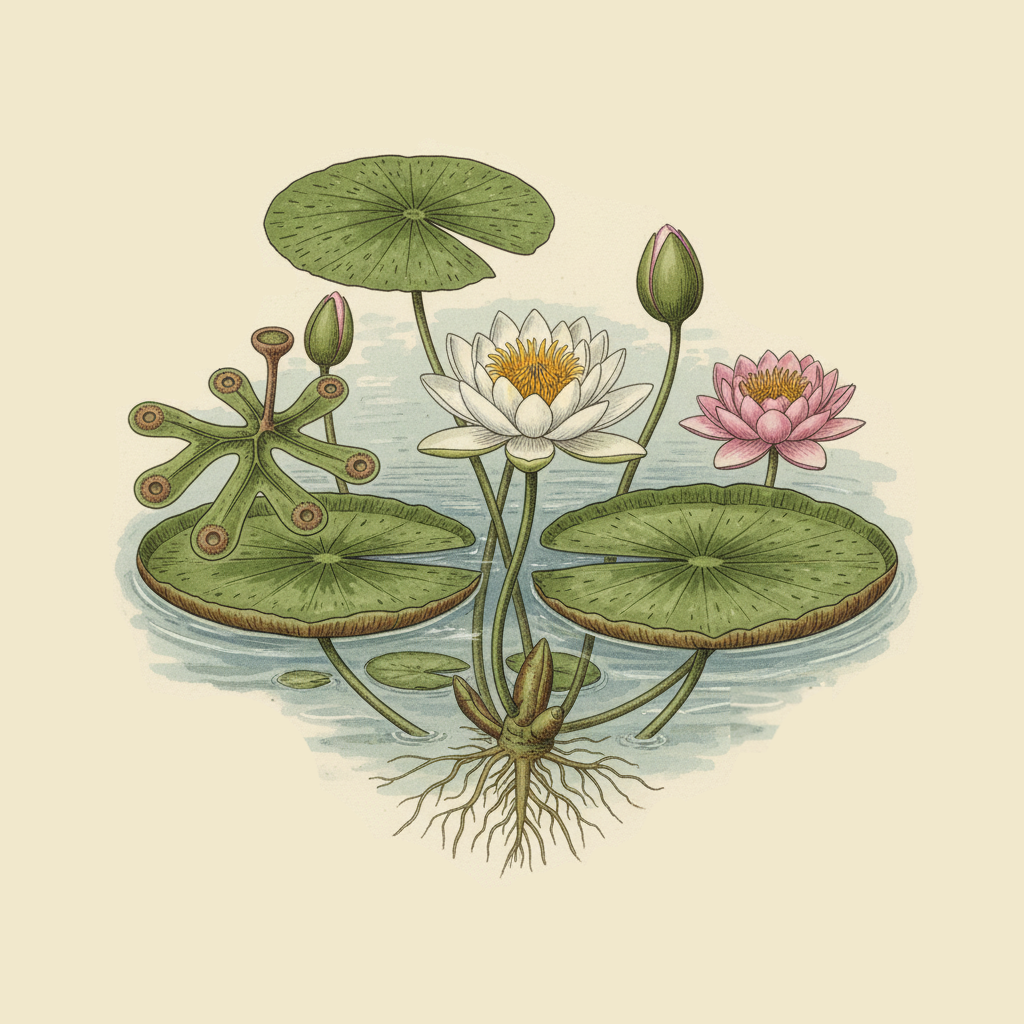
The Nenufar It has a cosmopolitan distribution, with native species on all continents except Antarctica. They are very old aquatic plants; nenufar fossils dating from the Cretaceous have been found. They had an important cultural and religious significance in ancient Egypt.
-
Distribution and Biomas: They live in freshwater biomas such as ponds, lakes, lagoons and slow watercourses in tropical, subtropical and temperate regions. They require quiet waters and muddy backgrounds to root.
-
Major Producers: "Production" focuses on the market for ornamental plants for ponds and aquariums. The largest producers and exporters of hybrid and crop varieties are specialized nurseries in countries such as the Netherlands, Thailand, the United States and Singapore.
Fast source: Royal Botanic Gardens Kew
Species & Culture
Use: Food (rhizomes / roots).
Evidence: Nenugo root starches were found in the dental calculation of adult neanderthals on the site of Spy, in northwestern Europe, dating in about 100,000 years. This means that Neanderthals actively sought vegetable food, demonstrating their ability to wade in the water to obtain it.
Fast source: PNAS
Nenuso has significant limitations for traditional extraction:
- Steam distillation: No essential oil produced in significant quantities
- Headspace technology: preferred method for capturing volatile compounds
- Subcritical extraction: Advanced techniques with specific solvents
- Ultrasound assisted extraction: To optimize efficiency
Aromatic characteristics
The olfactory profile of the nenufar is characterized by:
- Aqueous notes: Clear and fluid freshness
- Floral sweetness: Refined balance between sweetness and green freshness
- Melose nuances: Especially in Nymphaea caerulea
- olfactory transparency: Light quality that complements floral and aquatic chords
Synthetic molecules
Due to extraction limitations, they are used synthetic reconstitution by headspace technology and specific aromatic molecules that recreate the characteristic aquoso- floral profile.
Fast sources: Patents
The 51st Amendment of IFRA (June 2023) includes:
263 fragrance compounds with restrictions, specifications and / or prohibitions
Product categories: 12 main categories by exposure level
Implementation dates: Specific time limits for new and existing products
Safety assessments: Based on RIFM scientific data
Cosmetics regulation (EC No. 1223 / 2009):
Safety assessment: Mandatory for all ingredients
Cosmetic Product Safety Report (CPSR): Full technical documentation
Allergen labelling: > 10ppm in products that remain on the skin, > 100ppm in rinse products
CLP regulation: Classification, labelling and packaging of chemicals
REACH (Registration, Evaluation, Authorization and Restrictions of Chemicals):
Compulsory registration: For chemicals used in quantities exceeding 1 tonne / year
Safety assessment: Toxicological and ecotoxicological data
Authorisation: For highly concerned substances (HCV)
Space under construction by collaborators.
The section Technical information and has a general arguative character. It is presented for information purposes to promote responsible knowledge. Because of the risks associated with the incorrect use of botanical extracts, aromatic molecules and the increase in unregulated practices in the production of aromatic products, Myrodia Khartes has chosen not to disclose complete extraction methodologies or specific concentrations that may compromise public safety. Health, ethics and scientific integrity guide our decision to limit the exposure of certain technical data.
- European Commission. (2009). Regulation (EC) No 1223 / 2009 on Cosmetic Products. Official Journal of the European Union, L 342, 59-209.
-
IFRA (International Fragrance Association). (2023). IFRA Standards Library: 52nd Amendment.
- The Good Scens Company. (2025). Fragrance Raw Materials Database

