

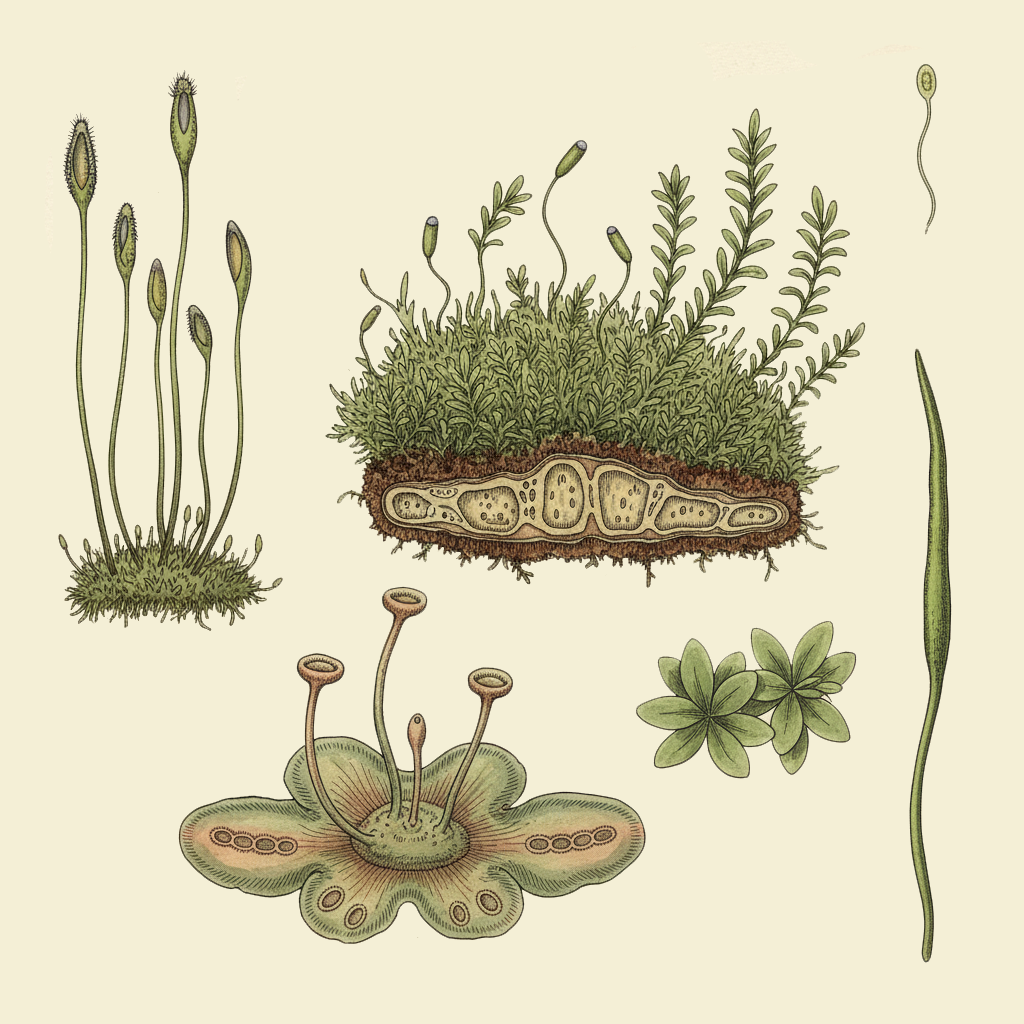
The Moss are a very old group of non-vascular plants. The oldest fossils similar to the moss date from the Carboniferous period, about 350 million years ago. They were among the first plants to colonize the land, paving the way for other plants.
-
Distribution and Biomas: They develop in virtually every terrestrial biome on the planet, from the Arctic to the tropics. They prosper in humid and shaded environments, such as forests (where they form the "soil" of the underforest), peat trees, rocks and tree crusts. They are crucial in tundra and turber ecosystems.
-
Major Producers: There is no "producer" in the agricultural sense. The main "production" comes from sustainable collection or cultivation in nurseries for use in horticulture (such as peat moss or for gardens), florist and regeneration. Countries like Canada, Russia, Finland and Chile are large peat extractors, a substrate made up of moss (mainly of the gender) Sphagnum) decomposed.
Fast source: Global Biodiversity Information Facility
Species & Culture
Use: Food (possibly complex carbohydrates), bed material or insulation.
Evidence: In a dental calculation study of a Neandertal in El Sidron, DNA was detected that coincided with moss. Although the moss has no known food history and pollution is a possibility, it has been discovered to contain complex carbohydrates, which would have given it some nutritional value. Domestic use (bedding): There is evidence from the Abric Roma (Spain) site that body waste was routinely incinerated along with grass and, potentially, moss, most likely as part of old bedding. Part of the environment: Their presence in dental calculation and household remains suggests that it was an element of their environment.
Fast source: Nature
The moss presents unique challenges for aromatic extraction:
- Hydrodistillation: Main method with yields of 0.23% (dry weight)
- Ethanol extraction:: Through 150 ° microwave assistance C
- Chloroform extraction: For specific components
- Supercritical extraction: Advanced methods for polar compounds
Identified Components
Moss GC-MS analyses reveal:
- Fithol31.95 per cent (main component)
- 1-octen-3-ol: Characteristic volatile compound
- Alifatic aldehydes: Large amounts
- Terpenes: Various monoterpenic and sesquiterpenic structures
- Aromatic compounds: Complex phenolic structures
Fast sources: PubMed
Moss extracts have no specific regulations as raw material, but individual compounds are subject to evaluation. It is important to note that the oakmoss (oak moss) is strongly regulated by IFRA due to its allergenic potential, but this does not necessarily apply to all species of Bryophyta.
Regulation (EU) 2023 / 1545 requires the specification of fragrances allergens, and while not completely prohibiting moss, restrictions on allergy-causing compounds, such as those present in these moss (also present in the Lyral banned), make their use virtually impossible or require modified and low-allergen extracts, or their replacement by synthetic alternatives.
Space under construction by collaborators.
The section Technical information and has a general arguative character. It is presented for information purposes to promote responsible knowledge. Because of the risks associated with the incorrect use of botanical extracts, aromatic molecules and the increase in unregulated practices in the production of aromatic products, Myrodia Khartes has chosen not to disclose complete extraction methodologies or specific concentrations that may compromise public safety. Health, ethics and scientific integrity guide our decision to limit the exposure of certain technical data.
- European Commission. (2009). Regulation (EC) No 1223 / 2009 on Cosmetic Products. Official Journal of the European Union, L 342, 59-209.
-
IFRA (International Fragrance Association). (2023). IFRA Standards Library: 52nd Amendment.
- The Good Scens Company. (2025). Fragrance Raw Materials Database

