

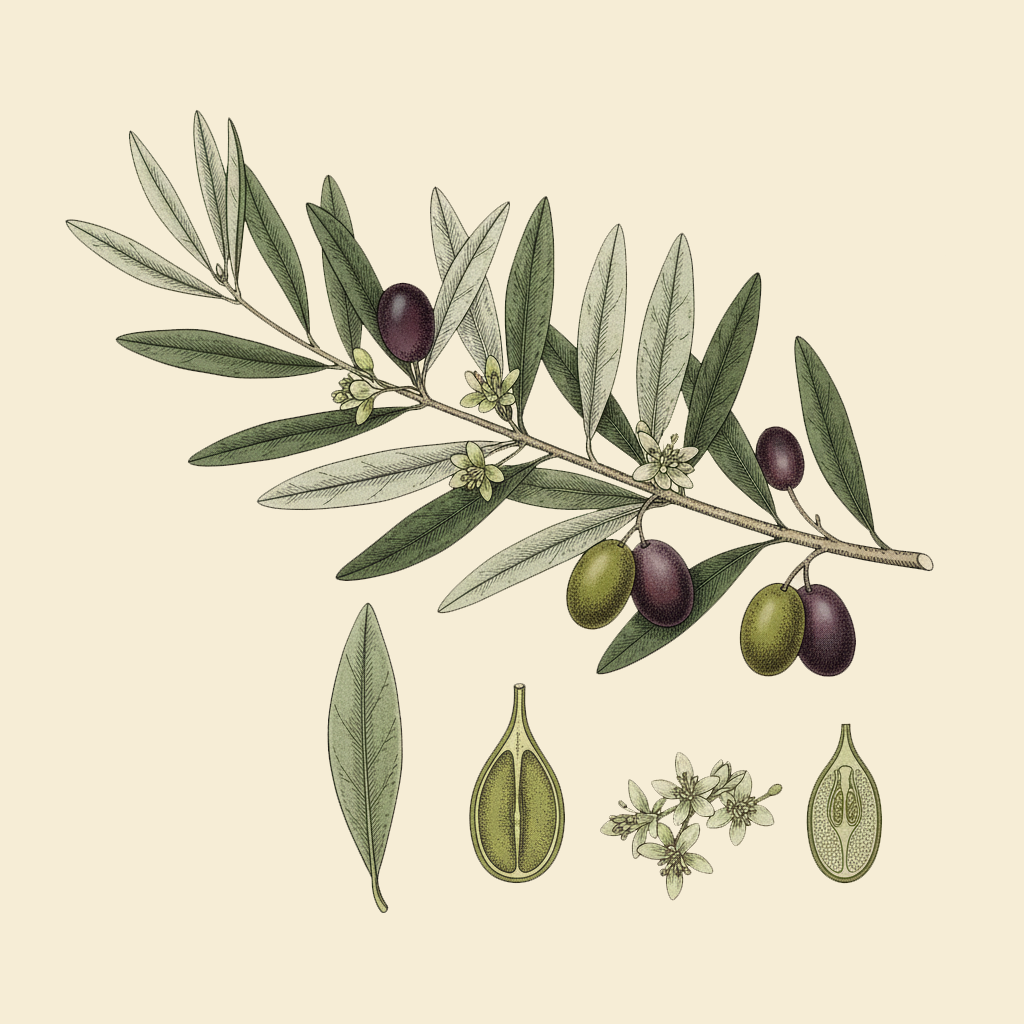
The Azebuche, Wild olive is the wild and ancestral form of the cultivated olive (Olea europaea var. europaea). It is native to the Mediterranean basin, where it has been present since prehistoric times. The cashew is the parent from which the olive tree was domesticated about 6000 years ago.
-
Distribution and Biomas: It is a fundamental element of the Mediterranean bush (maquia and garriga). It develops in the Mediterranean bioma, characterized by dry and hot summers and soft and humid winters. It is very drought-resistant and adapts to poor soils.
-
Major Producers: It is not "produced" in the agricultural sense, as it is not grown for oil in an extensive way. Its value is ecological (as part of natural ecosystems) and genetic (as gene reservoir to improve the cultivated variety). It is found naturally in all the countries of the Mediterranean basin.
Fast source: Royal Botanic Gardens Kew
Species & Culture
Use: Food (olives).
Evidence: Evidence of olive (Olea europaea) in Gibraltar, which is considered an indicator of maximum interglacial conditions, present along sequences ranging from last interglacial to present. Also mentioned are olive-like phytolytes (Olea europaea) in the layer associated with 122,000-year-old neanderthals in the cave of Tabûn, Monte Carmelo, Israel. The olive are among the plants harvested, without cultivation, by hunters-collectors. Studies have revealed that neanderthals in sites in the Near East, such as the Kebara Cave in Israel, Amud and Gibraltar, consumed a variety of plants. Among the carbonized remains recovered from the neandertal homes in these places, fruits such as the wild olive have been identified. In the Tabûn Cave in Israel, phytosites were recovered that were typical of the current Mediterranean forest vegetation of the area, including the olive tree (Olea europaea), the Palestine oak and the algarrobo.
Fast source: Elsevier
Absence of Commercial Aromatic Extraction
No commercial extraction process of essential oil of acebuche for perfumery. This wild variety is used exclusively for:
- High quality extra virgin olive oil production
- Extraction of antioxidant phenolic compounds
- Cosmetic applications for their nutritional properties
Aromatic molecules identified
Volatile studies in leaves of Olea europaea have identified:
- Pentanal (valderaldehyde): 60.5%
- Isobutanal (isobutyraldehyde): 22.1%
- n-octane, hexanal, isopentanal: Minor components
Use in Perfume
The industry uses the absolute fruit olive of the olive tree or uses synthetic molecules to create Mediterranean and green chords in perfumery.
Nomenclature and Technical Specifications
- INCI name: Olea europaea Fruit Oil
- CAS: 8001-25-0
- Extraction method: Solvent extraction of fresh olive fruits
- Origin: Mainly Italy and Egypt
- Appearance: Pale green liquid to translucent gold
Professional Aromatic Profile
Main notes:
- Exit: Fresh marine, sea breeze with herbaceous nuances
- Heart: Green pepperine characteristic of quality olive
- Fund: Soft lactonic fat notes, very subtle blue cheese reminiscent
Specific olfactory characteristics:
- Aromatic impact: Moderate (3 / 10 in direct evaluation, 4 / 10 in mixtures)
- Longevity: More than 12 hours in paper strip
- olfactory family: Green
- Viscosity: Vertible, moderately fluid
Chemical Composition and Aromatic Molecules
Main components
Preferred fatty acids:
- Oilacid (C18: 1): 55-83% - Major component
- Palmitic acid (C16: 0): 7,5-20%
- Linoleic acid (C18: 2): 2.5-21%
- Stearic acid (C18: 0): 0.5-5%
Aromatic volatile compounds:
- Hexanal (66-25-1): Main fatty aldehyde
- Trans-2-hexenal: characteristic green note
- 1-hexanol (111-27-3): Fat alcohol
- Ethyl acetate (141-78-6): Ester frutal
- Limonene (5989-27-5): Terpene present in traces
Bioactive phenolic compounds
- Hydroxythyrosol (10597-60-1): Main antioxidant
- Tyrosol (501-94-0): Simple aromatic phenol
- Oleeuropein: Precursor of aromatic compounds
Specific Aromatic Applications
Main functions:
- Green note modifier: Soften the aggressiveness of green synthetic compounds
- Creation of marine chords: Unusually combines with absolute algae
- Mediterranean notes: Evoca landscapes of olive groves and coastal breezes
- Base for gourmet compositions: Provides natural lactonic facets
Recommended combinations:
- With absolute colourless algae: Create sophisticated marine chords
- With galbanum: Strengthen green compositions
- With heavy florals: As a refreshing green counterpoint
Fast sources: PubMed | Fraterworks
IFRA regulation 51
European legislation - Regulation 1223 / 2009
Cosmetic Classification
Regulatory status:
- Cosmetic Ingredient allowed: No specific restrictions such as fixed oil
- Compulsory INCI: Olea europaea Fruit Oil must be declared
Consideration of allergens
Components to declare if they exceed thresholds:
- Limonene: If > 0.001% (leave-on) or > 0.01% (rhinse-off)
- Geraniol: If present at declarable concentrations
Regulation 2023 / 1545 / EU:
- 56 new identified allergens: Extension of the mandatory labelling list
- General threshold: 0,01% for products remaining on the skin
CIR Safety Assessment
Panel of Experts conclusion (2023):
- Olea europaea Fruit Extract: INSURANCE for cosmetic use
- Maximum concentration evaluated: No specific limitation established
- Eye irritation data: Insufficient for some extracts
Space under construction by collaborators.
The section Technical information and has a general arguative character. It is presented for information purposes to promote responsible knowledge. Because of the risks associated with the incorrect use of botanical extracts, aromatic molecules and the increase in unregulated practices in the production of aromatic products, Myrodia Khartes has chosen not to disclose complete extraction methodologies or specific concentrations that may compromise public safety. Health, ethics and scientific integrity guide our decision to limit the exposure of certain technical data.
- European Commission. (2009). Regulation (EC) No 1223 / 2009 on Cosmetic Products. Official Journal of the European Union, L 342, 59-209.
-
IFRA (International Fragrance Association). (2023). IFRA Standards Library: 52nd Amendment.
- The Good Scens Company. (2025). Fragrance Raw Materials Database

