

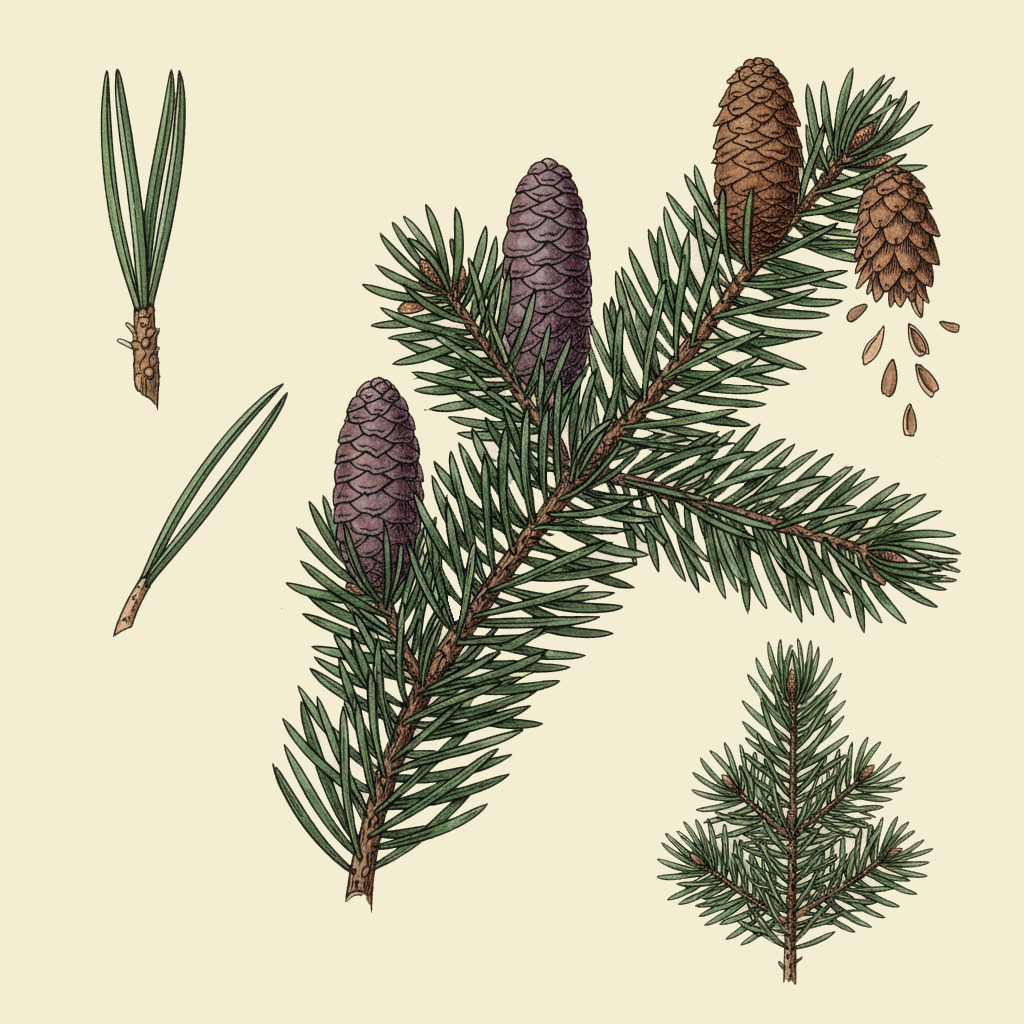
The Abeto is native to the northern hemisphere, with an evolutionary history dating back to the Tertiary period. There are about 50 species, many of which are key components of mountain and boreal forest ecosystems.
-
Distribution and Biomas: They are mainly found in mountain coniferous forests, moist boreal forests and, to a lesser extent, in coastal temperate forests. They prefer fresh climates and deep and humid soils.
-
Major Producers: As with birch, "production" refers to forestry. The largest producers of fir wood (used for pulp, sawn wood and Christmas trees) are Canada, Russia, the United States and several countries in Central and Northern Europe (e.g. Germany, Sweden).
Fast source: Royal Botanic Gardens Kew
Species & Culture
Use: Environment (forests), raw material (wood).
Evidence: In Happisburgh, on the east coast of the North Sea of Britain, where 900,000-year-old hominine tracks were found, the preserved pollen grains confirm that the environment was a cold pine and red fir forest (spruce). This indicates the presence of this species as part of the vegetation at the time when Homo before the area lived. In Schöningen, Germany, almost 400,000-year-old wooden spears were found, made by the ancestors of the Neanderthals, Homo heidelbergensis. The heidelbergensis artisans had cut young red fences (spruce trees), they had removed the side branches and the bark, using stone tools to shape them. These spears, about 2 meters long and pointed at both ends, had the centre of gravity located at a third of its length, similar to modern boars, and are believed to have been used to stab and kill horses that were then ruthless. This is a direct evidence of the use of red fir as a raw material for the manufacture of hunting weapons.
Fast source: University of Cambridge
The essential fir-needle oil is extracted by steam distillation of fresh needles and branches. The typical performance is 0.8-2.4% of the dry weight of the plant material.
Main Aromatic Molecules
- Bornyl acetate (5655-61-8): 20-35% - Main component
- α-pinene (80-56-8): 10-22%
- Caffen (79-92-5): 15-26%
- β-pinene (127-91-3): 6-14%
- Limonene (5989-27-5): 2-8%
- γ-eudesmol: Up to 8.1 per cent
Use in Perfume
It is used to create fresh and green balsamic notesin particular:
- Male fragrances fugère
- Forest and coniferous cords
- Cleaning products and air fresheners
- Fresh output notes
Fast sources: Bentham Science | BMV Fragrances
IFRA 51: No specific restrictions for fir oil. The present limonene should be declared when it exceeds the threshold concentrations.
EU Regulation 1223 / 2009:
- Limonene should be declared as allergic when it exceeds 0.001% (leave-on) or 0.01% (rhinse-off)
- Classified as H226, H304, H315, H317, H410 according to CLP
Space under construction by collaborators.
The section Technical information and has a general arguative character. It is presented for information purposes to promote responsible knowledge. Because of the risks associated with the incorrect use of botanical extracts, aromatic molecules and the increase in unregulated practices in the production of aromatic products, Myrodia Khartes has chosen not to disclose complete extraction methodologies or specific concentrations that may compromise public safety. Health, ethics and scientific integrity guide our decision to limit the exposure of certain technical data.
- European Commission. (2009). Regulation (EC) No 1223 / 2009 on Cosmetic Products. Official Journal of the European Union, L 342, 59-209.
-
IFRA (International Fragrance Association). (2023). IFRA Standards Library: 52nd Amendment.
- The Good Scens Company. (2025). Fragrance Raw Materials Database

