

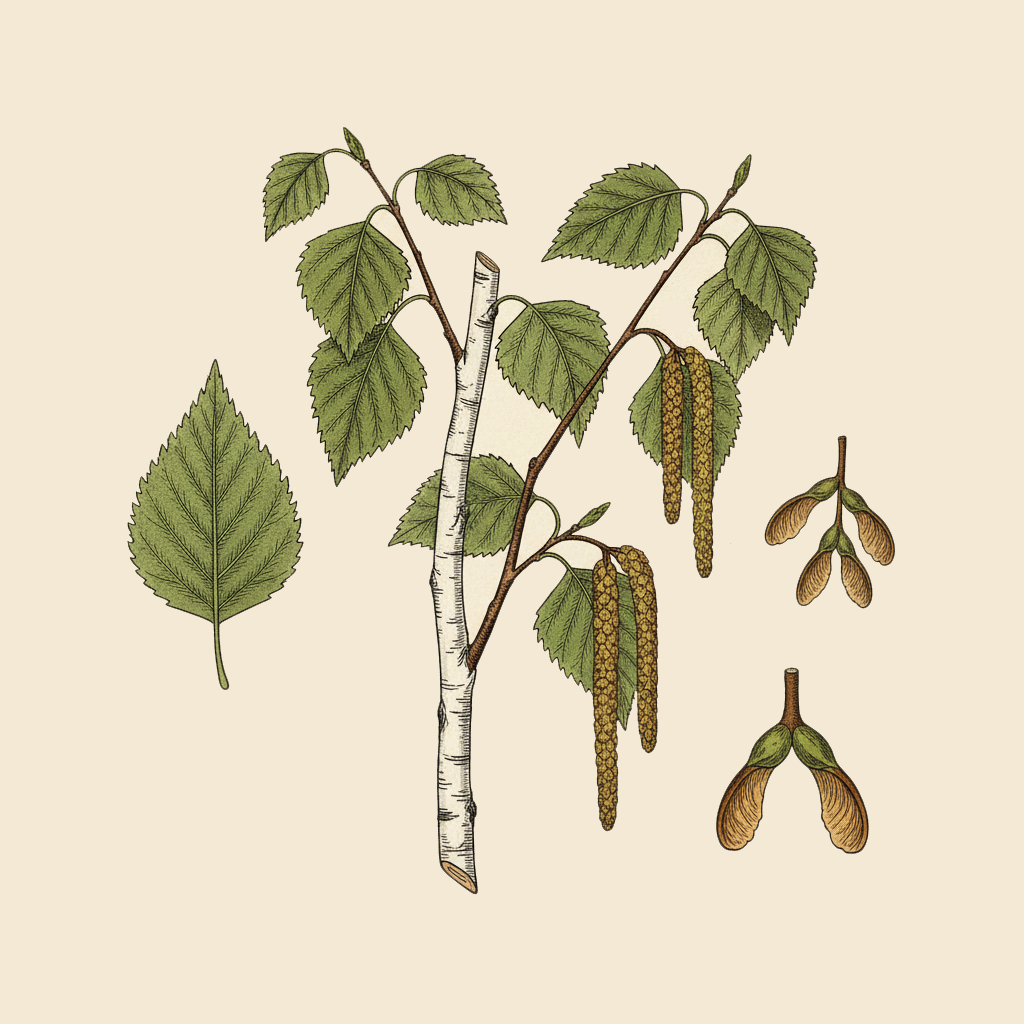
The Abedul It is native to the temperate and boreal regions of the northern hemisphere. Its fossil record dates back more than 50 million years (Paleoceno- Eocene). They are crucial pioneer species in ecological succession, being among the first to colonize clear land after fires or riots.
-
Distribution and Biomas: They develop in a wide range of biomas, but they are prevalent in the boreal (taiga) forests of Eurasia and North America, as well as in temperate deciduous forests and mountain areas. They prefer well drained and often acid soils.
-
Major Producers: It is not marketed as a main agricultural crop. The production of birch wood is linked to the forest industry in the Boreal countries. Russia, Canada, the Nordic countries (Finland, Sweden) and the United States are the largest natural forest wood extractors where birch is a common species.
Fast source: Royal Botanic Gardens Kew
Species & Culture
Use: Processing material (adhesive brea), raw material (wood).
Evidence: The birch tar was an important material used by neanderthals. It was used in the manufacture of adhesive tools ("hafting adhesives" or "mastic material"), being significantly more shock resistant than pine resin. The sources suggest a variety of applications for the "pitch" (tar), which can be derived from the birch. Medical substance: To stop bleeding and as antiseptic. Protector: As deodorant, and to protect the body against cold, sun and insects. Material processing: As a tanning agent for softening skin and preserving leather. The mention of birch tar is given in the context of Neandertal technology, specifically in the development of composite tools, where its resistance and the possibility of mixing it with bee wax to improve its properties are discussed. An academic reference by J. M. Grünberg (2002) is entitled "Middle Palaeolithic birch-bark pitch," indicating that the technology of extraction and use of this material is known in the Middle Paleolithic.
Fast source: The University of Liverpool| PubMed
Use: Processing material (adhesive brea), raw material (wood).
Evidence: In the Denisova Cave, environmental studies show variations between forests of pine, birch and deciduous during warm periods, and tundra during cold periods. Specifically, the palinological evidence of the Denisova Cave (Layer 19, ~168 ka) suggests temperate forests composed of birch, pine, with a mixture of aliso, tile and olmo.
Fast source: The University of Liverpool| PubMed
The birch tar oil is obtained by dry distillation (pyrolysis) of birch wood at temperatures of 600-800 ° C. This process produces a viscous and dark tar that must then be Rectified low vacuum to eliminate carcinogenic aromatic hydrocarbons (PAH), specifically benzopyrene, reducing its concentration from 1000 ppm to less than 10 ppm.
Main Aromatic Molecules
- Methyl salicylate (119-36-8): 60-85% - Main aromatic component
- Salicylic acid: Present naturally
- Betulene and betulenol: Characteristic compounds of the birch
- Guaiacol and cresol: Contribute to the smoked aroma
Use in Perfume
It is used in very low concentrations (generalmente <1%) para crear notas de cuero, animalicas, oud y chypre. Proporciona acordes ahumados distintivos en fragancias masculinas y de cuero.
Fast sources: Aromas Oil
IFRA 51: The crude birch tar oil is prohibited due to the PAH content. Only oil is allowed Rectified which complies with:
- PAH limitation: benzopyrene and 1,2-benzanthracene must not exceed 1 ppb in the final product
- Maximum concentration in category 1 (lips / toys): 0,21%
- Category 5A-D (body creams): 0,29%
EU Regulation 1223 / 2009: Methyl salicylate should be declared when it exceeds 0.001% in leave-on products and 0.01% in rhinse-off.
Space under construction by collaborators.
The section Technical information and has a general arguative character. It is presented for information purposes to promote responsible knowledge. Because of the risks associated with the incorrect use of botanical extracts, aromatic molecules and the increase in unregulated practices in the production of aromatic products, Myrodia Khartes has chosen not to disclose complete extraction methodologies or specific concentrations that may compromise public safety. Health, ethics and scientific integrity guide our decision to limit the exposure of certain technical data.
- European Commission. (2009). Regulation (EC) No 1223 / 2009 on Cosmetic Products. Official Journal of the European Union, L 342, 59-209.
-
IFRA (International Fragrance Association). (2023). IFRA Standards Library: 52nd Amendment.
- The Good Scens Company. (2025). Fragrance Raw Materials Database

