

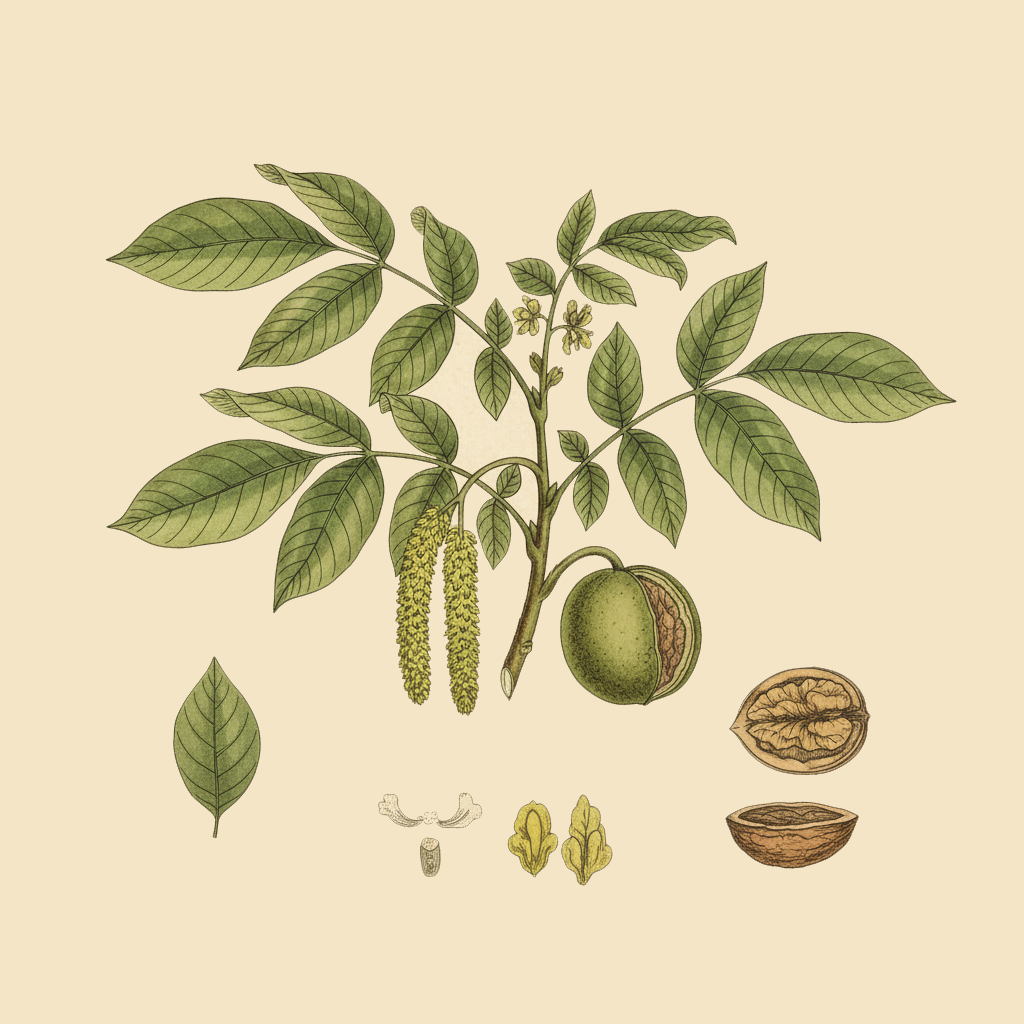
The Nogal It is native to a vast region from the Balkans to the Himalayas, south-west of China and Central Asia. It was introduced into Europe in prehistoric or Roman times and later in America. The nuts have been consumed by humans since at least 7000 BC.
-
Distribution and Biomas: It is naturally developed in mixed mountain forests in river valleys and wet slopes. Its current cultivation is spread through temperate areas around the world.
-
Major Producers: China is by far the world's largest producer of nuts, followed by the United States (California) and Iran.
- Fast source: Royal Botanic Gardens Kew
Species & Culture
Use: Food (nuts).
Evidence: The evidence comes from thousands of carbonized remains of almost 50 species of plants recovered from household sediments.
These findings show that, at least in sites with warmer climates, neanderthals had access to a variety of plant resources. The most prominent place mentioned is the Kebara Cave in Israel. Evidence was also found in other warm sites in the Near East, such as Amud and Gibraltar, which point to a range of plant remains in the Neandertal homes. In addition, in a more general context on the consumption of nuts by old hominids, in Gesher Benot Ya'aqov, Israel, a site of 780,000 years ago, a unique association of edible nuts (nuts including nuts) was found with hammers and masked yunks made by humans.
Fast source: JSTOR
The aromatic components of oak are obtained by various methods:
Solvent extraction: Process used to obtain oak wood absolute
- Material: Quercus robur wood chips
- Result: absolute viscous with smoked, avainylated and well-tied notes
Overcritical CO extraction: Modern method that preserves the full aromatic spectrum
There is no commercial extraction of essential oil of the nuts of Juglans regia for perfumery. Scientific research confirms that walnut oil is mainly used in culinary and cosmetic applications, not in perfumery.
Synthetic molecules used in perfumery
For the smell of walnut in perfumery is used:
-
3-Methyl-2-oxo-ethyl-pentanoate (Nuezate):
CAS No 26516-27-8
olfactory description: characteristic aroma of black walnut with matted nuances
Use: 0.1-1.0% in formulations
Natural aromatic molecules identified
Scientific research has identified key compounds of the nodal aroma:
Sotolon: Maggi condiment type aroma
(2E, 4E, 6Z) -non-2,4,6-triennial: responsible for the typical oatmeal aroma
Relationship 1: 1 of these molecules recreates the characteristic aroma of the walnut
Fast sources: ACS Publications | PHYS
Space under construction by collaborators.
The section Technical information and has a general arguative character. It is presented for information purposes to promote responsible knowledge. Because of the risks associated with the incorrect use of botanical extracts, aromatic molecules and the increase in unregulated practices in the production of aromatic products, Myrodia Khartes has chosen not to disclose complete extraction methodologies or specific concentrations that may compromise public safety. Health, ethics and scientific integrity guide our decision to limit the exposure of certain technical data.
- European Commission. (2009). Regulation (EC) No 1223 / 2009 on Cosmetic Products. Official Journal of the European Union, L 342, 59-209.
-
IFRA (International Fragrance Association). (2023). IFRA Standards Library: 52nd Amendment.
- The Good Scens Company. (2025). Fragrance Raw Materials Database

