

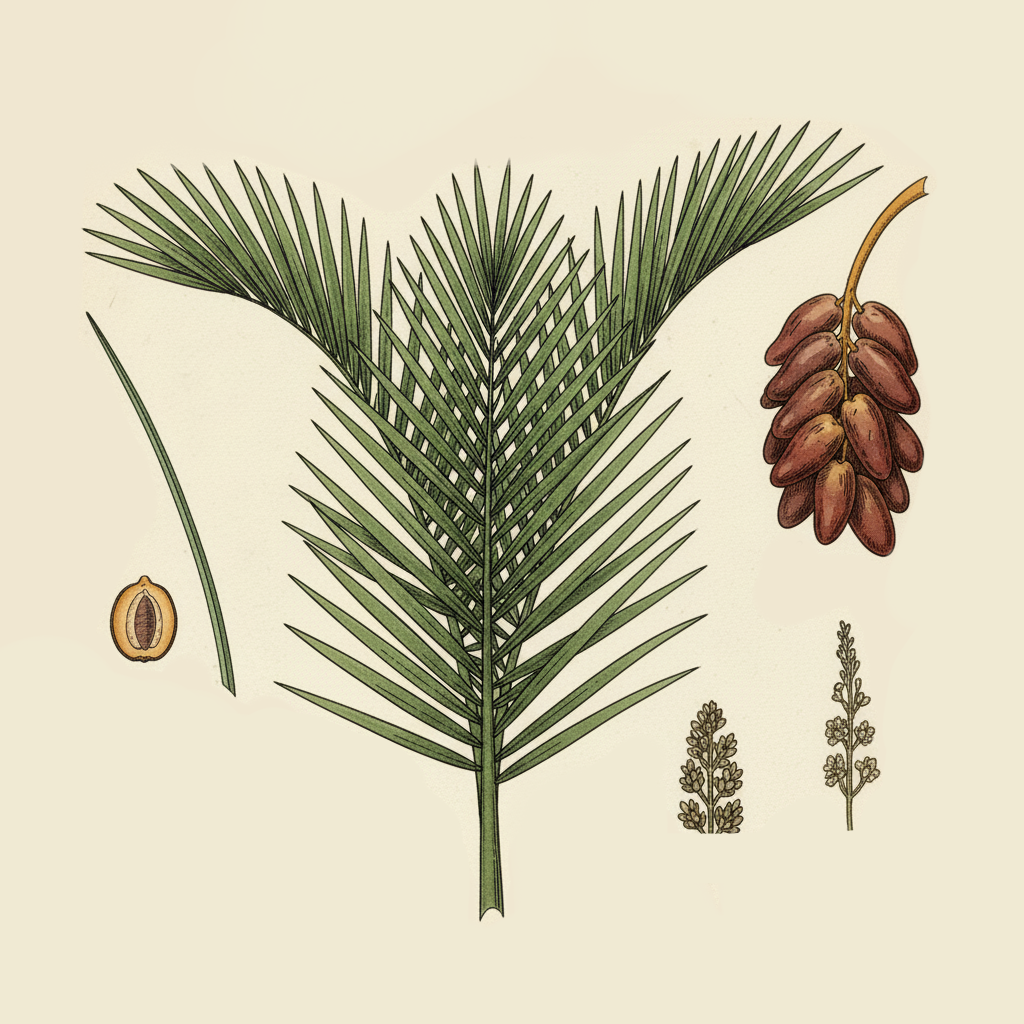
The Palm date is native to the region of Mesopotamia (modern Iraq) and the Fértil Growing, with evidence of cultivation dating back to 6000 BC Its domestication was fundamental to the development of civilizations in North Africa and the Middle East, providing food, building materials and shade in desert environments.
-
Distribution and Biomas: It is originally developed in oasis and river valleys of arid and semi-arid areas, where it has access to groundwater. It is currently grown in desert and arid regions around the world that meet its heat and water requirements.
Major Producers: Egypt, Iran, Algeria, Saudi Arabia and Iraq are the world's leading date producers.
Fast source: Royal Botanic Gardens Kew
Species & Culture
Use: Food (fruits).
Evidence: Analysis of fossil teeth in Shanidar (Iraq).
Fast source: Science in Spanish
Name in old languages
Sumerium: gišimmar (palm tree), zu-lum / su-lum (dry datile)
Acadio: gišimmaru (palm tree), suluppù (dry datile)
The date palm was possibly the oldest cultivated tree in the world, with evidence of cultivation in Mesopotamia and the Persian Gulf from 7000 to 6000 years before the present. It was the backbone of the economy of southern Mesopotamia.
Food: The dativa was a food of mass and daily consumption, a primary source of sugars for the entire population. Dates, dried (suluppù) appear frequently in the cuneiform texts from the period of Fara (ca. 2500 a. C.) onwards, documented in food distributions, offerings to temples and lists of supplies. The datile was consumed fresh, dry, like pasta, like syrup (dišpu) and as a component of breads and cakes.
Datile beer and wine: In addition to barley beer, mesopotamics produced datile beer (siqqum) and datile wine (karānum), important in both daily consumption and religious rituals. The datile was also combined with figs and raisins to make fruit wines.
Economy: The palm plantations were goods of high economic value, subject to contracts and legal records since the Paleobabilonic period. Texts from Larsa and Nippur document the ownership, lease and inheritance of palm orchards.
Construction and crafts: The palm trunks served as beams and pillars for building houses in the south of Mesopotamia. The fronts were used for roofing, mats and baskets. The fibers of the freckles used to make strings and baskets.
Medicine: Mesopotamic medical texts include datile preparations for the treatment of diseases and as a component of cataplasms and ointments. The medical text ORACC / Nineveh Medical Project prescribes the front of the date palm (gišimmaru) in preparations for cranial trauma.
Myth and religion: The date palm was the "Tree of Life" in Babylonian and Assyrian religious iconography (išu ša balāħi). It was sacred to the god Tammuz / Dumuzi and appears on the cylinders - seal and reliefs as the central motive of the cosmos. The Sumerians discovered the dioic nature of the plant and developed artificial pollination techniques at least from ca. 3300 a. C., which marks the beginning of scientific horticulture. The gifts of dates to deities are constant in the Templar files.
Bibliography — Phoenix dactylifera
Cambridge University Press (2019). "Date Palm and Date Palm Inflorescences in the Late Uruk Period (c. 3300 BC)." Iraq.
FAO (2005). "Origin of Date Palm." In Better Farming Series: Date Palm Culture.
Macquarie University (s.f.). "Date Palms - Phoenix dactylifera"Botanical Profile.
Oxford University Plants 400 (2021). "Phoenix dactylifera"Herbaria Oxford.
Stol, M. (1979). "Date Palm." In Reallexikon der Assyriologie und Vorderasiatischen Archäologie, vol. 2. From Gruyter.
Tengberg, M. (2012). "Beginnings and Early History of Date Palm Garden Cultivation in the Middle East." Journal of Arid Environments 86: 139–147.
There is no commercial process of direct extraction essential or absolute Phoenix oil dactylifera for perfumery. Scientific references confirm that the datable is not used as a source of traditional essential oils.
Synthetic molecules used in perfumery
The following synthetic molecules are used to recreate the flavour of the datile in perfumery:
-
Ethyl maltol: provides the characteristic caramel aroma
-
Furaneol: provides notes of burned sugar
-
Complementary natural extracts: molasses, honey or fig (which share similar aromatic characteristics)
Fast sources: Sterno | Perfume Stars
There are no specific IFRA restrictions for Phoenix dactylifera in perfumery, as it is not used as direct essential oil. The above-mentioned synthetic molecules follow the IFRA standard regulations according to their specific category. However, any extract must meet the general safety criteria, especially if applied to the skin.
Space under construction by collaborators.
The section Technical information and has a general arguative character. It is presented for information purposes to promote responsible knowledge. Because of the risks associated with the incorrect use of botanical extracts, aromatic molecules and the increase in unregulated practices in the production of aromatic products, Myrodia Khartes has chosen not to disclose complete extraction methodologies or specific concentrations that may compromise public safety. Health, ethics and scientific integrity guide our decision to limit the exposure of certain technical data.
- European Commission. (2009). Regulation (EC) No 1223 / 2009 on Cosmetic Products. Official Journal of the European Union, L 342, 59-209.
-
IFRA (International Fragrance Association). (2023). IFRA Standards Library: 52nd Amendment.
- The Good Scens Company. (2025). Fragrance Raw Materials Database

