

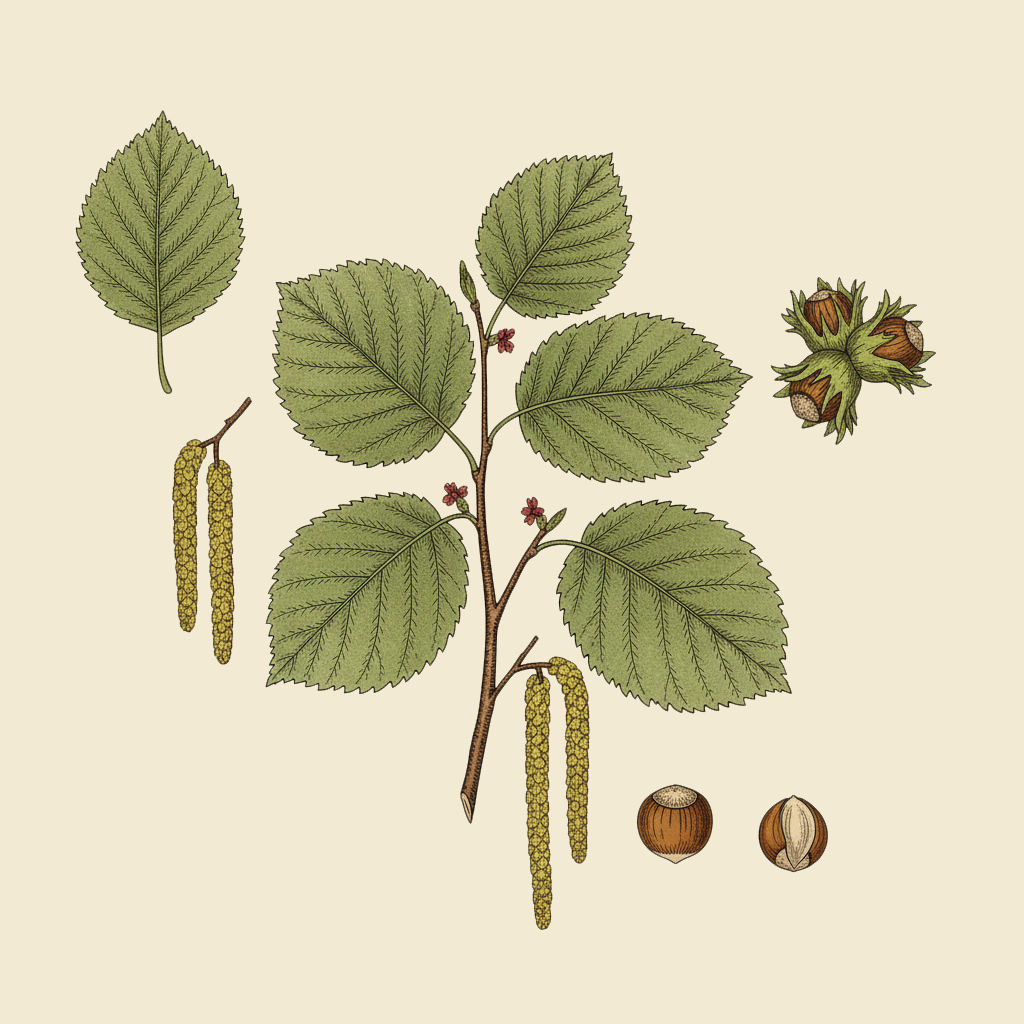
The Avellano is native to Europe and Asia Minor (Turkey). Its use by humans dates from the Mesolithic, and was widely cultivated by Greeks and Romans. It is a characteristic species of European forests and mushrooms.
-
Distribution and Biomas: It grows naturally on edges of forests, hedges and shrubs of temperate areas. It prefers fresh and wet soils. Its cultivation is concentrated in regions with temperate and humid climates.
-
Major Producers: Turkey is the world's dominant producer, followed by Italy, Azerbaijan, the United States and Chile.
Fast source: Royal Botanic Gardens Kew
Species & Culture
Use: Food (nuts).
Evidence: Remains in archaeological contexts in several fields. In Europe, hazelnut (Corylus) was part of the forest succession during the last interglacial (OIS 5e), forming part of a mixed temperate oak forest.
Fast source: PNAS
Cold-pressed: Main method of extraction of hazelnut oil
- Controlled temperatures (26-32 ° C)
- Performance: light, non-fat, fast absorption oil
- Main use: cosmetic, non-perfumistic
Solvent extraction: For aromatic concentrates
- Solvent: hexane or petroleum ether
- Result: extracts with higher aromatic concentration
Characteristics of aromatic molecules
Scientific research identifies key compounds of hazelnut aroma:
- 2,3-diethyl-5-methylpyrazine: musk and walnut notes
- 2-acetyl-1,4,5,6-tetrahydropyridine: caramelized aroma
- 3-methyl-4-heptanone: fruity and walnut notes
- 5-methyl- (E) -2-hepten-4-one: fruit and nut aromatic
Synthetic molecules in perfumery
The perfumers recreate the aroma of hazelnut using combinations of synthetic molecules that replicate the natural compounds mentioned.
Fast sources: PMC
Space under construction by collaborators.
The section Technical information and has a general arguative character. It is presented for information purposes to promote responsible knowledge. Because of the risks associated with the incorrect use of botanical extracts, aromatic molecules and the increase in unregulated practices in the production of aromatic products, Myrodia Khartes has chosen not to disclose complete extraction methodologies or specific concentrations that may compromise public safety. Health, ethics and scientific integrity guide our decision to limit the exposure of certain technical data.
- European Commission. (2009). Regulation (EC) No 1223 / 2009 on Cosmetic Products. Official Journal of the European Union, L 342, 59-209.
-
IFRA (International Fragrance Association). (2023). IFRA Standards Library: 52nd Amendment.
- The Good Scens Company. (2025). Fragrance Raw Materials Database

