
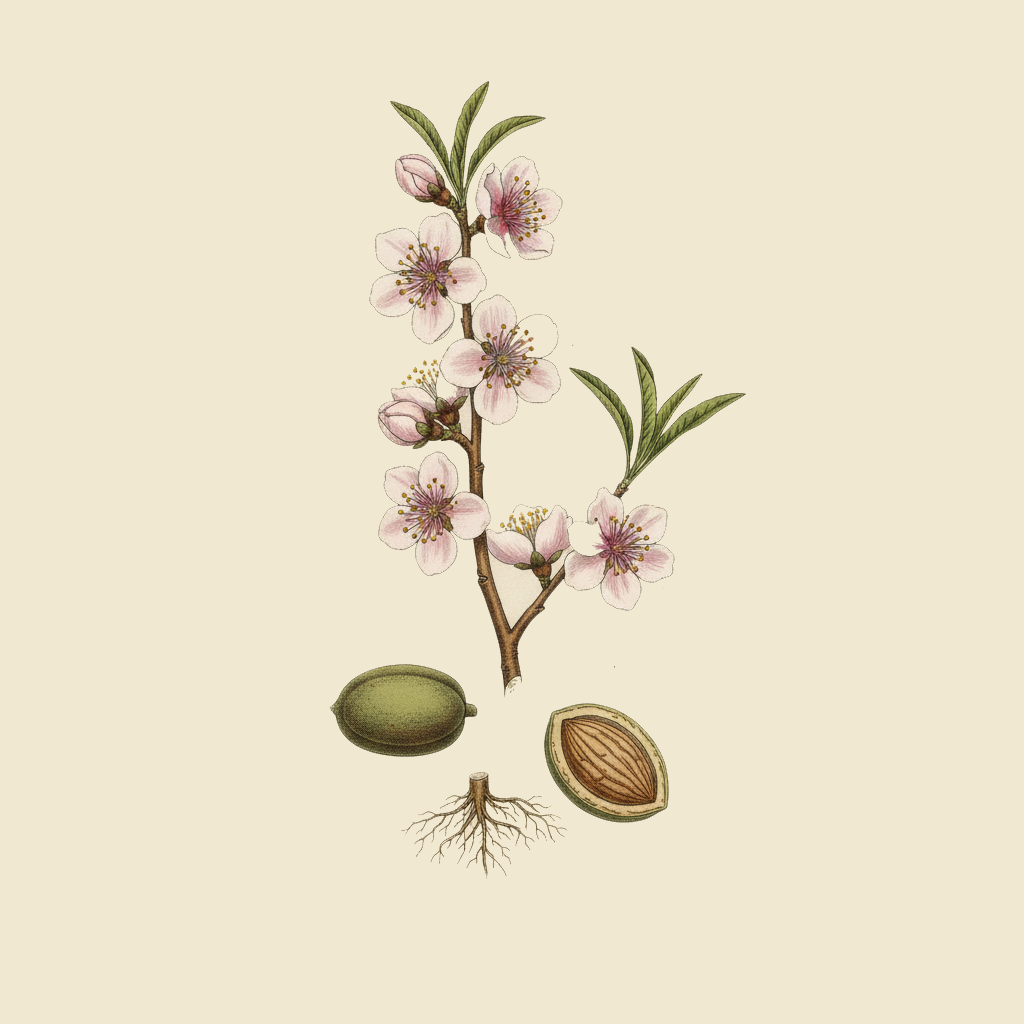

The wild ancestor of the domesticated almond is native to the mountainous regions of Central and Western Asia, including areas of Iran, Afghanistan and Turkmenistan. Its history with humans is millennial; it was one of the first fruit trees to be domesticated, evidenced by archaeological findings dating from the third millennium BC in the Eastern Mediterranean. Its cultivation rapidly expanded through the Mediterranean Basin thanks to Phoenicians, Greeks and Romans.
- Distribution and Biomas: Although adapted to Mediterranean biomas of temperate climate with cold winters and dry summers, it thrives on rocky and well drained slopes. It is a typical species of Mediterranean bush and open forests. The domesticated version is grown in regions with cold enough winters for correct vernalization, but wild forms are very resistant to drought and poor soils.
- Major Producers: Mass commercial production focuses on domesticated almond. The world's largest producers are: United States (California): Domines global production. Spain and Australia: They are other great actors. Iran and Morocco: Where significant wild populations can also be found.
Fast source: Royal Botanic Gardens Kew
[/ ohio _ text] [ohio _ tabs tabs _ type = "default" tabs _ alignment = "left" tabs _ title _ type = "null" tabs _ active _ title _ type = "null" tabs _ content _ type = "null"] [ohio _ tabs _ inner title = "Pleistocene" tab _ id = "1757035280649-0f08c9b0-4289] [ohio _ text _ type _ null]"]
Species: Homo sapiens
Neolithic complex: Göbekli Tepe
Use: Consumption as edible dry fruit (wild almonds) in combination with cereals and other plant resources, probably roasted or dry, perhaps used as a fatty-protein supplement in daily feeding contexts and, by extension, also in festivities linked to monumental sites.
Evidence: The macrophotanic analyses carried out by Renate Neef on the sediments of Göbekli Tepe have identified almonds (Prunus sp.), although the set of plant remains is numerically very small due to poor site conservation conditions. These findings come from both hand-collected and flotation samples, and are interpreted as an indication of the use of dry fruits of Mediterranean-iranoturanian bushes in the diet of the groups that used the sanctuary. The low amount of macroesters prevents the reconstruction of quantities or preparation techniques, but, by analogy with other neolithic contexts of Anatolia and the Levant, it is reasonable to assume that almonds were consumed decarbed, possibly roasted, and could be combined with cereals in energy mixtures served during the "work feasts" documented for Göbekli Tepe.
[/ ohio _ text] [/ ohio _ tabs _ inner] [/ ohio _ tabs]
Aromatic extraction processes
Almond Sweet Oil
Cold-pressed: The most common method for obtaining almond sweet oil is by cold mechanical pressing of the seeds. This process preserves the quality of the oil and does not require chemical treatments, so the resulting product can be considered "virgin."
Solvent extraction: Although it provides higher industrial performance, this method results in oils that cannot be considered virgins due to the chemical treatments involved.
Extraction with supercritical fluids (CO): Produces higher quality oils but at very high cost.
Almond Amarga Essential Oil
A more complex process is used to obtain essential aromatic oil:
-
Fixed oil disposal: The fatty oil is first extracted by pressing
-
Maceration: The powder residue is milled in a debilly acidic water (pH 5) at 40 ° C for 1 hour to fully hydrolise amigdalin
-
Steam distillation: The material is distilled for 1 hour, producing approximately 0.7% performance
-
Purification: Toxic cyanhydric acid (CN) should be removed by treatment with ferrous hydroxide and calcium hydroxide, followed by additional steam distillation
Main Aromatic Molecules
Benzaldehyde
The main aromatic molecule of almond is benzaldehyde (CAS 100-52-7), which constitutes up to 62.52% of the essential oil of bitter almond. This molecule is responsible for the characteristic aroma of almond and is naturally formed during the hydrolysis of amigdalin.
Alternative Synthetic Molecules
Due to the restrictions of natural benzaldehyde, synthetic molecules are often used in perfumery:
-
Heliotropin (Piperonal): Synthetic compound with sweet and powdered aroma, between vanilla and almond
-
Coumarin: Provides almond, tobacco and hay facets
-
Anisic aldehyde: Synthetic molecule more tenacious than heliotropin, with floral accents
Fast sources: PubMed
[/ ohio _ text] [/ ohio _ tabs _ inner] [ohio _ tabs _ inner title = "IFRA & European regulation" tab _ id = "1750227770388-d051c060-7fd2 ″] [ohio _ text _ typo =" null "]
IFRA regulations set specific limits for the use of essential artemisia oils due to their tujone content, considered a neurotoxic substance:
For artemisia oils (Armoise), the maximum permitted concentrations according to IFRA 51 are:
- 2.641% in finished products
- These concentrations are derived from calculations that do not replace chromatographic quantification in individual lots
[/ ohio _ text] [/ ohio _ tabs _ inner] [/ ohio _ tabs] [ohio _ accordion accordion _ tabs _ type = "'{' object object ']'] [ohio _ accordion _ inner title =" Section "tab _ id =" 1750383125616-1f3c5929-6068 ″ heading = "Fragances with the note" heading _ typo = "null 'content _ typo =" null']
Space under construction by collaborators.
[/ ohio _ text] [/ ohio _ accordion _ inner] [ohio _ accordion _ inner title = "Section 1 ″ tab _ id =" 1750234080997-b2aba55c-8d4f "heading =" References and Considerations "leading _ type =" null "content _ type =" null "]
The section Technical information and has a general arguative character. It is presented for information purposes to promote responsible knowledge. Because of the risks associated with the incorrect use of botanical extracts, aromatic molecules and the increase in unregulated practices in the production of aromatic products, Myrodia Khartes has chosen not to disclose complete extraction methodologies or specific concentrations that may compromise public safety. Health, ethics and scientific integrity guide our decision to limit the exposure of certain technical data.
Sources that may interest you:
- European Commission. (2009). Regulation (EC) No 1223 / 2009 on Cosmetic Products. Official Journal of the European Union, L 342, 59-209.
-
IFRA (International Fragrance Association). (2023). IFRA Standards Library: 52nd Amendment.
- The Good Scens Company. (2025). Fragrance Raw Materials Database
[/ ohio _ accordion _ inner] [/ ohio _ accordion]

